Sunday, 4 October 2026
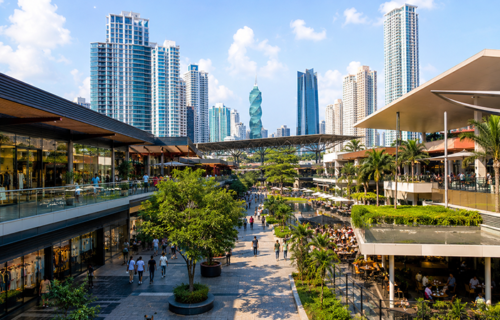
Panama City’s retail property market is entering a more mature phase in 2026, supported by economic growth, increasing tourism and expanding residential districts, while competition between shopping destinations is placing greater emphasis on location, customer traffic and the quality of the retail offer. The capital already has an extensive network of shopping centres, retail plazas and mixed-use developments. With monitored stock reaching approximately 2.02 million square metres at the end of 2025, the market is increasingly being shaped by how effectively existing properties capture consumer spending rather than by the construction of large amounts of additional space.
Despite a modest increase in inventory during 2025, overall occupancy improved. The combination suggests that the market was able to accommodate additional space without creating a corresponding rise in empty units. However, performance varies considerably between locations and property categories. Higher-quality centres generally entered 2026 in a stronger position, with vacancy among Class A properties at approximately 8% at the end of last year, compared with around 14% across Class B+ and B properties. Class A+ properties recorded vacancy of approximately 11%, illustrating that classification alone does not determine performance and that individual location and tenant composition remain critical.
Differences between parts of the metropolitan area are even more pronounced. Class A properties within the Canal Area recorded vacancy of less than 1% at the end of 2025, while availability in the eastern and northern parts of the market remained below 8%. By contrast, vacancy across Class A properties in the southwest approached 27%. Such variations make a single citywide vacancy figure increasingly less useful when assessing Panama City retail. A shopping centre serving a growing residential population can operate under very different conditions from a larger destination mall, while an older property competing against newer centres may struggle even when the wider retail market is improving.
This divergence is also visible in rents. Premium retail space can command considerably higher asking levels than secondary properties, with some top-end locations marketed at around USD 50 per square metre per month at the end of 2025. Elsewhere, rents vary significantly according to location, customer traffic, accessibility and property quality. Advertised rents do not necessarily represent the final economic terms agreed between landlords and retailers, as incentives, contributions towards store fit-outs and individually negotiated lease structures can materially change the effective occupancy cost.
The wider picture nevertheless suggests that Panama City is not experiencing widespread rental acceleration. Asking levels have remained comparatively stable in much of the market, giving retailers alternatives even as occupancy improves. This balance is placing greater pressure on landlords to demonstrate that their properties can generate sales rather than simply provide space. Retailers increasingly assess potential locations according to the number and profile of consumers they can reach, the strength of neighbouring tenants, ease of access, parking, public transport and the frequency with which customers return. A cheaper unit is not necessarily more attractive if the surrounding property cannot generate sufficient sales.
That shift is helping reshape the role of shopping centres. Large malls increasingly combine traditional retail with restaurants, entertainment, health, beauty, leisure and other services. These uses can increase the length and frequency of visits while providing consumers with experiences that cannot easily be transferred online. Supermarkets, pharmacies and everyday services have a different but equally important role, with their ability to generate frequent visits making them important components of neighbourhood and convenience-led retail, particularly in expanding residential areas.
Panama City’s continuing outward growth is strengthening this part of the market. Residential expansion towards the eastern, northern and western parts of the metropolitan area is creating additional demand for shopping and services closer to where people live. Traffic congestion reinforces the trend, as consumers who can reach a supermarket, pharmacy, restaurant or service provider close to home have less reason to travel across the city for routine purchases. This creates opportunities for smaller retail centres without requiring them to compete directly with Panama City’s major regional malls.
Destination shopping remains important. Established centres such as Albrook Mall and Multiplaza operate on a different scale, drawing consumers from across the metropolitan area as well as visitors from elsewhere in Panama and overseas. Their size, tenant mix and combination of shopping, restaurants and entertainment allow them to function as destinations rather than simply collections of stores.
Tourism is providing an additional source of spending in 2026. Panama welcomed approximately 1.76 million international visitors during the first six months of the year, around 17.4% more than during the same period of 2025. This followed a strong 2025, when international arrivals exceeded three million. Visitor expenditure is also increasing, with tourism income reaching approximately USD 3.23 billion during the first five months of 2026, around 15.3% above the corresponding period last year.
The increase has implications for Panama City because the capital serves as the principal entry point and commercial centre for many international visitors. Hotels, restaurants, entertainment venues and shopping destinations can benefit when visitors remain in the city rather than simply passing through the country. Tocumen International Airport handled approximately 11.5 million passenger movements during the first half of 2026, although much of this traffic consists of international connections and should not be treated as direct consumer demand for Panama City.
More significant for the local economy is the increasing number of connecting travellers choosing to spend time in Panama. More than 132,000 visitors used the Panama Stopover programme during the first half of 2026, an increase of around 38% year-on-year. Converting a greater proportion of connecting passengers into overnight or short-stay visitors creates additional opportunities for hotels, restaurants, entertainment and retail.
Domestic economic conditions are also providing support. Panama’s economy expanded by 4.8% year-on-year during the first quarter of 2026, with wholesale and retail trade among the activities contributing positively to growth. Hotels and restaurants, transportation, construction and property-related activities also recorded expansion. For the full year, the IMF expects economic growth of approximately 3.8%. Continued expansion combined with relatively moderate inflation provides a supportive environment for consumer spending, although household income, employment and affordability continue to influence purchasing decisions.
Panama City’s retail market therefore benefits from several different sources of demand. Domestic consumers provide the foundation, residential expansion is creating new neighbourhood catchments, and increasing international tourism provides additional spending concentrated particularly around major destinations and central locations. These factors, however, do not translate automatically into stronger performance for every property.
Older centres without a clear customer proposition face growing competition from both established destination malls and newer convenience-oriented developments. The ability to attract recognised brands, restaurants, services and leisure concepts is becoming increasingly important to maintaining customer traffic. Physical stores are also changing as retailers integrate their digital and traditional sales channels, increasingly functioning not only as places where transactions occur but also as locations where customers experience brands, collect products, return online purchases and interact with services.
The change does not eliminate the importance of physical retail. Instead, it raises the standard that successful retail property needs to meet. For landlords, active management is becoming increasingly important. Maintaining common areas, adjusting the tenant mix, introducing new concepts and responding to changing consumer behaviour can directly influence the competitiveness of a centre.
For developers, the existing scale of Panama City’s retail market argues against indiscriminate expansion. Only around 6,100 square metres was under construction within the Class A segment covered by the market survey at the end of 2025, while little significant development was recorded across most other categories. The limited pipeline suggests that new development is being approached more selectively than during previous expansion cycles.
Future projects are therefore more likely to emerge as components of mixed-use developments, neighbourhood centres serving growing residential areas or schemes addressing specific gaps in local provision rather than as another widespread generation of large shopping malls.
For investors, the same selectivity applies to acquisitions. Vacancy and asking rents provide useful indicators, but they cannot fully explain the strength of a retail property. Customer numbers, retailer sales, tenant retention, lease structures, surrounding demographics and the amount of investment required to maintain competitiveness can have a greater influence on long-term value. Properties with strong catchments, established tenants and clear reasons for consumers to visit should remain better positioned, while secondary assets facing stronger nearby competition may require investment or repositioning even if the wider market continues to improve.
The outlook for the remainder of 2026 is therefore one of gradual improvement rather than rapid expansion. Existing inventory is being absorbed, consumer activity is supported by economic growth and international visitor numbers are rising, while relatively limited new construction reduces the immediate risk of another large increase in supply. The more significant transformation is occurring within the existing retail stock.
Panama City is moving towards a market where successful properties are increasingly defined by their relationship with consumers rather than simply their size. Large destination malls, neighbourhood centres and mixed-use retail can all perform well, but each needs a clear role within the metropolitan economy. As Panama City continues to grow and consumer behaviour evolves, the next stage of its retail market is unlikely to be measured primarily by how many additional square metres are constructed, but by which properties can convert economic growth, tourism and changing residential patterns into sustainable customer traffic and retailer sales.
Source: © CIJ.World Research & Analysis Team