Monday, 19 October 2026
Germany’s economic outlook has improved following a stronger-than-expected first half of 2026, but the recovery remains heavily dependent on government spending while private investment, household demand and parts of the industrial economy continue to underperform.
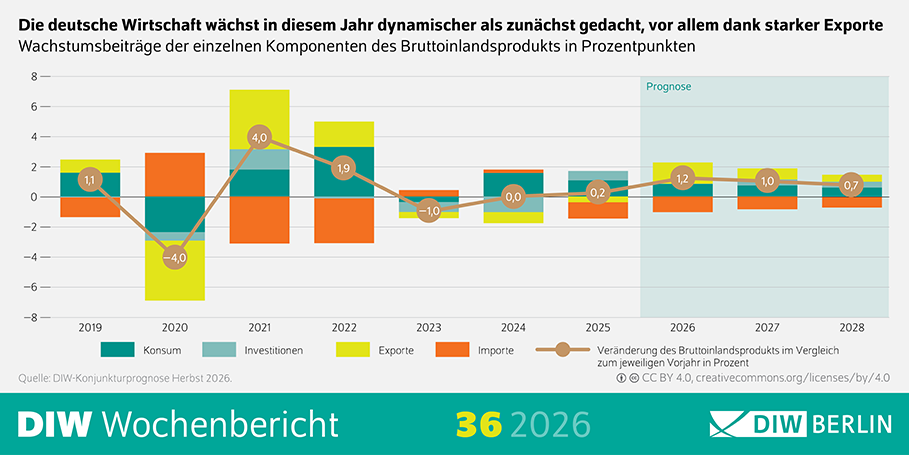
The German Institute for Economic Research (DIW Berlin) now expects GDP to expand by 1.2% in 2026, followed by growth of 1.0% in 2027 and 0.7% in 2028. The upgrade reflects stronger export performance earlier in the year and a less severe energy-price shock than initially feared.
Germany’s economy expanded by 0.3% quarter-on-quarter during the second quarter. Foreign trade provided much of the momentum, with exports increasing by 2.0%. Petroleum products and chemical intermediate goods contributed to the improvement, while manufacturers of computing and electronic equipment benefited from international investment associated with the expansion of artificial intelligence infrastructure and data centres.
Domestic activity presents a less convincing picture. Private consumption increased by only 0.1% during the quarter, with households remaining cautious amid labour-market uncertainty and limited income growth. Business investment has also remained subdued, leaving government expenditure as an unusually important component of the recovery.
DIW estimates that public consumption and investment account for around 70% of Germany’s economic growth this year. Infrastructure expenditure, defence investment and higher government spending in areas including healthcare and social services are consequently supporting an economy in which private-sector demand has yet to generate comparable momentum.
This composition of growth has important implications for Germany’s property and construction markets. An economy expanding primarily through public investment can create opportunities for contractors, infrastructure providers and property markets connected with defence, transport, energy and other government-backed projects without necessarily producing an equivalent recovery across conventional commercial real estate.
Germany’s substantial infrastructure programme could therefore become one of the most important sources of construction demand over the next several years. Increased expenditure on transport networks and other public assets provides greater visibility for infrastructure-related construction at a time when privately financed development continues to face relatively difficult conditions.
Defence expenditure could have a similar effect in selected locations. Increased investment can generate requirements extending beyond military equipment to manufacturing facilities, logistics infrastructure, warehouses, research facilities and supporting supply chains. The property consequences are likely to be concentrated geographically rather than spread evenly across the country.
Technology investment provides another potential source of demand. The global expansion of AI-related infrastructure is already benefiting parts of Germany’s electronics and computing manufacturing sector. Continued investment in digital infrastructure could support industrial and data-centre-related activity, although the strength of the international AI investment cycle itself represents an increasingly important economic risk.
For traditional commercial property, the picture remains less straightforward. Weak private consumption provides limited support for consumer-dependent sectors, while cautious corporate investment restricts the prospects for a rapid improvement in occupier demand. Germany may therefore record stronger headline economic growth without immediately experiencing an equally broad recovery in offices, retail or privately financed development.
Industrial property also faces competing forces. Export growth helped Germany during the first half, but energy-intensive industries continue to operate in a challenging environment. Elevated gas prices remain a particular concern, while low water levels on important shipping routes are creating additional difficulties for chemicals, metals and other industries dependent on reliable transport and energy supplies.
DIW expects economic activity to lose momentum during the third quarter, with GDP broadly stagnating. Some of the export strength recorded earlier in the year may also have resulted from companies bringing forward activity because of uncertainty surrounding energy markets, meaning the first-half performance should not automatically be extrapolated into the remainder of 2026.
The labour market remains another constraint. DIW expects employment to decline from approximately 45.88 million people in 2025 to 45.68 million this year, while the unemployment rate is forecast to increase from 6.3% to 6.4%. Consumer-price inflation is projected at 2.7% in 2026 before easing to 2.6% next year and 2.0% in 2028.
Germany’s fiscal position is simultaneously becoming more expansionary. DIW forecasts a government deficit equivalent to 4.1% of nominal GDP this year, increasing to 4.6% in 2027 before easing slightly to 4.3% in 2028. The widening deficit reflects, among other factors, the greater role being played by public investment and expenditure.
For real estate investors, the headline improvement in GDP therefore tells only part of the story. The sectors most closely exposed to infrastructure, defence, technology investment and government expenditure may encounter substantially different conditions from property dependent on household consumption or broad-based corporate expansion.
Germany appears to be moving away from the stagnation that characterised much of the previous period, but the foundations of the recovery remain uneven. The critical question for property markets is whether government-supported investment can eventually stimulate stronger private capital expenditure, business expansion and household confidence.
Until that transition occurs, Germany’s commercial real estate recovery is likely to remain similarly divided: stronger where public spending and structural investment are creating demand, but considerably more cautious in sectors still waiting for the private economy to regain momentum.