Tuesday, 20 October 2026
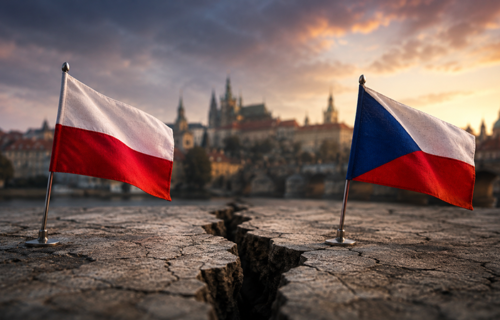
A coordinated online campaign has attempted to create friction between Poland and the Czech Republic by reviving an obscure historical border question and presenting it as evidence of a new territorial dispute between the two neighbouring countries.
The narrative suggested that Warsaw was preparing to seek Czech territory, despite there being no genuine political confrontation between the two governments over the issue. Instead, those behind the campaign appear to have combined fragments of historical fact with fabricated documents, impersonated officials and manipulated media content to make the story appear credible.
At the centre of the narrative was a border adjustment agreed between Poland and Czechoslovakia in 1958. Under the settlement, Poland transferred 1,205.9 hectares while receiving 837.46 hectares, creating a difference of 368.44 hectares. The discrepancy was never completely resolved, but for decades it has been handled as a technical matter between the countries rather than as an active territorial conflict.
The recent information campaign attempted to give this largely forgotten question a very different meaning.
One element involved the website of Polish regional broadcaster Radio PiK, where a fabricated story appeared following a cyberattack. A separate website designed to resemble Czech public radio was also reportedly used to give false information the appearance of legitimate journalism.
The campaign went further by creating social-media identities that appeared to belong to government representatives. One account impersonated the Czech ambassador to Poland and circulated a forged document supposedly showing that Poland wanted more than 600 hectares of Czech territory. Another profile presented itself as belonging to a Polish deputy foreign minister.
The difference between the historical 368-hectare imbalance and the considerably larger figure circulated through the false material is particularly important. The campaign was not simply drawing attention to an unresolved administrative question; it was constructing a new political narrative around it.
Those responsible also introduced Zaolzie into the story, bringing a considerably more sensitive historical issue into the campaign. The region became a source of Polish-Czechoslovak tension during the twentieth century and consequently provides considerably greater emotional potential than the technical border settlement of 1958.
False social-media material included claims about opposition to alleged Polish influence in the Czech city of Třinec. By connecting contemporary fabrications with historical disputes, the campaign attempted to make the suggestion of renewed Polish-Czech tensions appear more plausible.
The choice of Poland and Czechia is significant. Both countries are members of NATO and the European Union and have developed increasingly important political, economic and security cooperation. They have also been prominent supporters of Ukraine since Russia’s invasion.
At the same time, their shared history contains episodes that can be selectively presented to generate nationalist resentment. Modern influence campaigns do not necessarily need to invent an entirely new disagreement. An unresolved historical detail can instead provide the foundation upon which a much larger fictional confrontation is constructed.
Poland’s NASK disinformation specialists have indicated that techniques associated with the operation resemble methods previously identified in campaigns linked to Russian influence activity. Similar concerns have emerged on the Czech side.
That assessment, however, needs to be distinguished from definitive attribution. Publicly available evidence has not established conclusively that a particular Russian intelligence organisation or other specific group directed the operation. Similarity in methods can provide an indication of origin without constituting proof of who ordered or conducted a campaign.
Authorities and officials on both sides responded quickly to the false claims, rejecting suggestions that a territorial confrontation was developing and emphasising the strength of bilateral relations.
The attempt also appears to have struggled to move from manipulated websites and social media into established news coverage. Rather than reporting the supposed territorial dispute as genuine, mainstream reporting largely treated the material as an example of an effort to manufacture hostility between the two countries.
That outcome demonstrates one of the most effective defences against such operations: rapid verification before a fabricated narrative has time to establish itself.
The Polish-Czech case also illustrates how sophisticated disinformation does not have to be entirely fictional. In some circumstances, the most convincing false narratives begin with something that is demonstrably true.
The 1958 border adjustment happened. The resulting territorial imbalance exists as a historical issue. Zaolzie has a complicated Polish-Czech history. What changes the story is the artificial connection of those facts to invented contemporary demands, false government documents and impersonated officials.
This combination can be more persuasive than a completely fabricated story because readers encountering one verifiable element may assume that the surrounding claims are equally reliable.
The episode therefore has implications extending beyond relations between Warsaw and Prague. Central Europe contains numerous historical borders, minority questions and twentieth-century territorial changes that can be removed from their original context and repackaged for modern political purposes.
As Poland, Czechia and other countries in the region deepen cooperation on defence, energy, infrastructure and support for Ukraine, attempts to exploit historical sensitivities are likely to remain an information-security concern.
In this instance, the effort appears to have produced the opposite of its intended effect. Rather than triggering a serious diplomatic dispute, the fabricated territorial narrative resulted in Polish and Czech representatives publicly reinforcing the strength of their relationship.
The wider lesson is that disinformation can be most difficult to recognise when it contains enough genuine history to sound believable. The challenge for governments, media organisations and the public is therefore not simply identifying completely false stories, but recognising when authentic facts have been deliberately rearranged to manufacture a conflict that does not exist.
Source: WEI