Tuesday, 20 October 2026
The redevelopment of Prague’s former Žižkov Freight Station is moving into a new phase as transport infrastructure begins to advance alongside the residential and commercial projects planned across one of the capital’s largest regeneration areas.
Construction of a new tram connection between Olšanská and Habrová began on 31 August, adding an important piece of infrastructure to the emerging district. The route will run close to several planned developments in the area, including Yards Žižkov, a residential-led project being prepared by Cresco Real Estate.
The new Malešická and Nad Kapličkou stops are expected to improve public transport access across the former railway site and provide connections towards central Prague. Passenger services on the new section are scheduled to begin in 2027.
The tram investment is significant for the wider transformation of the Žižkov Freight Station because development of the extensive brownfield depends not only on delivering new housing but also on creating sufficient transport capacity, public amenities and connections with established surrounding neighbourhoods.
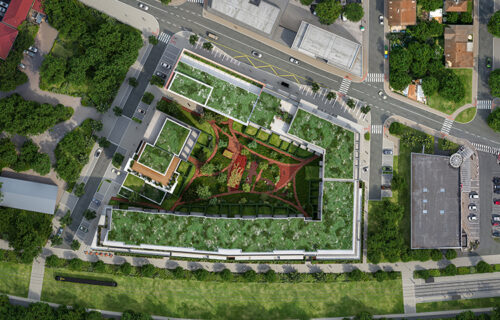
Cresco’s Yards Žižkov forms part of this broader redevelopment. The scheme is planned as a mixed urban neighbourhood combining residential buildings with commercial premises, public spaces and community facilities.
A kindergarten is included in the plans, while ground-floor areas are intended for shops and services. The development will also incorporate a new square and a pedestrian promenade running alongside the future tram corridor.
The urban and architectural concept has been prepared by QARTA Architecture. The design seeks to connect the new development with the existing character and scale of Žižkov while drawing on the industrial history of the former freight station.
Rather than functioning as a predominantly residential enclave, the project is being planned around a mixture of housing and everyday services. This approach is also intended to encourage walking, cycling and public transport for shorter journeys within the district.
The arrival of the tram infrastructure could prove particularly important as the population of the former industrial area increases. Large brownfield projects can place considerable pressure on surrounding roads and existing public transport when residential construction advances faster than supporting infrastructure.
At Žižkov, the challenge is larger because several individual developments are contributing to the transformation of the former railway land. Their long-term success will depend partly on how effectively housing, transport, streets, public spaces, schools, services and green areas are connected across the wider district.
Cresco argues that reducing the distance between homes and everyday amenities can decrease the need for residents to travel across Prague for routine activities. While the eventual travel patterns of residents will depend on employment locations and the range of services that ultimately occupy the development, the combination of mixed uses and improved public transport should provide alternatives to car-dependent development.
For Prague’s property market, the transformation of the Žižkov Freight Station represents more than the addition of another residential pipeline. It is gradually converting a major former industrial and railway site into an extension of the existing city.
With tram construction now underway and private developments progressing across the area, the focus is increasingly shifting from individual projects to whether the different components can be delivered as a coherent district. The coordination of transport infrastructure with residential development will be one of the most important factors determining how successfully this substantial part of Žižkov is integrated into Prague.