Monday, 19 October 2026
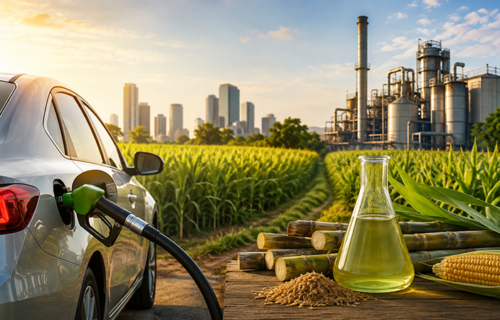
India has reached its 20% ethanol-blending objective years earlier than originally planned, marking a significant change in the country’s transport-fuel market. The achievement reduces the amount of conventional petrol required, creates a substantial domestic market for ethanol producers and farmers, and forms part of India’s wider attempt to reduce its exposure to imported energy.
The rapid transition, however, has created a new set of questions. Having demonstrated that E20 can be introduced on a national scale, policymakers now face the more complicated challenge of ensuring that motorists, vehicle manufacturers and the agricultural supply chain can adapt without undermining the economic and environmental benefits behind the programme.
India’s ethanol expansion has been remarkable. The share of ethanol blended into petrol was only around 1.5% in 2013-14. The country initially intended to reach 20% by 2030, but accelerated the programme as domestic production capacity expanded. By the current ethanol supply year, the average blend had reached the 20% level.
Reducing dependence on imported oil is one of the strongest arguments for the policy. India remains one of the world’s major crude-oil importers, leaving the economy exposed to international prices, currency movements and geopolitical disruption.
Replacing a proportion of petrol with domestically produced ethanol cannot eliminate that dependence, but the cumulative effect is becoming substantial. Official figures indicate that the blending programme has generated foreign-exchange savings exceeding ₹1.97 lakh crore and replaced the equivalent of almost 31.6 million tonnes of crude oil.
The agricultural impact is also considerable. Ethanol production has created another large market for crops and agricultural products that can be converted into transport fuel. Government figures put payments associated with ethanol feedstocks to farmers at more than ₹1.66 lakh crore.
This has helped turn ethanol policy into more than an energy programme. It has become part of India’s agricultural and rural industrial strategy, connecting fuel demand with sugar production, maize cultivation, distilleries, storage, transport and processing infrastructure.
There are nevertheless limits to how far this argument can be taken. E20 does not make India independent of international oil markets. Petrol represents only one part of national petroleum consumption, while the country’s wider demand for crude and refined products remains substantial.
The environmental calculation is similarly more complicated than replacing one litre of petrol with ethanol and assuming an equivalent reduction in emissions.
Government estimates attribute approximately 95 million tonnes of avoided carbon dioxide emissions to the ethanol programme. Ethanol can produce lower lifecycle greenhouse-gas emissions than conventional petrol, but the size of that advantage depends on how the feedstock is cultivated, transported and processed.
Water consumption is particularly important in India. Sugarcane, historically one of the principal sources of domestic ethanol, requires considerable quantities of water. Expanding ethanol production indefinitely through water-intensive crops could therefore create environmental pressures of its own.
Future growth is likely to require a more diversified supply base involving maize, agricultural waste and advanced biofuels alongside conventional sugar-derived ethanol. Developing these alternatives will become increasingly important if India wants to expand biofuel production without creating excessive competition for agricultural land, food production or water.
For motorists, however, the debate is less about national energy strategy and more about what happens inside their vehicles.
The transition towards E20-compatible vehicles has taken place progressively. Manufacturers were expected to introduce vehicles using materials capable of handling E20 from 2023, followed by engines specifically designed to operate efficiently with the blend from 2025.
That does not mean every petrol vehicle manufactured before 2023 is unsuitable for E20.
Testing undertaken by Indian automotive authorities and manufacturers has not identified evidence of widespread engine failures caused by the transition. Older vehicles have already been operating through successive increases in ethanol content without a corresponding pattern of systemic mechanical problems.
There is nevertheless an important distinction between a vehicle being able to operate on E20 and being specifically designed to obtain its best performance from it.
Older vehicles may contain fuel-system components originally specified for lower ethanol concentrations, while engine calibration may have been developed around conventional petrol or E10. Owners of older cars and motorcycles therefore have legitimate reasons to seek clear manufacturer guidance concerning compatibility and servicing.
Fuel economy is the most obvious consequence for consumers.
Ethanol contains less energy per litre than petrol. Unless an engine has been designed to exploit other characteristics of the fuel, increasing the ethanol proportion can therefore result in slightly higher consumption.
Indian testing indicates that the reduction in fuel efficiency can generally fall within a range of approximately 2% to 6%, depending on vehicle design and calibration. For some vehicles developed around E10, government assessments have indicated a difference of roughly 3% to 5%.
For an individual driver, even a relatively small reduction can be noticeable. A vehicle travelling fewer kilometres on the same quantity of fuel creates a direct cost that motorists can measure every time they fill the tank.
This helps explain why public perceptions of E20 can differ from the government’s assessment of its national benefits.
Foreign-exchange savings, lower oil imports and agricultural income are distributed across the economy. Reduced mileage, by contrast, is experienced immediately by the person driving the vehicle.
Consumer communication will therefore be critical to the next phase of the programme. Motorists need clear information about whether individual models were designed for E10, are compatible with E20 or were specifically optimised for the higher blend.
Fuel choice presents another issue.
India is moving towards E20 becoming the normal petrol specification rather than maintaining widespread parallel availability of conventional petrol, E10 and E20. This simplifies fuel distribution but leaves owners of older vehicles with fewer alternatives.
International comparisons show that there is no single approach to ethanol.
The United States sells several ethanol blends, although E10 overwhelmingly dominates petrol consumption and alternatives are not available at every filling station. Brazil has taken a much more aggressive approach, combining a high mandatory ethanol content in petrol with a mature market for vehicles capable of operating on high-ethanol fuel.
India is gradually developing flex-fuel vehicles of its own, but this part of the market remains relatively small. Wider adoption could eventually give motorists more flexibility while allowing the country to use higher ethanol concentrations where economically and technically appropriate.
The most important question surrounding E20 has therefore changed.
A few years ago, the challenge was whether India could produce enough ethanol, modify its fuel-distribution network and coordinate the automotive industry sufficiently to achieve 20% blending.
That target has now effectively been reached.
The harder task is ensuring that the system remains sustainable once the headline target disappears from the policy agenda.
India will need sufficient ethanol without placing unreasonable pressure on food production or water resources. Vehicle manufacturers will need to provide greater clarity for owners of older models. New vehicles will need to become increasingly efficient when operating on ethanol blends, while consumers will expect the economics at the filling station to make sense.
E20 should therefore neither be presented as an unquestionable solution to India’s energy challenges nor dismissed as a policy introduced before the country was ready.
Its rapid implementation demonstrates that India can transform a major part of its fuel market when government policy, agriculture, energy companies and manufacturers move in the same direction.
The next stage will be more demanding because success will no longer be measured simply by the percentage of ethanol blended into petrol. It will depend on whether India can make that achievement economically acceptable to motorists, environmentally sustainable for agriculture and sufficiently scalable to deliver meaningful long-term energy security.
Source: © CIJ.World India Research & Analysis Team