Tuesday, 20 October 2026
India’s rapid adoption of artificial intelligence is beginning to transform the country’s data-centre industry, creating demand for facilities that require considerably more electricity, advanced cooling and larger infrastructure commitments than earlier generations of digital infrastructure.
The change extends beyond simply building additional server capacity. AI applications depend on powerful computing systems capable of processing enormous quantities of information, meaning developers increasingly have to reconsider where facilities are located, how much power they can secure and how efficiently they can manage the heat generated by high-performance equipment.
India already has around 1.6 GW of operational data-centre capacity, with approximately another 3.1 GW either under construction or planned. Current projections indicate that national capacity could exceed 4.5 GW by 2030 as cloud computing, digital services and AI applications continue to expand.
AI is likely to accelerate this development because its computing requirements differ significantly from those of conventional corporate IT systems. Traditional data-centre racks have generally operated at relatively modest power densities, often averaging around 10–12 kW. Infrastructure designed for high-performance AI computing can require 40–100 kW per rack or more, with some of the latest configurations moving considerably beyond those levels.
The difference has substantial consequences for real estate. A building containing high-density computing equipment requires far more electrical infrastructure for the same amount of technical floor space. It also generates significantly greater heat, requiring more sophisticated cooling and mechanical systems.
Liquid cooling is therefore becoming increasingly important. Instead of relying entirely on conventional air-conditioning systems, new facilities can use technology that transfers heat directly from processors through liquid-based systems. This allows greater computing density but changes the design and cost of the property. Developers must allocate more space and capital to power distribution, cooling equipment and supporting infrastructure.
The result is that the value of a potential data-centre site is increasingly determined by what surrounds the land rather than simply the land itself. Reliable access to large quantities of electricity is becoming one of the most important considerations in site selection. Fibre connectivity, water availability, renewable-energy potential and proximity to major digital networks are also becoming increasingly influential.
This could gradually change the geography of India’s data-centre market. Mumbai remains the country’s largest hub, with operational capacity approaching 900 MW during the first half of 2026. Its established digital infrastructure, international connectivity, corporate demand and concentration of operators continue to give the city a significant advantage.
Chennai has also developed into one of India’s principal data-centre locations, supported by international cable connectivity and a large technology economy. Hyderabad and Delhi-NCR have established substantial positions of their own and should no longer be viewed as secondary data-centre locations.
Hyderabad in particular is attracting major investment. New projects announced by international and domestic operators are adding hundreds of megawatts of planned capacity, strengthening Telangana’s position within India’s digital infrastructure market.
The more significant development is the emergence of additional locations capable of hosting very large AI-oriented campuses. Visakhapatnam is becoming one of the clearest examples.
Google is developing a major AI and data-centre hub in the city as part of an investment programme valued at approximately USD 15 billion between 2026 and 2030. The development is expected to include large-scale computing infrastructure alongside new energy and telecommunications capacity. The scale of the project demonstrates how a single major technology investment can change the position of an emerging city within India’s digital economy.
Jamnagar provides another example of how AI could widen the country’s data-centre geography. Meta has committed to capacity within a large AI-oriented facility being developed by Reliance Industries, demonstrating that future hyperscale investment does not necessarily have to remain concentrated in established metropolitan markets.
These developments suggest that the next generation of Indian data centres could increasingly follow electricity and infrastructure availability rather than conventional commercial property patterns. Large AI campuses may require hundreds of megawatts of power. Future projects could eventually operate at gigawatt scale, making their energy requirements comparable with major industrial developments.
This creates an important challenge for India’s electricity system. Data centres already account for a measurable share of national power consumption, and demand is expected to increase substantially as new capacity becomes operational. AI could accelerate that growth because high-performance computing requires much more electricity than conventional digital workloads.
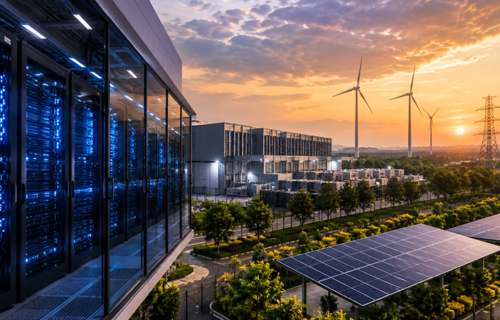
Developers are consequently placing greater emphasis on renewable power. Long-term agreements for solar and wind electricity are becoming more important, while battery storage could eventually help operators manage the difference between intermittent renewable generation and the continuous electricity requirements of data centres.
However, renewable generation alone does not solve the problem. Data centres require exceptionally reliable electricity at every hour of the day, meaning grid infrastructure, substations, storage and backup systems remain critical.
Water represents another challenge. Cooling large computing facilities can require substantial quantities of water, particularly in locations using evaporative cooling systems. India’s existing data-centre industry is already estimated to consume significant water resources, and consumption could rise sharply as capacity expands.
This makes cooling technology and local water availability increasingly important considerations when selecting future sites. New facilities may rely more heavily on closed-loop systems, recycled water, desalination or other technologies designed to reduce pressure on municipal supplies.
These requirements are beginning to make data centres resemble infrastructure projects as much as conventional real estate developments. A major campus may require extensive land not only for server buildings but also for substations, cooling facilities, backup power, energy storage and telecommunications infrastructure.
This creates opportunities beyond the data-centre property itself. Large developments require electrical equipment, cooling technology, construction materials, network infrastructure and specialist maintenance services. Suppliers serving these facilities can create additional requirements for industrial and logistics property nearby. Data-centre investment can therefore become a catalyst for wider industrial development.
For property investors, this changes the characteristics that make a site valuable. Cheap land alone is unlikely to attract major AI infrastructure. A successful location needs a combination of available land, sufficient grid capacity, dependable electricity, fibre connectivity and a regulatory environment capable of supporting very large projects.
States able to provide these conditions could attract investment that previously would have been concentrated in Mumbai, Chennai or other established markets. Mumbai is unlikely to lose its position as India’s leading data-centre centre in the immediate future. Its connectivity, existing infrastructure and large customer base remain difficult to replicate.
But the scale of future AI computing requirements means that India’s digital infrastructure market is likely to become more geographically diverse. Hyderabad is strengthening its position as a major established market, while developments in Visakhapatnam and Jamnagar demonstrate the potential for large projects to create entirely new digital infrastructure clusters.
India’s data-centre expansion is therefore entering a different phase. The first stage was largely driven by cloud adoption, digital services and rising internet consumption. The next will increasingly be influenced by the enormous computing requirements of artificial intelligence.
That transition will change the buildings themselves, but its greatest impact may be on where they can realistically be developed. For the next generation of India’s data centres, the decisive question may no longer be where technology companies want to locate their servers, but where developers can find enough land, electricity, connectivity and cooling capacity to operate them.
Source: © CIJ.World India Research & Analysis Team