Monday, 19 October 2026
China’s commercial real estate investment market is beginning to regain momentum, but the capital behind the improvement looks markedly different from that of previous property cycles. Rather than relying on a broad return of overseas funds, transaction activity in 2026 is increasingly being supported by Chinese companies acquiring premises for their own use, insurance groups, domestic institutions and private investors prepared to take long-term positions in assets whose values have already undergone substantial correction.
Shanghai provides one of the clearest examples of this shift. Commercial property transactions strengthened during the second quarter of 2026, while companies purchasing buildings for their own occupation emerged as one of the market’s most important sources of demand. Owner-occupiers accounted for approximately 45% of Shanghai investment activity during the quarter. Across the first half of the year, their share was around 43%, compared with approximately 18% for 2025 as a whole.
This represents more than a temporary change in transaction statistics. It suggests that the investment market is developing a new domestic buyer base capable of providing liquidity at a time when many traditional international property investors remain highly selective about China.
Companies have become particularly important purchasers of office buildings. After several years of falling valuations, acquiring an existing building can now make financial sense for businesses that previously would have leased their headquarters. A corporate buyer does not necessarily evaluate a property in the same way as an investment fund. Long-term occupation, control over premises, corporate identity and the ability to replace future rental expenditure with ownership can all influence the decision.
This difference in motivation is helping transactions take place even while conventional investment fundamentals remain challenging. Shanghai continues to face substantial office availability and pressure on rents, but these conditions do not automatically prevent a company from purchasing a building if the acquisition price has fallen sufficiently.
The changing market can already be seen in major transactions. Corporate and financial-sector buyers have acquired prominent Shanghai office properties for headquarters or strategic occupation. Such deals demonstrate how the correction in commercial property values is opening buildings that might previously have been priced primarily for institutional investment to a much broader range of domestic purchasers.
Domestic capital now dominates Shanghai investment activity more generally. During the first half of 2026, corporate purchasers represented more than half of transaction demand, while institutional and insurance investors provided another substantial share. Overseas capital remains present, but it is no longer necessary for international funds to lead the market for significant transactions to occur.
Beijing is experiencing a similar transformation. Domestic buyers accounted for virtually all recorded investment activity during the first half of the year, while corporate purchasers represented a particularly large proportion of acquisitions. Taken together, developments in China’s two largest commercial property markets suggest that this is becoming a structural change rather than an isolated Shanghai phenomenon.
Insurance capital is emerging as another important part of the new ownership landscape. Chinese insurers manage large pools of long-term capital and require assets capable of generating income over extended periods. With domestic fixed-income returns relatively low and commercial property prices substantially below earlier peaks, selected offices, retail properties and other mature assets have become increasingly attractive.
Several significant transactions have already demonstrated the scale at which insurance capital can participate. Insurers have taken positions in major commercial properties, including large Beijing assets, while billions of dollars have been deployed into Chinese real estate over recent years.
For property owners seeking to sell, this creates a valuable alternative source of liquidity. Developers dealing with balance-sheet pressure, overseas funds approaching the end of investment periods and existing owners seeking to release capital can potentially sell to institutions that are under less pressure to achieve short-term capital appreciation.
The investment logic nevertheless remains highly selective. Chinese insurers and other domestic institutions are not simply purchasing commercial buildings because prices have fallen. Location, tenant quality, income security, building specifications and the ability to maintain occupancy remain critical. Older properties in weaker locations can therefore continue to struggle even while transactions return elsewhere in the market.
This creates an increasingly pronounced division between buildings capable of attracting long-term domestic capital and properties that remain difficult to finance or sell.
The role of international investors also requires careful interpretation. Foreign capital has not abandoned China, and selected investors continue to examine opportunities. However, overseas funds no longer occupy the position they once held in determining market liquidity.
In some transactions, international investors are now sellers rather than buyers. Assets accumulated during China’s earlier expansionary period are being brought to market after substantial valuation adjustments, creating opportunities for domestic companies and institutions to acquire established properties at prices that would have been difficult to achieve several years ago.
The result is effectively a transfer between investment cycles. Buildings assembled when foreign institutional capital was expanding aggressively in China are gradually moving toward a more domestically controlled ownership structure.
That transition is occurring against a property market that remains far from fully recovered.
Office vacancies remain high in several major Chinese cities and landlords continue to face rental pressure. Development investment has also contracted sharply. During the first six months of 2026, national real estate development investment remained significantly below the previous year, with spending on offices and commercial buildings recording particularly steep declines.
The contrast is important. Investors are showing greater willingness to acquire completed properties at corrected valuations while remaining cautious about committing capital to new development.
China therefore appears to be experiencing an investment-market recovery before experiencing a development-market recovery.
The distinction also explains why transaction volumes can increase despite weak rental indicators. Property prices have adjusted much faster than many occupational markets have recovered. For purchasers with substantial cash resources and long investment horizons, that repricing can create opportunities before rents or occupancy begin improving materially.
Another important development could further accelerate the transformation. China expanded the role of publicly traded real estate investment vehicles during 2026, including the introduction of commercial property REITs backed by established office and retail assets.
A deeper domestic REIT market could eventually provide owners with another mechanism for releasing capital from mature properties. It could also create an institutional exit route for investors acquiring and repositioning buildings today, increasing the potential liquidity of commercial assets.
Retail property could particularly benefit where shopping centres have stable occupancy, established operating histories and predictable cash flows. Rather than requiring an overseas fund to acquire an entire property, mature assets could increasingly move between domestic private owners, insurers, institutions and listed investment structures.
State-related and government-linked capital may also participate in this changing landscape, particularly where acquisitions have strategic, financial or urban-development objectives. However, the strongest evidence from the first half of 2026 points toward a broader domesticisation of investment rather than a market being rescued primarily by state-owned buyers.
This matters because China may be constructing a commercial property investment system that functions differently from the one that existed before the downturn.
During the previous expansion, developers, international funds and rapidly appreciating property values played central roles. The emerging market is more dependent on existing assets, corrected prices, operating income and purchasers willing to hold property for strategic or long-term financial reasons.
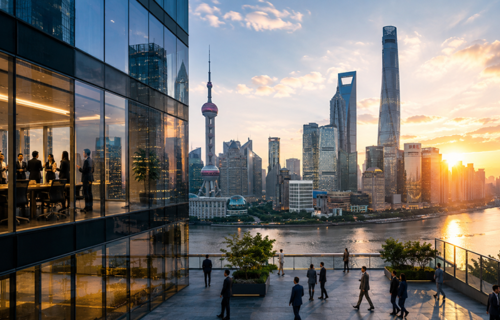
Shanghai has become the clearest testing ground. Rising transaction activity is taking place even without a dramatic recovery in office rents or the wholesale return of overseas capital. Companies are buying headquarters, insurers are examining long-duration assets and domestic institutions are purchasing properties at valuations that increasingly compensate for leasing and economic risks.
The significance of China’s commercial property recovery may therefore lie less in how much real estate is being traded than in who is purchasing it.
If this pattern continues, the next Chinese property cycle will not simply restore the market that existed before the downturn. It could leave the country’s most important commercial buildings in substantially different hands, with domestic corporate and institutional capital becoming the foundation of investment liquidity rather than an alternative to foreign money.
Source: CIJ.World Research & Analysis Team