Sunday, 25 October 2026
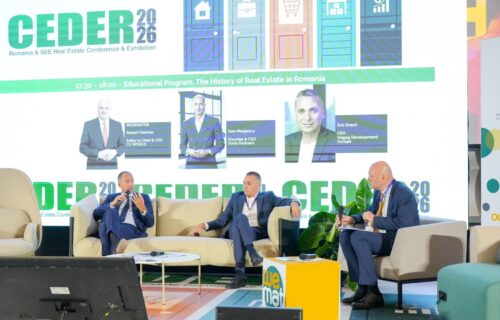
The final panel held at CEDER 2026, entitled “The History of Real Estate in Romania” touched upon aspects about the past and future of real estate development in Bucharest and beyond. As showcased by this discussion, the evolution of modern cities has moved beyond the construction of isolated structures to a philosophy of integrated urban regeneration. As the real estate market matures, developers are increasingly focused on how buildings “shape the way people experience a city every day”. This shift marks a transition from chaotic expansion to projects that actively influence entire districts and communities.
According to Geo Mărgescu, Founder & CEO of Forte Partners, the foundation for successful regeneration lies in strict urbanistic rules. Referring to historical examples of “well-done urban development” like the Ioanid Lotization or the Grant Lotization, he notes that municipality-imposed regulations should be seen as “value-added attempts” rather than obstacles. These early 20th-century developments succeeded because they were planned as “complete neighborhoods” featuring public parks and specific architectural standards.
In the modern context, major developments have the power to breathe life into neglected zones. Mărgescu points to The Bridge project in Bucharest as a prime example of this influence. Before its completion, the surrounding area was “completely dead,” dominated by railway lines. Today, it anchors a district with hundreds of thousands of square meters of office and residential space, proving that a single project can “change the city for good”. Similarly, the Sector Zero initiative transformed a “dead and dark area” into a “sunny and joyful playground for the whole community”.
International perspectives also emphasize the developer’s duty to the public. Eric Drach, CEO of Hagag Development Europe, highlights the Israeli model of urban renewal where developers are encouraged to “bring something back to the community” in exchange for building rights. This might include community centers or essential services, such as the retail solutions integrated into the H Pipera Lake project. Drach argues that success is measured by long-term value, noting that a truly successful building attracts further investment and improves the “day-to-day living” of the surrounding neighborhood.
The ultimate goal of this new development wave is a profound societal shift. Mărgescu encapsulates this responsibility by citing Winston Churchill: “We are shaping the buildings, and the buildings are shaping us”. By creating beautiful streets and integrated neighborhoods, developers are not just building real estate; they are “shaping the generations to come”. As Bucharest moves toward a future of smart urban renewal, the industry is increasingly prioritizing the user at the center of every project.