Friday, 23 October 2026
Long known as one of Bratislava’s busiest transport intersections, Trnavské mýto is entering a new phase of development as a series of public and private investments reshape the area into a mixed-use urban district. While the large-scale Istropolis redevelopment is the most visible project, a growing number of residential, commercial and regeneration schemes are collectively changing the character of one of the capital’s best-connected neighbourhoods.
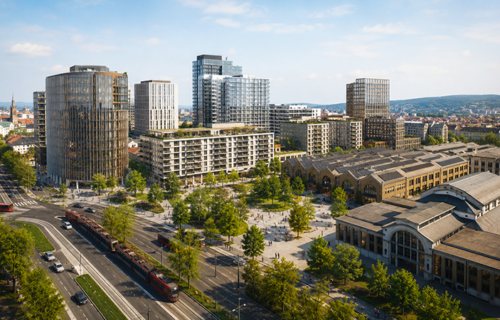
The transformation is centred on the former House of Trade Unions site, where developer Immocap has begun construction of the first phase of the new Istropolis district. The development represents one of Slovakia’s largest real estate investments, with an estimated value of around €600 million, and will be delivered over several stages extending into the early 2030s.
The first phase comprises three buildings, including office and residential space supported by retail and public amenities. Once fully completed, the district is expected to include nine buildings, approximately 600 apartments, office space for thousands of employees, a new cultural and congress venue, retail premises and landscaped public spaces designed to reconnect surrounding neighbourhoods.
The project reflects a broader shift in urban planning priorities, moving beyond individual buildings towards creating integrated districts where offices, housing, cultural facilities and public space coexist within walking distance of major transport infrastructure.
Development activity is also expanding into neighbouring streets. On nearby Kominárska Street, the Lofty Kominárska project is converting a former industrial printing facility into residential lofts and apartments rather than replacing the existing structure. The development preserves much of the original reinforced concrete construction while adapting the building for contemporary residential use, illustrating the growing emphasis on adaptive reuse across Bratislava.
The project also incorporates permanent contemporary art installations within the retained industrial spaces, demonstrating how former manufacturing buildings are increasingly being repurposed as cultural as well as residential assets.
Its location alongside the Unitas housing complex further reinforces the area’s architectural significance. Designed in the early 1930s by pioneering functionalist architects Friedrich Weinwurm and Ignác Vécsei, Unitas remains one of Slovakia’s most important examples of modernist social housing and continues to influence redevelopment in the surrounding neighbourhood.
Investment is not limited to new buildings. Nearby Nová Tržnica, one of Bratislava’s landmark market halls, continues to undergo gradual modernisation through upgrades to public areas, lighting and visitor navigation, complementing wider improvements to the public realm.
Transport infrastructure remains a defining advantage for the district. Trnavské mýto already serves as one of Bratislava’s principal interchange points for trams, buses and trolleybuses, while the ongoing reconstruction of Bratislava-Východ (Bratislava East) railway station is expected to further strengthen regional and national connectivity. Planned transport improvements, including the future Metro Line M3 proposal, are intended to reinforce the area’s long-term accessibility.
The wider district is also attracting additional residential investment. New housing developments surrounding Istropolis are gradually filling former industrial and underused sites, creating a more balanced mix of residential, office and commercial uses than previously existed.
Urban planners increasingly view the transformation as part of a longer-term evolution rather than a collection of isolated projects. Alongside new construction, developers are placing greater emphasis on preserving industrial heritage, introducing pedestrian-friendly public spaces, expanding greenery and improving links between previously disconnected parts of the city.
As construction progresses over the coming years, Trnavské mýto appears set to evolve from a transport gateway into one of Bratislava’s most significant mixed-use districts, combining employment, housing, culture and public space within one of the capital’s best-connected locations.