Saturday, 17 October 2026
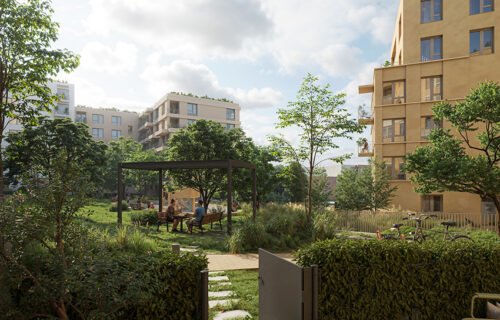
Green inner courtyards within residential developments can significantly reduce temperatures and improve environmental conditions during the summer months, according to measurements commissioned by developer Corwin and carried out by researchers from the Technical University of Košice.
The findings were presented as the company prepares to launch its first large-scale residential project in Prague, Dvory Vysočany.
Measurements conducted in Bratislava during June compared conditions at a busy urban intersection with those inside the courtyard of the nearby Blumental residential project. According to the study, temperatures inside the courtyard reached 26.5°C, compared with more than 31°C at the nearby intersection, representing a difference of almost five degrees within the same city centre area.
Researchers also reported lower levels of noise and airborne dust particles within the courtyard environment. Noise levels were measured at around 30% lower than at surrounding streets, while concentrations of fine dust particles were reduced by more than 10%.
The company said the results reflect the impact of urban design strategies that prioritise green space, shaded public areas and reduced surface traffic. Corwin stated that its approach has been developed in cooperation with urban planners Jan Gehl and David Sim.
According to Jakub Dobrý, Corwin’s country manager for the Czech Republic, the quality of public space between buildings plays a significant role in how residents experience urban environments during periods of high temperatures.
The Dvory Vysočany project in Prague will incorporate underground parking, landscaped courtyards, rain gardens and green roofs across all buildings. The developer said these measures are intended to improve water retention, reduce heat accumulation and support biodiversity.
Corwin also referred to thermal measurements carried out by specialist company Terradron at its Guthaus residential project in Bratislava. According to the company, a green roof on one section of the development recorded lower surface temperatures than neighbouring conventional roofs during measurements taken in July 2024.
The developer added that the use of mature vegetation, rainwater retention systems and insulated building materials can contribute to improved comfort levels for residents, particularly during increasingly frequent summer heatwaves in Central European cities.