Mündel Trans Secures 17,000 sqm of Logistics Space in Burgkunstadt

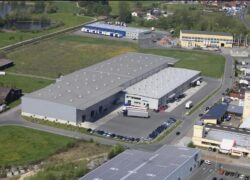
Logistics service provider Mündel Trans GmbH has leased nearly 17,000 square metres of space in Burgkunstadt, Upper Franconia, in a deal advised by integrated logistics real estate consultant Logivest. The properties, owned by Friedrich-Baur-GmbH, are located on Joseph-Weiermann-Straße 1 and Bahnhofstraße 28.

The lease includes two facilities: an 11,400 square metre warehouse on Joseph-Weiermann-Straße and a 5,400 square metre property on Bahnhofstraße, both equipped with multiple ramp gates. The sites are well connected via the nearby B289 highway, providing direct access to the company’s headquarters in Sonneberg, Thuringia, roughly 30 kilometres away.

According to Stefan Moor, Head of Industrial and Logistics Letting at Logivest in Nuremberg, the Lichtenfels district offers strategic advantages for logistics operations. “Its location at the Thuringian border and proximity to Czechia make it attractive, and the area also provides large-volume existing spaces with good links to the A70, A73 and A9 motorways,” he said.

Mündel Trans has already taken occupancy of the space.

Mündel Trans Secures 17,000 sqm of Logistics Space in Burgkunstadt

Logistics service provider Mündel Trans GmbH has leased nearly 17,000 square metres of space in Burgkunstadt, Upper Franconia, in a deal advised by integrated logistics real estate consultant Logivest. The properties, owned by Friedrich-Baur-GmbH, are located on Joseph-Weiermann-Straße 1 and Bahnhofstraße 28.

The lease includes two facilities: an 11,400 square metre warehouse on Joseph-Weiermann-Straße and a 5,400 square metre property on Bahnhofstraße, both equipped with multiple ramp gates. The sites are well connected via the nearby B289 highway, providing direct access to the company’s headquarters in Sonneberg, Thuringia, roughly 30 kilometres away.

According to Stefan Moor, Head of Industrial and Logistics Letting at Logivest in Nuremberg, the Lichtenfels district offers strategic advantages for logistics operations. “Its location at the Thuringian border and proximity to Czechia make it attractive, and the area also provides large-volume existing spaces with good links to the A70, A73 and A9 motorways,” he said.

Mündel Trans has already taken occupancy of the space.

Mitzilinka – When PR Eats Authenticity for Breakfast

Once upon a time in Central and Eastern Europe, a journalist sat down to interview a woman in real estate. The goal was simple: capture her real story—struggles, triumphs, the occasional ugly-cry in the office bathroom. You know, the human stuff.

But then the answers went through the Great Corporate PR Blender™. Out came not a voice, but a smoothie of “synergy,” “innovation,” and “forward-looking solutions.” Deliciously bland, with all the lumps of personality removed.

Suddenly, instead of “I messed up but learned from it,” the quote became “Our organization values resilience as part of its strategic vision.” Instead of “Sometimes I doubt myself,” it was “We leverage opportunities to foster inclusive growth.” And instead of “I like tennis,” it was “Sports and recreation embody our core commitment to sustainability.”

The journalist, blinking through the corporate fog, made a daring suggestion: “Maybe we could add a few real-life details? Let her sound… human?”

The company’s response: a polite email equivalent of slamming the door. Better silence than spontaneity.

And that, ladies and gentlemen, is how we keep getting real estate “profiles” that read like IKEA manuals: technically correct, but guaranteed to put you to sleep.

This might be forgivable if it were about quarterly profits. But no—these were stories meant to inspire real estate readers. Imagine how much more powerful it would be if executives admitted: Yes, I felt intimidated. Yes, I got interrupted. Yes, I once wore two different shoes to a board meeting because last night was chaos. That’s the stuff that makes you go: Finally, someone gets it.

Instead, they’re handed paragraphs polished smoother than a wax museum statue. Authenticity? Missing. Relatability? Deleted. What remains is corporate kabuki theater, performed in the dialect of Buzzwordish.

The irony is rich: in trying to look strong, brands end up looking robotic. In trying to “control the message,” they lose the very thing audiences crave—the messiness of real human stories.

So, if the goal is truly to inspire future real estate executives, companies might want to try a radical strategy: let people talk like people. Imperfection won’t kill your brand. In fact, it might just make it loved.

Until then, every journalist in the region knows the drill: prepare your questions, hit record, and then watch as marketing departments translate blood, sweat, and tears into… “strategic alignment.”

Author: Mitzilinka (Turning grim reality into comic relief—without losing the truth)

Construction Begins on CZK 1.5 Billion MUSE7 Development in Holešovice

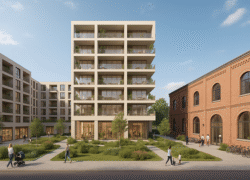
Work has officially started on the MUSE7 residential complex in Prague’s Holešovice district, a CZK 1.5 billion investment by Syner Real Estate. Rising on a site close to the Nádraží Holešovice metro station, the project will bring 150 apartments, 15 ground-floor retail units, and a new community center for Prague 7.

The design, prepared by architects Lucie Pachmanová and Pavel Slezák of AGE projekt, blends modern elements with heritage features. A historic building from the site’s former paper mill will be restored for community use, while new structures are arranged around a landscaped courtyard.

Residents will have access to underfloor heating, a ventilation system with heat recovery, a private gym, a wellness area with sauna, a staffed reception, and even a bicycle wash. The scheme is aiming for an A energy performance certificate and BREEAM “Very Good” certification, reflecting its sustainability goals.

Sales have been strong: more than four-fifths of the apartments are already sold or reserved. Completion is scheduled for the second quarter of 2027.

MUSE7 is one of several projects reshaping Holešovice and the wider Bubny–Zátory area, where thousands of new homes and public facilities—including the planned Vltava Philharmonic concert hall—are expected to transform what was once largely industrial land.

Moody’s Reaffirms Prague’s Credit Standing with Stable Outlook

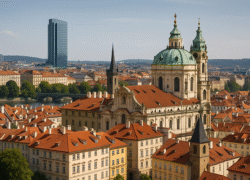
Prague’s financial reputation received another vote of confidence this week as Moody’s Investors Service maintained the city’s high-grade credit assessment at Aa3, accompanied by a stable outlook. The confirmation keeps the Czech capital aligned with the sovereign rating, underscoring both its fiscal discipline and the expectation of national backing in times of stress.

According to council documents released on Monday, Moody’s praised Prague’s ability to consistently generate sizeable operating surpluses, which provide the main source of funding for major infrastructure projects. Analysts also pointed to the city’s ample reserves and exceptionally light debt burden, which together give it room to withstand economic shocks.

The agency nevertheless noted several structural challenges. Prague’s revenues are closely tied to the performance of the national economy, leaving it less flexible than some peers in how it raises income. At the same time, rapid growth and the demands of modernization continue to impose heavy spending obligations. For the city’s rating to rise further, an improvement in the Czech Republic’s own standing would be necessary.

The confirmation places Prague in the same rating category as Paris, while other regional capitals remain lower on the scale. Warsaw, for example, is aligned with Poland’s sovereign A2 rating, and Budapest continues to sit near the bottom of the investment-grade spectrum.

East German Towns Turn to “Trial Living” to Fight Depopulation

Cities across eastern Germany are experimenting with a novel approach to halt decades of population decline: offering newcomers the chance to try life in their communities at minimal cost.

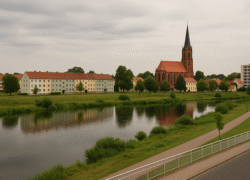
In Guben, a border town on the Oder River opposite Poland’s Gubin, authorities are inviting potential residents to rent furnished apartments for around €100 per week for up to a month. The idea is to give families and young professionals a taste of the quieter lifestyle, affordable housing, and community amenities in a region that has lost half its population since reunification. Guben counted more than 30,000 residents in 1990; today it is closer to 16,000.

Other towns such as Eisenhüttenstadt are rolling out similar programs. Municipal leaders say the goal is to counter long-term outmigration, especially among young people and women, who have often left for larger cities in western Germany.

Researchers warn that the trend poses a significant challenge for the German economy. Tim Leibert of the Leibniz Institute for Regional Geography describes the steady departure as “a demographic time bomb,” pointing to shrinking workforces and a distorted age structure in many eastern regions. Projections from Germany’s Federal Statistics Office suggest that the east could lose between 8 and 16 percent of its population in the next two decades if current trends continue.

The effort faces hurdles. Many outsiders still associate towns like Guben and Eisenhüttenstadt with economic collapse following the fall of East Germany’s heavy industry. Yet local officials insist conditions have improved. “Jobs exist in health care, logistics and manufacturing,” said Kerstin Geilich, who coordinates Guben’s revitalization campaign, though she concedes perceptions are hard to change.

For some, the offer is compelling. One young mother who relocated temporarily from western Germany said she was surprised by the green surroundings and family-friendly services, including subsidized childcare. Whether such short stays lead to long-term commitments remains uncertain, but officials see the experiment as one of the few practical tools available to bring new life to towns still struggling with the legacies of reunification.

East German Towns Turn to “Trial Living” to Fight Depopulation

Cities across eastern Germany are experimenting with a novel approach to halt decades of population decline: offering newcomers the chance to try life in their communities at minimal cost.

In Guben, a border town on the Oder River opposite Poland’s Gubin, authorities are inviting potential residents to rent furnished apartments for around €100 per week for up to a month. The idea is to give families and young professionals a taste of the quieter lifestyle, affordable housing, and community amenities in a region that has lost half its population since reunification. Guben counted more than 30,000 residents in 1990; today it is closer to 16,000.

Other towns such as Eisenhüttenstadt are rolling out similar programs. Municipal leaders say the goal is to counter long-term outmigration, especially among young people and women, who have often left for larger cities in western Germany.

Researchers warn that the trend poses a significant challenge for the German economy. Tim Leibert of the Leibniz Institute for Regional Geography describes the steady departure as “a demographic time bomb,” pointing to shrinking workforces and a distorted age structure in many eastern regions. Projections from Germany’s Federal Statistics Office suggest that the east could lose between 8 and 16 percent of its population in the next two decades if current trends continue.

The effort faces hurdles. Many outsiders still associate towns like Guben and Eisenhüttenstadt with economic collapse following the fall of East Germany’s heavy industry. Yet local officials insist conditions have improved. “Jobs exist in health care, logistics and manufacturing,” said Kerstin Geilich, who coordinates Guben’s revitalization campaign, though she concedes perceptions are hard to change.

For some, the offer is compelling. One young mother who relocated temporarily from western Germany said she was surprised by the green surroundings and family-friendly services, including subsidized childcare. Whether such short stays lead to long-term commitments remains uncertain, but officials see the experiment as one of the few practical tools available to bring new life to towns still struggling with the legacies of reunification.

Czech Courts Report Surge in Personal Bankruptcies

The number of people seeking court protection from debts in the Czech Republic has risen sharply this year. From January through August, courts declared more than 10,800 personal bankruptcies, roughly 14 percent higher than in the same period of 2024. Petitions for insolvency also increased, with over 11,000 accepted in the first eight months, a jump of about 12 percent year-on-year.

Analysts note that this is the steepest rise in personal insolvencies recorded in an eight-month span since 2021, reversing the temporary decline seen between 2020 and 2023. The trend has been linked to weaker payment discipline, reflected in the growing share of non-performing consumer loans. At the same time, household savings are expanding more slowly, while demand for short-term credit has grown close to ten percent this year.

Regional figures show that the largest numbers of bankruptcies were declared in the Moravian-Silesian Region, the Ústí Region, and Central Bohemia. The lowest counts were registered in Zlín, Vysočina, and Karlovy Vary. In Prague, the year-on-year increase was especially steep, with the capital recording about a third more cases than a year earlier.

Looking at bankruptcies relative to population, the Ústí Region remains the most affected, with more than 40 cases per ten thousand residents over the past 12 months. By contrast, Pilsen has seen only about six per ten thousand inhabitants, the lowest rate in the country.

Altogether, Czech courts have declared more than 15,000 personal bankruptcies in the past 12 months, an 11 percent rise from the previous year. With consumer borrowing still climbing and wages rising at a brisk pace, experts caution that the upward momentum is likely to continue in the coming months.

Czech Courts Report Surge in Personal Bankruptcies

The number of people seeking court protection from debts in the Czech Republic has risen sharply this year. From January through August, courts declared more than 10,800 personal bankruptcies, roughly 14 percent higher than in the same period of 2024. Petitions for insolvency also increased, with over 11,000 accepted in the first eight months, a jump of about 12 percent year-on-year.

Analysts note that this is the steepest rise in personal insolvencies recorded in an eight-month span since 2021, reversing the temporary decline seen between 2020 and 2023. The trend has been linked to weaker payment discipline, reflected in the growing share of non-performing consumer loans. At the same time, household savings are expanding more slowly, while demand for short-term credit has grown close to ten percent this year.

Regional figures show that the largest numbers of bankruptcies were declared in the Moravian-Silesian Region, the Ústí Region, and Central Bohemia. The lowest counts were registered in Zlín, Vysočina, and Karlovy Vary. In Prague, the year-on-year increase was especially steep, with the capital recording about a third more cases than a year earlier.

Looking at bankruptcies relative to population, the Ústí Region remains the most affected, with more than 40 cases per ten thousand residents over the past 12 months. By contrast, Pilsen has seen only about six per ten thousand inhabitants, the lowest rate in the country.

Altogether, Czech courts have declared more than 15,000 personal bankruptcies in the past 12 months, an 11 percent rise from the previous year. With consumer borrowing still climbing and wages rising at a brisk pace, experts caution that the upward momentum is likely to continue in the coming months.

Slovak Housing Market Pushes Higher as Sellers Test Limits

Apartment prices in Slovakia have climbed again, giving many homeowners the confidence to demand more for their properties—even when buyers may not share the same enthusiasm.

Fresh figures from the Real Estate Union show that the average price of a flat reached just over €3,200 per square meter at the end of August, up nearly five percent in only two months. Compared with last summer, values are roughly 15 percent higher. The rise reflects not only strong demand but also the limited supply of new housing and a recent boost in household incomes, which together have created a seller’s market.

But agents warn that not every listing will fetch top euro. Many owners set asking prices based on personal attachment or the cost of past renovations, rather than on actual market evidence. While this optimism is understandable in a rising market, brokers note that inflated expectations often leave apartments unsold for weeks, only to be reduced later at the expense of the seller.

Industry data suggests that the first two weeks after a property goes on the market are decisive: if viewings and inquiries are thin during that period, it is a sign that the price may be too high. Small adjustments at that stage usually preserve momentum, while big cuts made months later can erode confidence and prolong the process even further.

The fundamentals still support a high price environment. Wage growth has been outpacing inflation, giving households more purchasing power, while developers are struggling to deliver enough new units to keep up with demand. Analysts expect these forces to keep pushing values upward through the autumn.

Yet, as professionals point out, the best results still come from grounded expectations. Listings priced in line with recent comparable sales and neighborhood conditions tend to sell faster and with fewer concessions, while overreach risks missing the moment when buyers are most attentive.

LATEST NEWS