Fitch Affirms NEPI Rockcastle’s ‘BBB+’ Rating with Stable Outlook

Fitch Ratings has reaffirmed the long-term credit rating of NEPI Rockcastle N.V. at ‘BBB+’, maintaining a Stable Outlook. The same rating was applied to the group’s senior unsecured bonds, including those issued by NE Property B.V., which are guaranteed by NEPI.

The rating reflects the company’s solid operating performance and strong balance sheet, underpinned by a high-quality retail portfolio across Central and Eastern Europe. Fitch highlighted stable occupancy levels, healthy tenant sales, and consistent cash generation, supported by prudent financial management despite rising interest rates.

NEPI maintains a low leverage profile, with net debt to EBITDA expected to stay below 5.1x through 2028 and a loan-to-value ratio of 33% at mid-2025, comfortably below the company’s internal ceiling of 35%. Net interest coverage remains healthy, although Fitch anticipates some reduction over the coming years as older, low-interest debt is refinanced at higher rates.

In September 2025, NEPI issued a new €500 million bond with an eight-year maturity and a 3.875% coupon, using the proceeds to refinance half of its 2026 and 2027 bond maturities. The company retains strong liquidity, with €373 million in cash and €690 million in undrawn revolving credit facilities, ensuring ample capacity to manage its €250 million October 2026 bond repayment.

Fitch noted that NEPI’s development pipeline remains an important driver of future income growth. Ongoing projects include Promenada Mall in Bucharest, with 55,400 sqm of new space scheduled for completion in early 2027, already around 70% pre-let. Additional developments in Plovdiv and Galați are expected to launch between 2026 and 2027, both in advanced permitting stages.

Recent acquisitions have strengthened the company’s regional footprint. NEPI’s purchase of Magnolia Park in Wrocław and Silesia City Centre in Katowice for nearly €760 million expanded its Polish portfolio, generating annual rental income of roughly €55 million combined. The company continues to focus on leading, high-traffic shopping destinations across its markets, which attract major international tenants such as LPP, Inditex, Carrefour, and Auchan.

Fitch also pointed to NEPI’s investment in renewable energy, with €110 million earmarked for solar projects in 2025–2026. Once completed, these installations will deliver 212 MW of capacity, covering nearly half of the company’s energy needs and generating up to €30 million annually.

Operationally, NEPI’s performance remains robust. Net rental income grew 11.9% year-on-year in the first half of 2025, while like-for-like income rose 4.2%. Tenant sales increased 3.9%, supported by higher basket values, though footfall remained stable. Vacancy rates continued to decline, standing at 1.6% by mid-2025.

When compared with peers such as Globalworth Real Estate Investments and Globe Trade Centre, Fitch considers NEPI’s financial metrics stronger, particularly its moderate leverage and resilient rental income. The agency expects the company to maintain stable performance and sufficient liquidity over the medium term.

Fitch concluded that an upgrade is unlikely in the near term, given NEPI’s retail sector focus and geographic concentration in Central and Eastern Europe. However, the current rating reflects the company’s consistent profitability, conservative funding structure, and well-managed asset base, which together support its ‘BBB+’ rating with a Stable Outlook.

Source Fitch Ratings

Poland’s Job Market Shows Signs of Strain as Demand for Workers Flattens

After months of muted activity, Poland’s job market remains steady but shows increasing signs of strain, according to the latest Job Offer Barometer compiled by the University of Information Technology and Management in Rzeszów and the Bureau of Investment and Economic Cycles. The index, which tracks changes in the number of online job advertisements, edged up slightly in September to 258 points from 254.9 in August — a marginal rise that analysts describe as part of a stagnant pattern rather than a sustained recovery.

The modest increase in job postings contrasts with a slowly rising unemployment rate, which climbed for the third consecutive month in August to 5.6%. Excluding seasonal workers, the figure suggests that labour demand is weakening even as employers continue to advertise at similar levels. Economists warn that the combination of stable vacancies and higher unemployment could indicate the onset of a cyclical slowdown. “The job market clock has shifted closer to signalling a downturn,” the report notes.

Across occupational groups, trends remain mixed. After five months of decline, demand for manual labourers increased slightly, though overall activity still trails its long-term upward trend. In contrast, professions requiring technical or scientific training have seen job postings rise for ten consecutive months, particularly in construction and research roles. Yet even here, total offers remain below pre-2022 levels, underscoring a cautious hiring environment. IT positions, especially programming jobs, dipped for the first time in nearly a year, while postings for engineers and occupational safety experts also softened.

Sectors linked to social sciences, law, and services show minimal movement. The number of job offers for lawyers, marketers, real estate agents and human resources specialists continues to decline, though corporate purchasing roles have shown a slight recovery after a prolonged downturn. In customer service and call centre work, activity remains stable but without significant growth.

Within the services segment, modest rebounds were observed in media and logistics — industries that had faced earlier declines — but the tourism sector suffered its fourth consecutive drop in job offers, reflecting waning demand ahead of the winter season. Education remains one of the few areas maintaining strong recruitment, with the number of advertised vacancies still near record highs.

Despite the latest uptick in the Job Offer Barometer, experts view the data as a warning rather than a sign of improvement. The labour market’s apparent calm may precede broader weakening, as companies brace for slower growth and potential layoffs. The next update of the Barometer, based on October data, is scheduled for publication on 17 November 2025.

The Job Offer Barometer is a joint research project of the University of Information Technology and Management in Rzeszów and the Bureau of Investment and Economic Cycles, analysing monthly online job listings and seasonally adjusted labour market trends.

Slovakia Records Historic Peak in Tourist Accommodation in August 2025

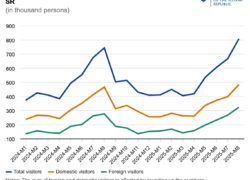
Slovakia’s accommodation sector reached a new milestone in August, as the number of guests staying in hotels, guesthouses, and other facilities exceeded 800,000 for the first time. The growth was driven by a strong recovery in foreign tourism, which returned to levels last seen before the pandemic.

According to data from the Statistical Office of the Slovak Republic, 808,000 visitors stayed in accommodation establishments during August — a 9% increase compared with the same month in 2024. The number of overnight stays surpassed 2.2 million, up 6.6% year-on-year, with an average stay length of 2.8 nights.

Domestic tourists continued to form the majority of visitors, accounting for roughly two-thirds of all guests, or 484,000 people, a 4% increase from the previous year. While domestic tourism remains strong, its peak was recorded during 2020–2021, when travel restrictions encouraged residents to holiday within the country.

The strongest recovery came from foreign visitors, whose numbers rose by 17% year-on-year to nearly 324,000 — just 0.5% below the pre-Covid record. This marked the closest foreign tourism has come to full recovery since 2019, highlighting renewed international interest in Slovakia as a summer destination.

Regional data show that all eight Slovak regions recorded growth in visitor numbers compared with the previous year. Žilinský Region led the way with a 12.3% increase, hosting nearly 200,000 guests for the first time. Bratislavský and Prešovský Regions also exceeded 150,000 visitors, with the three regions together accounting for 63% of national tourism.

Five regions — Žilinský, Prešovský, Banskobystrický, Košický, and Trnavský — achieved their highest-ever August visitor counts. Meanwhile, Bratislavský, Nitriansky, and Trenčiansky Regions remained slightly below their pre-pandemic highs.

Between January and August 2025, accommodation providers across Slovakia hosted 4.3 million guests, up 6% year-on-year. Foreign arrivals increased more sharply than domestic ones, while total overnight stays grew by 5%.

Compared with the record year of 2019, Slovakia’s accommodation sector remains only 1.4% below peak levels, or about 59,000 guests short, suggesting that full recovery may be within reach by the end of the year.

The Statistical Office noted that its tourism figures are based on reports from all registered accommodation establishments in Slovakia, including hotels, guesthouses, and campsites providing temporary lodging to visitors.

Source:SOSR

Mapletree Seals Major Logistics Lease in Central Poland

Singapore-based real estate investor Mapletree has finalised a large warehouse lease agreement with Polish furniture retailer Agata S.A., marking what industry observers describe as one of the most significant logistics deals in Poland this year.

The agreement covers both the renewal of existing leases and the construction of a new logistics building in Piotrków Trybunalski, a key transport hub in central Poland. Once complete, the total leased space will reach around 128,000 square metres. The new facility, tailored to the tenant’s operational needs, will be built alongside two existing distribution centres already occupied by Agata.

Piotrków Trybunalski’s location has long made it a strategic choice for logistics companies. Situated near the intersection of the A1 motorway and the S8 expressway, it offers direct road access to major cities such as Łódź, Warsaw, and Katowice. The town has become a cluster for modern warehousing and e-commerce distribution, attracting both local and international developers.

The new building will feature environmentally efficient design standards, including provisions for water recycling and solar energy systems, reflecting the broader shift toward sustainability in the logistics real estate sector. Construction is expected to begin soon, with completion scheduled for the coming year.

Industry analysts note that the deal demonstrates continued confidence in the Polish logistics market, even as development activity slows under higher financing costs. Retailers and logistics operators are still expanding their networks to meet rising consumer demand and the shift toward faster, more flexible distribution.

Mapletree has been active in Central Europe since 2018 and has steadily grown its portfolio in Poland. Its properties are concentrated along key transport corridors, supporting both domestic and regional supply chains. The company’s long-term focus on energy-efficient logistics parks aligns with growing investor and tenant interest in sustainable real estate.

While large lease agreements have become less frequent in 2025, this transaction underscores the resilience of Poland’s industrial property sector. Demand from retail, manufacturing, and e-commerce tenants continues to underpin stable occupancy levels across the country’s logistics hubs.

For Agata S.A., one of Poland’s leading furniture chains, the expanded space strengthens its national distribution network and supports its ongoing retail growth. For Mapletree, the deal consolidates its position among the top international logistics investors in the Polish market.

The project in Piotrków Trybunalski is another sign that, despite slower construction activity across Europe, Poland remains a key destination for strategic industrial investment.

Czech Post Reviews Offers for Historic Jindřišská Building in Prague

Czech Post has received several purchase proposals for its central Prague property at the corner of Jindřišská Street and Politických vězňů. The building, one of the postal service’s best-known assets, remains in state ownership as management continues to evaluate the bids.

According to the postal operator, the expected sale price is based on expert valuations, estimated at roughly CZK 1.4 billion. While some of the offers submitted have reportedly not met the company’s internal criteria, discussions are ongoing. Real estate advisory firm Knight Frank has been overseeing the process since last year.

Czech Post has described the property as no longer necessary for its operations and said any sale would be conducted transparently and at fair market value. Proceeds would be directed toward the company’s investment and modernisation plans. The supervisory board, which reports to the Ministry of the Interior, has been briefed on each stage of the tender.

General Director Miroslav Štěpán said the company would only proceed with the sale if the final price matched the appraised value and could be justified under its stewardship obligations. He added that there was no fixed deadline for completing the process and confirmed that Czech Post remains the current owner.

The post office reported a loss of about CZK 1.25 billion last year, an increase compared with the previous period. The company has been seeking to improve efficiency and offset costs by selling non-core properties across the country.

The Jindřišská building, a protected structure in the centre of Prague, has long been viewed as a valuable but under-used asset. Previous attempts to attract a buyer have proven difficult due to the building’s size, historical status, and maintenance demands.

The eventual sale of the property will depend on the approval of both management and the supervisory board. Until then, the landmark remains part of Czech Post’s portfolio, representing one of the most significant real estate assets still held by the state-owned enterprise.

Source: CTK

UAE Introduces Sweeping Banking Reforms to Regulate the Digital Financial Era

The United Arab Emirates has enacted a far-reaching reform of its financial regulation, granting its Central Bank new powers to supervise a broader range of companies involved in digital and technology-driven finance. The new law, which came into effect in September 2025, replaces the 2018 framework and represents a major shift in how the country oversees its rapidly modernising financial system.

The legislation significantly expands the Central Bank’s authority to include technology providers and platforms that support financial transactions, even when those companies do not issue traditional banking products themselves. This change means that businesses offering infrastructure or services that facilitate payments, digital tokens, or open-finance solutions will now fall under direct regulatory supervision.

The updated rules also introduce much higher financial penalties for violations. The maximum fine has been lifted from the hundreds of millions to the billion-dirham range, underscoring the government’s intent to strengthen compliance and deter unlicensed activity. Companies that continue to operate without proper authorisation may face severe financial and even criminal consequences.

Another notable aspect of the reform is its attention to governance and sustainability. The Central Bank now has an explicit mandate to promote responsible finance and environmental goals in its activities. At the same time, oversight of Islamic finance has been reinforced, with national religious rulings now binding on all local Shari’ah supervisory committees.

In keeping with the UAE’s growing ambitions in digital innovation, the law also gives the Central Bank formal authority to issue a digital form of the national currency, often referred to as the Digital Dirham. This provision creates a legal foundation for the potential introduction of a central-bank-backed digital currency in the future.

A new appeal body has been established to review disputes arising from regulatory actions, ensuring that businesses have a clear channel to challenge decisions and maintain confidence in the fairness of the system.

Market participants have been granted a one-year transition period to align their operations with the new requirements. During this time, the Central Bank is expected to release further guidance clarifying which activities require a licence and what exemptions may apply.

For the country’s expanding financial technology sector, the reform marks a decisive turning point. Companies that once operated in regulatory grey zones will now have to assess their position within the newly defined framework. The move is widely viewed as part of the UAE’s strategy to position itself as a global financial centre that embraces innovation while maintaining robust oversight.

By tightening its laws and adapting them to digital realities, the UAE has placed itself among the leading jurisdictions seeking to balance financial progress with stability and trust — a signal that the era of unregulated digital finance in the Gulf is drawing to a close.

Europe’s Cleantech Manufacturing Push Faces Uneven Progress, OECD Warns

Europe’s transition to a low-carbon economy hinges on its ability to integrate small and medium-sized enterprises (SMEs) into the fast-growing cleantech manufacturing sector, according to a new study released by the Organisation for Economic Co-operation and Development (OECD). The report, “The Evolution of Cleantech Manufacturing: Implications for FDI and SME Linkages Across Europe,” highlights that while foreign direct investment (FDI) in green industries has accelerated, the benefits remain concentrated in a limited number of countries and industrial clusters.

The OECD’s findings show that global investment in clean technology manufacturing expanded more than tenfold between 2016 and 2023, rising from around USD 13 billion to USD 134 billion. Much of this growth has been driven by the rapid build-out of battery production facilities, with major gigafactories emerging across Europe, Asia and North America. Europe continues to lead in wind-energy technology, attracting roughly one-quarter of global investment in the sector, yet it remains heavily dependent on imports in other areas. More than 90 percent of solar panels installed within the European Union are still sourced from Asia, particularly China, according to analyses by both the European Commission and the think tank Bruegel.

Although SMEs represent about 95 percent of companies involved in cleantech-related industries, their role in exports and high-value manufacturing remains limited. The OECD notes that smaller firms tend to occupy early stages of production—such as materials, components and recycling—rather than the final assembly of complete systems. Without stronger access to financing, skilled labour and international partnerships, many could remain on the margins of Europe’s industrial transformation. The World Bank’s research on Central and Eastern Europe supports this view, estimating that SME participation in green exports could triple if governments strengthen investment incentives and reduce administrative barriers.

The OECD report underlines the need for better coordination between national investment strategies and EU-level industrial policy. Initiatives such as the Net-Zero Industry Act and Critical Raw Materials Act are already aimed at fostering manufacturing capacity and reducing dependence on imports, yet implementation across member states has been uneven. The European Central Bank has similarly warned that Europe’s green transition will require unprecedented levels of financing, urging policymakers to close the investment gap through public support and private-sector mobilisation. The ECB’s latest economic bulletin cites skills shortages, regulatory complexity and lengthy permitting procedures as major obstacles to scaling up green manufacturing.

Bruegel analysts have echoed these concerns, arguing that Europe’s industrial policy must strike a balance between environmental ambition and global competitiveness. Without a more predictable and coordinated regulatory framework, investors could continue favouring countries with clearer approval procedures and faster project delivery.

Looking ahead, the OECD study presents several possible trajectories for the evolution of cleantech value chains depending on global cooperation and sustainability efforts. In its more optimistic outlook, Europe could develop robust, interconnected regional ecosystems that link international investors with local innovators. In a less favourable scenario, persistent import dependence and fragmented policymaking could widen disparities between advanced and lagging regions.

The coming years will be decisive for Europe’s industrial transformation. As EU recovery and climate funds continue to be channelled into manufacturing and technology upgrades, policymakers face the challenge of ensuring that new investment supports both decarbonisation goals and balanced regional growth. As one OECD policy expert observed, “The direction of investment is clear. What matters now is whether Europe’s smaller firms and regions can capture a fair share of this momentum.”

Most Poles Still Confuse Credit Scoring with Income Assessment, Survey Shows

A new consumer study has found that 77% of Poles are unfamiliar with the concept of “credit scoring,” often confusing it with an assessment of income levels needed to obtain a loan. In response, the Credit Information Bureau (BIK) has sought to clarify how its scoring system works and to dispel common misconceptions about the effect of multiple loan applications on a person’s credit standing.

According to BIK, consumers comparing loan offers within a 14-day period can do so without lowering their credit score. Applications for the same type of loan made during those two weeks are treated as a single inquiry. The bureau notes that in almost all cases, loans are approved within two weeks of the first application, so typical comparison shopping has no negative effect on an applicant’s scoring.

BIK underlines that the main purpose of assessing creditworthiness is to prevent excessive borrowing and protect consumers from insolvency. While the final decision on granting a loan rests with banks and other lenders, the data gathered by BIK enables these institutions to make informed evaluations of a borrower’s overall financial behaviour. Since its establishment in 1997, BIK has served as Poland’s central credit register, collecting information from banks, credit unions, and lending firms to support responsible lending practices and encourage financial awareness among consumers.

Many people in Poland continue to conflate creditworthiness with credit scoring. Creditworthiness is an institution’s assessment of whether a borrower is able to repay a loan, taking into account income stability, living costs, and existing debt. This analysis is based on information provided by the client, as well as data obtained from financial records and external databases, including BIK.

BIK scoring, on the other hand, is a statistical indicator of a person’s likelihood to repay obligations, expressed on a scale from 0 to 100 points. The score is shaped by several key factors: how promptly a person repays debts, how they use credit products such as cards or instalment loans, their overall level of debt, and how often they apply for new credit. A higher score reflects a stronger repayment history and responsible borrowing habits.

Despite the growing importance of credit data in everyday financial decisions, BIK reports that public awareness remains limited. Few consumers regularly monitor their own scoring, even though it is easy to check through the BIK website. The online Credit Analyzer simulates how banks assess creditworthiness and helps users understand how taking out new loans may affect their financial stability.

BIK stresses that regular monitoring of one’s own credit data can help prevent over-borrowing and avoid the so-called “debt spiral.” People who frequently submit loan applications are statistically more likely to face repayment difficulties, which may in turn lower their credibility in the eyes of lenders.

Although various factors influence the final credit assessment, BIK reminds consumers that the most important one remains the timely repayment of obligations. Maintaining discipline in this area helps borrowers preserve a positive financial reputation and increases their access to credit in the future.

Source: BIK

EU Air Traffic Nears Pre-Pandemic Levels as Summer Travel Demand Remains Strong

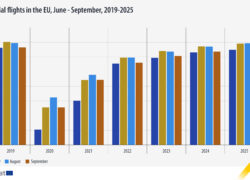
The number of commercial flights in the European Union rose again in September, edging closer to pre-pandemic volumes as travel demand remained resilient across the continent. According to the latest flight data released by Eurostat, airlines operated just under 653,100 commercial services during the month — slightly more than in the same period last year but still marginally below 2019 levels.

Flight activity was 2.6% higher than in September 2024, marking another step in the aviation sector’s recovery. Compared with the same month in 2019, the figure was 1.8% lower, continuing the gradual narrowing of the gap that has persisted through the summer.

From June to August, traffic also showed consistent year-on-year growth of around 3%, with August seeing flight numbers come within a fraction of their 2019 benchmark. The pattern suggests that, while the recovery has largely stabilised, overall flight volumes have yet to fully match those of the final summer before the COVID-19 pandemic.

Twelve EU countries have now surpassed their pre-pandemic flight activity. Cyprus, Poland, and Greece recorded the strongest gains, with each exceeding 2019 figures by more than 20%. The increase reflects robust tourism and expanding regional air networks in southern and eastern Europe.

At the same time, several northern countries continue to trail earlier levels. Latvia, Sweden, and Finland reported flight totals still between 24% and 30% below 2019, underscoring uneven recovery across the continent. Analysts attribute the gap partly to slower rebounds in business travel and changes in route structures following airline network adjustments.

Across the EU, the aviation sector has now reached roughly 98% of its 2019 traffic level, confirming that most of Europe’s skies have returned to near-normal density. Industry observers note that growth is expected to remain moderate into the winter months, with airlines focusing on cost management and route efficiency as demand steadies after the summer peak.

Eurostat’s data form part of ongoing monitoring of the European air transport market, offering insight into how passenger demand, economic trends, and airline capacity continue to shape post-pandemic recovery patterns.

Source: Eurostat

3.9 Million People in Poland Hold Disability Certificates, Statistics Poland Report

As of the end of 2024, nearly 3.9 million people in Poland had a legally recognised disability, representing 10.5% of the country’s total population, according to new data from Statistics Poland. The figures are based on valid certificates of disability or incapacity to work issued by authorised medical committees and institutions.

Most persons with recognised disabilities—about 3 million—held certificates issued by medical examination committees, while 1.68 million held certificates from the Social Insurance Institution (ZUS). A smaller share had documents issued before 1998 by the Agricultural Social Insurance Institution (KRUS) or the Ministries of Defence and Internal Affairs.

Women accounted for 53.3% of all people with certified disabilities, and the largest age group was between 70 and 74 years, numbering more than 550,000.

In terms of severity, 41.1% of certificates confirmed a moderate level of disability, 29.9% a severe level, and 24% a mild level. About 5.8% of certificates were issued for children under 16 years old without a specified category.

Regional data show that the highest number of people with disabilities lived in Śląskie Voivodeship (448,000), while the lowest number was recorded in Opolskie (85,600). The highest rate of disability per 1,000 residents was in Lubuskie Voivodeship (160.7), with the lowest in Mazowieckie (74.0).

Motor impairment remained the most common cause of disability, affecting about 1.38 million individuals, followed by cardiovascular and musculoskeletal conditions. The smallest group—around 68,000 people—were certified due to epilepsy.

More than 793,000 people with valid disability certificates also held parking cards, most commonly in Lubuskie, where the rate reached 33.4 per 1,000 residents.

The report notes that 24,800 outpatient clinics and medical practices, representing 91% of all facilities, were adapted to the needs of people with disabilities. Among cultural institutions, 55% had at least one adaptation, with cinemas showing the highest level of accessibility.

In transport, 97.6% of buses and 57.5% of trams were equipped for passengers with disabilities.

Education data reveal that during the 2024/25 school year, 279,900 children and young people with special educational needs attended schools—5.3% of all students. At the university level, 23,500 students with disabilities were enrolled, accounting for 1.9% of the total student population.

Statistics Poland said the figures were compiled from multiple national databases, including medical examination committees, ZUS, KRUS, and the Ministries of Defence, Interior, and Education. The data provide an updated view of disability in Poland, reflecting both demographic trends and ongoing efforts to improve accessibility and inclusion across sectors.

Source: GUS

LATEST NEWS