Bridging the digital gap between construction and agriculture

A decade ago, agriculture was seen as one of the least digitised sectors. Today, it is among the most successful in combining traditional practices with advanced technology, using data-driven systems to improve productivity and sustainability. Construction, in contrast, has yet to achieve similar results in digitising core processes, despite investing heavily in modern machinery. While the industry adopts advanced equipment, many companies still rely on spreadsheets and paper drawings for project data.

According to Adam Heres Vostarek, Regional Manager at PlanRadar, artificial intelligence could act as a catalyst for change in construction, as it has in agriculture. Forecasts suggest the global AI market in construction could grow from USD 4.96 billion in 2025 to USD 14.72 billion by 2030. PlanRadar’s analysis shows that 97% of construction professionals expect to increase digitalisation investments, but progress is hindered by the absence of consistent, high-quality, and integrated data.

Agriculture addressed similar issues by first defining data standards, integrating sources, and ensuring consistency before deploying AI to identify patterns, make predictions, reduce costs, and improve efficiency. The example of European agricultural equipment manufacturer Agrifac illustrates this approach: its NEED Farming technology combines GPS, crop sensors, and environmental data to precisely manage water, fertiliser, and pesticide use, leading to higher yields and reduced chemical inputs. In the Czech Republic, more than 15% of arable land is now managed using such technologies.

In construction, however, adoption remains limited. Only 27% of workers report using AI, often infrequently, and 60% are unaware of any AI initiatives within their company. This indicates a lack of basic digital processes and infrastructure needed for effective AI use. Establishing systematic data capture, standardising procedures, centralising project information in cloud-based platforms, and providing regular training on digital tools are considered essential steps.

With a strong data foundation, AI could improve all stages of the building lifecycle. Generative AI could produce multiple design options in minutes, while predictive models could help manage schedules, anticipate cost overruns, enhance site safety, and reduce operational energy use.

Vostarek emphasises that agriculture’s transformation demonstrates the value of consistent data collection as a starting point. In construction, companies that move early to invest in data and digital skills may gain a competitive advantage, while slower adopters risk falling behind. He argues that the industry is already entering a digital transformation phase, and leadership will depend on those willing to change established practices and develop the necessary digital infrastructure.

Source: PlanRadar

Measures to help cities Cope with upcoming heatwave

Meteorologists expect high temperatures across the Czech Republic at the end of this week and into next week. In densely built urban areas, the combination of heat-retaining surfaces and limited greenery can create heat islands, where temperatures remain high even at night. According to Gregor Grassl, Associate Partner and Head of Green Urban Development at Drees & Sommer, strategies such as external shading, green facades and roofs, and thermally efficient building materials can help maintain indoor comfort.

Well-planned measures, Grassl notes, can reduce heat stress, improve air quality, enhance biodiversity, and make cities more resilient to climate change. Drees & Sommer has supported several German cities, including Düren, Dormagen, and Rastatt, in implementing such solutions.

Increasing urban shade through tree planting, adding green facades, and replacing impermeable surfaces with breathable materials can improve microclimates. In Dormagen, drinking fountains have been installed in public areas to promote hydration and reduce heat-related health risks. Light-colored, reflective materials can lower surface temperatures, particularly on roofs and paved areas.

Grassl cautions that reliance on air conditioning can worsen outdoor heat. Instead, low-energy cooling strategies—such as night ventilation with stored thermal mass, underfloor cooling, and seasonal thermal storage—can reduce the need for mechanical systems. At the district scale, shared low-energy networks can alternate between heating in winter and cooling in summer.

Urban design also plays a role: higher buildings can shade each other and promote air circulation if window areas are kept to a manageable proportion.

Across Europe, adaptation measures are becoming more common. Examples include Paris’s “Schoolyard Oasis” project, Vienna’s temporary “cool streets,” and Rotterdam’s Benthemplein water square, which combines water management with cooling features.

Source: Drees & Sommer

B&B HOTELS to open in Unterschleissheim as part of expansion strategy

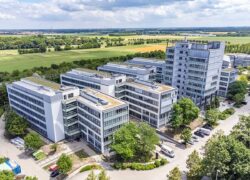
B&B HOTELS has signed a 20-year lease with Union Investment to open a new hotel in Unterschleissheim, north of Munich. The project involves converting around 3,400 sq m of vacant office space in the Lohhof district into 93 hotel rooms. The location is 20 kilometers from Munich Airport and has direct S-Bahn access to the airport and city center.

The site, formerly occupied by Deutsche Pfandbriefbank until 2019, is owned by Union Investment’s open-ended real estate fund UniImmo: Europa, which is investing approximately €9.6 million in the redevelopment. The hotel will fill a gap in the local market, as there is currently no comparable business hotel in the area. The opening is scheduled for the third quarter of 2027.

Local authorities support the development, which is expected to benefit nearby office tenants, including Sauter-Cumulus GmbH and TenneT TSO GmbH. Union Investment is also in negotiations for leasing an additional 3,000 sq m of office space. Plans to attract a fitness center, restaurants, and retail are part of a broader strategy to diversify the previously office-only location.

The hotel will share a development core with the adjacent office building, enabling the reuse of existing building systems to reduce costs and environmental impact. Facilities will include 50 underground parking spaces, with 10 equipped for electric vehicle charging.

Union Investment considered other uses for the vacant space, including light industrial, serviced apartments, and residential, before selecting a hotel as the most suitable option for the location. Alexander Zahrt of Deal Manufaktur GmbH brokered the lease agreement.

Silverton leases office space to Corall Ingenieure in Meerbusch

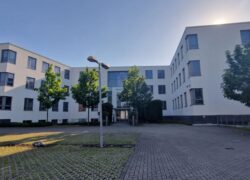
The Silverton Group has leased approximately 950 sq m of office space at Otto-Hahn-Strasse 10 in Meerbusch, near Düsseldorf, to Corall Ingenieure GmbH under a long-term agreement. The engineering company, which specialises in preventive fire protection, plans to relocate its headquarters to the site at the beginning of 2026. The lease increases the building’s occupancy from 51% to more than 80%.

The property, which has a total rental area of around 3,100 sq m, is part of the Elephant portfolio. Silverton acquired the asset in 2019 as a local partner alongside EPISO 5, a fund managed by Tristan Capital Partners, and continues to act as asset manager. The building holds a “BREEAM Good” sustainability certification. Existing tenants include GEL Express Logistik and Lehmann Natur.

Completed in 2006 on a plot of roughly 4,000 sq m, the three-storey building provides 64 outdoor parking spaces and 19 underground spaces, including electric vehicle charging points. The site has direct access to the A44 motorway and is within walking distance of local public transport links.

Aruna Immobilien of Meerbusch assisted Silverton in the letting process. Legal advice was provided to the landlords by Dentons Europe (Germany) and to the tenants by Antweiler Liebschwager Nieberding Rechtsanwälte PartG mbB. Technical advice for Corall Ingenieure was provided by apoprojekt GmbH, Düsseldorf, which will also manage the tenant fit-out.

Office suites ranging from 400 to 950 sq m remain available on the building’s second floor.

German real estate industry assesses federal government’s first 100 days

Representatives from the German real estate sector have shared their views on the federal government’s performance in its first 100 days, highlighting both positive developments and ongoing challenges.

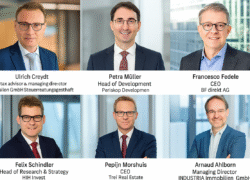
Ulrich Creydt, tax advisor and managing director of Ypsilon GmbH Steuerberatungsgesellschaft:
“In my opinion as a tax advisor, the federal government has achieved some good things in its first 100 days. However, I am missing the bigger picture, which would enable more people to become homeowners, boost the economy and simplify tax law.

The gradual reduction in the corporation tax rate is the right move, especially in an international comparison. However, it would have been desirable to make the first step of the reduction retroactive to 1 January 2025. This would mean that the corporation tax rate would already be 14 per cent for the current year. As it stands, the first reduction will not come until the beginning of 2028.

I believe that a “construction boom” would be triggered if all first-time buyers who use their own four walls did not have to pay land transfer tax. Existing measures in individual federal states, such as the “Hessengeld”, do not achieve much and are complicated to apply for. The most important reason why many households cannot afford to buy their own home is the high proportion of own funds required. The property transfer tax is the biggest chunk of this. A tax waiver for this group of buyers would ease the strain on their wallets and help them build up their private assets.

If a tax expert from our company were Chancellor, he would radically simplify tax collection: fewer declaration requirements and the immediate abolition of the solidarity surcharge and trade tax. These should be replaced by a system of income and corporation tax for local authorities. This would also end competition between municipalities to offer the lowest possible trade tax rates and contribute to fair tax revenue for all local authorities.

I give the German government’s foreign policy a “thumbs up” – especially in Europe. European investors are increasingly interested in investing more in Germany again.”

Francesco Fedele, CEO, BF.direkt AG:
I see both positive and negative aspects for the real estate industry. It started with big promises for more economic growth. Some approaches are promising, such as tax relief for companies, which should help to stimulate the economy, among other things. Many companies also want to invest billions of euros in Germany, if their promises following a meeting with Chancellor Friedrich Merz in mid-July are to be believed. The planned spending on defence and infrastructure will also likely support the economy.

However, the associated increase in government debt financed by borrowing could cause inflation to rise. Higher US tariffs could have the same effect on EU countries. This would dampen consumer sentiment and could also lead to higher interest rates on real estate loans. The European Central Bank (ECB) seems to recognise the danger and, after several interest rate cuts, decided not to adjust interest rates at the end of July.

The German government cannot do much about the global political challenges. It can only try to respond appropriately.

In stark contrast to housing policy, where it has greater scope for action, but I see contradictory signals. On the one hand, the streamlining of building regulations is intended to help speed up the granting of building permits.

I doubt that this “approval turbo”, if it takes off, will trigger a “construction turbo”. This is because many factors that inhibit commercial and private housing construction continue to exist, including high land, material and labour costs. For private builders, there is also the land transfer tax.

Anyone wishing to build and rent out a flat could be deterred by the extension of the rent cap. Plans to tighten index-linked rent clauses and the letting of furnished flats are doing the rest. The government’s announcement that it will cut funding for energy-efficient renovations by a fifth is also contributing to further uncertainty. The real estate market needs reliability and predictability.”

Prof. Dr Felix Schindler, Head of Research & Strategy, HIH Invest Real Estate:
The mood in the German economy has brightened in the first 100 days of the new federal government. However, there is still a lack of concrete measures to strengthen Germany as a business location and – with regard to the real estate markets – to create more living space and to make construction processes and projects more flexible, less bureaucratic, more digitalised and faster (the so-called “construction turbo”). The amendment to the Building Code already initiated by the previous government is intended to significantly reduce bureaucratic hurdles and speed up planning processes. The law is scheduled to be passed in autumn.

The most far-reaching economic policy decision was taken by the last Bundestag before the formation and appointment of the current federal government: the conditions for the establishment of a special fund for infrastructure and climate neutrality amounting to 500 billion euros. It is now up to the federal government to use the framework conditions and financial leeway created for structural reforms and sustainable growth.

We can only hope that the federal government will follow up its announcements on strengthening Germany as a business location and the plans of the Federal Ministry of Housing, Urban Development and Construction with concrete action. It is important to provide the right impetus so that private capital from Germany and abroad is once again invested in Germany and the course is set for higher long-term growth and thus greater prosperity in Germany.”

Pepijn Morshuis, CEO of Trei Real Estate:
The black-red coalition has sent important signals on the issue of housing construction – in particular with the draft law on accelerating housing construction. Shortened approval processes and the facilitation of redensification can actually accelerate new housing construction.

We also welcome the fact that Federal Building Minister Verena Hubertz explicitly sees redensification and the conversion of existing commercial space – such as supermarket roofs – as part of the solution. This is exactly where we come in at Trei Real Estate: we are currently planning and developing projects in Berlin, Wiesbaden, Hamburg, Munich and Düsseldorf on former commercial sites – some with, some without commercial ground floor uses (e.g. local amenities or restaurants), depending on the specific location conditions.

But while the federal government is pushing ahead with construction, it is putting the brakes on in other areas: not only has it extended the rent cap, it has also announced further tightening of tenancy law, including stricter regulation of index-linked rents. This threatens to make new housing construction even less attractive for private investors.

My conclusion after 100 days: the federal government has recognised the urgency of the situation – now it must show that good intentions can be turned into practical solutions. The measures adopted so far are not enough to increase the supply of housing. If you want to create housing, you don’t need symbolic politics, but reliable framework conditions that make building possible and worthwhile again.”

Arnaud Ahlborn, Managing Director of INDUSTRIA Immobilien GmbH:
The new federal government has set the course for its housing policy – some of it in the right direction, some of it with problematic side effects. Above all, the “construction turbo” sends an important signal to the industry. Faster approval procedures, the simplification of building regulations and better coordination between the federal, state and local governments are urgently needed to get new housing construction back on track. The announcements give cause for cautious optimism – the decisive factor will be how quickly and consistently these measures are implemented. Reducing bureaucracy must not remain lip service, but must be reflected in accelerated project implementation.”

Thomas Wirtz, Managing Director of INDUSTRIA Immobilien GmbH:
“We take a critical view of the extension of the rent cap in the new federal government’s 100-day review. Although this instrument provides short-term relief for individual tenant households, it inhibits investment in urgently needed new construction and reduces the attractiveness of the residential property market for institutional investors. Instead of treating the symptoms, we need structural responses to the housing shortage – for example, through more supply and targeted incentives for new construction.

The announced cuts in subsidies for energy-efficient renovation are also worrying. Given the ambitious climate targets in the building sector and the massive rise in construction costs, this decision is a step backwards. Energy-efficient renovation of existing buildings is a key element of the housing industry – also in terms of social compatibility.”


PORR to modernise two key railway lines in Poland

PORR has secured contracts from PKP Polskie Linie Kolejowe S.A. for the modernisation of two major railway lines in south-eastern Poland: line 108 between Jasło and Nowy Zagórz, and line 104 between Rabka Zaryte and Fornale. The combined contract value exceeds EUR 372 million (around PLN 1.6 billion).

For line 108, PORR will be responsible for both design and construction works along an 80 km section. The project will include modernisation of 18 stations and stops, construction of six new stops, renewal of 78 points and 80 level crossings, and installation of barrier-free infrastructure. The work also involves a 1,650-metre tunnel in Krosno, three additional railway tunnels, and three road viaducts. The contract is valued at EUR 240 million (PLN 1.4 billion) and is scheduled for completion in late 2028 after a 44-month construction period.

On line 104, PORR will work in partnership with Trakcja System Sp. z o.o. to modernise a 15 km section between Rabka Zaryte and Fornale. The project aims to increase maximum train speeds to 120 km/h, electrify the route, and improve regional and cross-border connectivity between Poland and Slovakia. It will include new platforms at Raba Niżna, Mszana Dolna Marki, and Mszana Dolna station. The scope covers 66 engineering structures, including nine railway bridges, four road bridges, five viaducts, and an underpass, along with modernisation or replacement of level crossings. The value of the contract is EUR 132 million (PLN 567 million), with PORR holding a 90.5% share. Work is expected to conclude in the third quarter of 2027 following a 24-month schedule.

Both projects are intended to improve transport infrastructure, reduce travel times, and strengthen links within Poland and with neighbouring countries.

Brama Jury nears completion in Zawiercie

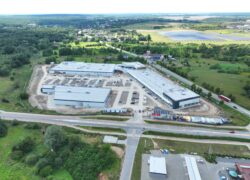
Master Management Group is completing the commercialisation of the Brama Jury shopping centre in Zawiercie, with the first tenants taking possession of their premises to begin interior fit-outs. The opening is planned for the fourth quarter of this year.

The development combines elements of a retail park and a shopping mall. Among the newly confirmed tenants are the One Gym fitness club, occupying nearly 1,500 sq m, and an Agata furniture store with approximately 350 sq m of space.

Brama Jury will host a mix of retail, service, dining, and leisure tenants. Clothing and fashion brands will include H&M, Sinsay, New Yorker, Diverse, Big Star, Ochnik, Sizeer, and 4F. Beauty and personal care stores will be represented by Douglas, Rossmann, and Hebe, while jewellery will be available at Apart and Briju. Empik and Maxi Zoo will also be part of the offer.

The services segment will feature Laguna Travel and Travel Air travel agencies, telecom operators Orange, Plus, and T-Mobile, as well as Teletorium and a currency exchange. Dining options will include cafés and restaurants, and entertainment facilities will feature a four-screen Planet Cinema, the only one of its kind in the region.

The centre is located in the western part of Zawiercie, in the Kraków-Częstochowa Upland, a few minutes from the city centre. It has access to national roads and the A1 motorway, enabling convenient travel from surrounding towns. The site will provide 525 parking spaces for visitors.

Cordia launches residential project on Costa del Sol

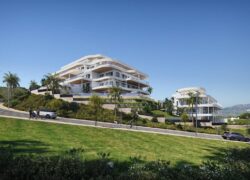
Cordia has begun the first phase of “360° by Cordia,” a multi-phase residential development in Costa del Sol, Spain, which will eventually comprise more than 500 apartments. The project is located near Marbella, about five minutes from the sea, and is designed to incorporate sustainable construction and a variety of residential and community facilities.

Situated on a hillside in the Cerrado del Águila area, the development offers views of the Mediterranean Sea and surrounding mountains. When complete, the project will include over 500 homes; the initial phase consists of 71 apartments across six low-rise buildings, offering one- to three-bedroom units and four-bedroom penthouses. Ground-floor units will have private gardens, and all apartments will feature large terraces and floor-to-ceiling windows.

The site is positioned within five minutes of Mijas Costa’s beaches, seven minutes from Fuengirola, and around 20 minutes from both Marbella city centre and Málaga International Airport. It is also accessible to main transport routes along the Costa del Sol.

Planned amenities include outdoor pools, an indoor spa with heated pool and sauna, a gym with yoga space, co-working areas, a gastrobar, gaming lounge, and children’s play zones. The location provides access to a golf course, tennis and padel courts, and nature trails. Future plans for the nearby Grand Green Park of Mijas are expected to add further recreational space.

Designed by HCP Arquitectos, the buildings will follow BREEAM sustainability standards and hold an A-rated energy certificate. Apartments will include smart home systems, electric vehicle charging points will be available, and the site will have 24-hour security.

Cordia is part of the Futureal Group and operates in Hungary, Poland, Romania, Spain, and the UK. The company has been active in residential real estate development for 20 years and holds several industry awards.

DC BLOX secures $1.15 billion green loan for Atlanta data center campus

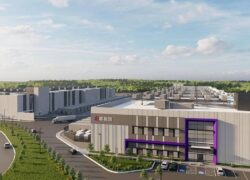
DC BLOX has secured $1.15 billion in green loan financing to develop a data center campus in Douglas County, Georgia. The project will initially deliver 120 MW of capacity, with plans for an additional 80 MW available by 2027. The facility is intended to support demand from cloud computing and AI workloads.

The financing will also enable expansion of DC BLOX’s data center network in the Atlanta metropolitan area, complementing existing hyperscale-ready capacity in Conyers and Douglasville. The company has recently undertaken several projects in the Southeast, including multiple hyperscale edge nodes.

This transaction follows a $265 million green loan completed earlier in 2025 and growth equity committed by Post Road Group in late 2024.

The lending group for the new financing was led by ING Capital LLC as Structuring and Administrative Agent. ING, Mizuho Bank, Ltd, and Natixis Corporate & Investment Banking served as Initial Coordinating Lead Arrangers and Joint Bookrunners, with First Citizens Bank as Coordinating Lead Arranger. CoBank ACB, LBBW New York Branch, The Toronto-Dominion Bank New York Branch, and KeyBank National Association acted as Joint Lead Arrangers, while The Huntington National Bank was Mandated Lead Arranger. ING and Natixis CIB also acted as Joint Green Loan Coordinators. A&O Shearman advised DC BLOX, and Milbank represented the lenders.

Poland’s future inflation index falls for fourth consecutive month

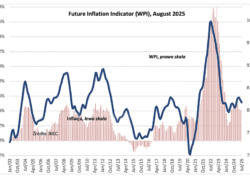
The Future Inflation Index (WPI), which anticipates changes in consumer prices several months ahead, declined by 0.4 points in August 2025 from the previous month. This marks the fourth monthly drop in a row, with the decrease similar in scale to recent declines. Short-term global and domestic factors are currently slowing the pace of price growth and the main measure of inflation, the Consumer Price Index (CPI). However, longer-term risks remain.

External risks include ongoing armed conflicts worldwide and the unstable trade policy of the US administration, both of which influence global commodity prices. Domestically, challenges include rapidly rising public debt, the absence of a consistent energy policy, wage growth significantly outpacing inflation, and sharp increases in food and service prices.

The largest downward pressure on the index comes from declining inflation expectations among consumers and manufacturing sector representatives. In July, the share of consumers expecting prices to rise at least as fast as before fell by 2 percentage points from the previous month and by 5 points year-on-year. The group anticipating faster price growth has halved over the past year, from 22% to 11%.

In manufacturing, the share of companies expecting price increases over those planning reductions has dropped from 13.3% in January to 2.6% in July. This trend varies by industry, with the energy sector seeing notable price decreases and the food processing sector still expecting increases. In the services sector, companies planning price hikes continue to dominate, particularly in tourism, hotels and catering, insurance, real estate, and financial services, where the share ranges from 12% to nearly 18%.

On global markets, raw material prices have been declining since the start of the year, though recent days have brought higher oil, gas, and some metal prices. The appreciation of the Polish zloty against the US dollar has partly offset the impact of more expensive imports for domestic producers.

Industrial capacity utilisation in Poland stood at about 77% in July, unchanged from April, a level consistent with moderate economic growth. Historically, utilisation ranges from around 70% in downturns to 83% in peak periods. However, underinvestment in the private sector could lead to higher machinery failure rates and increased repair costs in the future.

Source: BIEC

LATEST NEWS