Monday, 21 September 2026
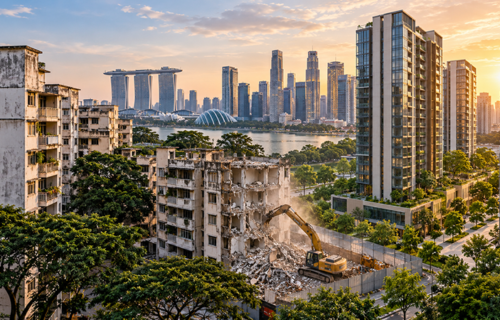
Singapore is preparing for a period in which the future of older buildings will become an increasingly important part of the property market. Changes to collective-sale legislation approved in 2026 will make it easier for owners of ageing developments to agree to sell their properties for redevelopment, just as a growing number of residential and commercial buildings approach an age where major investment or replacement may become necessary.
The biggest change concerns developments that have been standing for at least four decades. Properties aged between 40 and 59 years will require 70% owner support for a collective sale, while the threshold for developments aged 60 years or more falls to 65%. The requirement remains at 80% for buildings aged between 10 and 39 years and 90% for those less than a decade old. Around 20,000 private non-landed homes in almost 250 developments have already reached the 40-year mark, creating a sizeable pool of properties potentially affected by the new rules.
The legislation does not simply make collective sales easier. It also changes how owners can begin and repeat the process. At least 35% of owners by strata area will need to support the formation of a collective-sale committee, while the period for gathering the necessary signatures will become shorter. Where an attempt fails, another campaign will generally have to wait longer. The intention is to give mature developments a more realistic route towards redevelopment without allowing small groups of owners to repeatedly push unwilling neighbours towards a sale.
The timing coincides with signs of renewed interest in redevelopment land. Loyang Valley changed hands for S$880 million in one of the year’s major residential collective sales, while Kingsford Group acquired the older Tan Boon Liat Building for S$950 million, opening the way for a residential-led redevelopment. Other mature estates have been offered to the market during 2026, demonstrating that developers and property owners are already looking again at the value that can be released from sites occupied by ageing buildings.
Singapore has also eased some of the time pressure facing developers taking on exceptionally large residential sites. Qualifying projects expected to deliver 700 to 1,399 homes can receive six years to complete and sell the development, while projects containing at least 1,400 homes can receive seven years subject to specific sales requirements. This is particularly relevant to large collective-sale sites, where demolition, approvals, construction and the disposal of a substantial number of new apartments can make redevelopment considerably more complicated than developing a smaller parcel of land.
The opportunity is not restricted to condominiums. Singapore also has older strata offices, retail properties and mixed commercial developments divided among numerous owners. These buildings can occupy valuable locations but remain difficult to replace because securing agreement among a fragmented ownership base is challenging. Easier collective-sale requirements for older properties could unlock some of these sites, while existing planning initiatives are already encouraging the transformation of ageing commercial areas through redevelopment and the introduction of new uses.
The regulatory changes do not guarantee another en-bloc boom. Developers still have to pay a price acceptable to existing owners while making the subsequent project financially viable after construction, financing, planning and development costs. Many sites will continue to struggle to bridge that gap. What has changed is the range of properties capable of reaching the starting line. As more of Singapore’s building stock passes 40 and eventually 60 years of age, the country’s next development cycle may increasingly depend not on opening new land, but on finding economically viable ways to rebuild what is already there.
Source: CIJ.World Research & Analysis Team