Monday, 21 September 2026
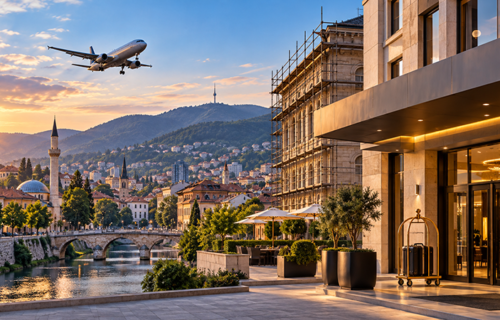
Sarajevo’s expanding international air network is strengthening the investment case for new hotels and the conversion of existing buildings into hospitality properties. Passenger numbers continue to reach new highs in 2026, while additional European connections are making the Bosnian capital more accessible from important tourism markets and potentially widening the customer base for accommodation operators.
Sarajevo International Airport entered the summer season with direct connections to around 40 destinations and a growing range of airlines. New services include Paris-Orly, Berlin and Ankara, adding to an increasingly diverse European and regional network. Passenger traffic reached 202,074 in May, the airport’s strongest May on record, while the cumulative passenger total for 2026 passed one million during July.
Tourism data provide another reason for hotel investors to pay attention. Bosnia and Herzegovina recorded 160,780 tourist arrivals and 324,184 overnight stays in April, with foreign visitors accounting for around 69% of overnight stays. Hotels and similar accommodation captured almost 95% of registered overnight stays, demonstrating the importance of conventional hospitality properties to the country’s visitor economy. A 2026 passenger survey at Sarajevo Airport also indicated that international visitors place considerable importance on the availability of direct flights when selecting the city as a destination.
Property investment is beginning to respond. The former headquarters of the Football Association of Bosnia and Herzegovina in central Sarajevo was sold for approximately BAM 4.56 million during 2026, with plans subsequently emerging to reposition the Ferhadija property for luxury hospitality use. Reports have differed over whether the final concept will operate as a conventional five-star hotel or luxury serviced accommodation, but either format would represent a significant repositioning of an existing central-city property towards tourism.
New supply is also appearing elsewhere in Sarajevo. A new four-star hotel in Hrasno, offering 20 rooms, was scheduled to open in September. Although relatively small, the project adds to evidence that hospitality investment is taking place beyond the historic centre. In the wider tourism region, investors are also pursuing a much larger hotel and retail project at Jahorina, which could benefit indirectly from Sarajevo’s improving international accessibility even though it should not be counted as part of the city’s hotel inventory.
The opportunity extends beyond construction of purpose-built hotels. Sarajevo’s constrained central development environment means existing office, institutional and other commercial buildings may increasingly become candidates for conversion where location, structure and planning conditions permit. Growing visitor numbers could improve the economics of such repositioning, particularly for properties close to the historic centre and established tourism infrastructure.
Sarajevo is not yet experiencing a hotel construction boom, but the ingredients for greater investment interest are becoming more visible. Record airport traffic, broader international connectivity, substantial foreign visitor demand and emerging hospitality projects are gradually changing the investment environment. If passenger growth continues, the next stage of Sarajevo’s hotel market could increasingly involve both selective new development and the transformation of existing buildings into higher-value hospitality assets.
Source: CIJ.World Research & Analysis Team