Monday, 21 September 2026
Switzerland’s expanding digital economy is changing the requirements for data centre development, with access to electricity infrastructure becoming increasingly important alongside land, location and connectivity. Growing demand for cloud computing and digital services is continuing to support the sector, but developers must increasingly determine whether individual locations can obtain the substantial electricity capacity required for new facilities.
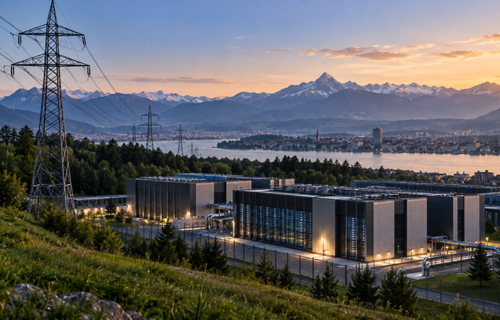
The challenge is particularly apparent around Zurich, the country’s principal data centre market. Development land is limited, while some parts of the electricity network have restricted capacity for additional large users. New grid infrastructure can alleviate these constraints, but substations and network upgrades require considerable planning and construction time. As a result, a site that appears suitable from a conventional property perspective may not necessarily be capable of supporting a large computing facility within the required development timetable.
This could gradually broaden Switzerland’s data centre geography. Areas including Aargau and Schaffhausen may attract greater attention where developers can combine available land with electricity capacity and strong fibre connections. The change could reduce the importance of being located immediately within an established business centre, particularly for facilities where reliable infrastructure and the ability to expand are more important than proximity to office districts.
The pressure should not be interpreted as Switzerland running short of electricity nationally. The country produced around 67.5 TWh of electricity in 2025, compared with consumption of approximately 58 TWh. The development challenge lies further down the system, where local networks may not have enough capacity to connect very large new users without additional investment. Meanwhile, a 2026 federal study estimated Swiss data centres used just under 2.1 TWh in 2024 and projected consumption could increase to around 2.5–3.2 TWh by 2030.
Artificial intelligence could make site selection more demanding in the years ahead. AI currently represents only part of Swiss data centre activity, but more intensive computing can concentrate much greater electricity demand within individual facilities. It can also increase cooling requirements, making access to suitable cooling solutions, water resources where required and opportunities to reuse heat more important. Electricity, cooling, fibre connectivity and planning conditions are consequently becoming interconnected considerations when assessing potential developments.
These changes could create new opportunities for existing industrial and commercial properties. Older sites with substantial electricity infrastructure may possess an advantage that cannot easily be replicated on newly acquired land. Securing a major new grid connection can require significant investment and time, meaning an otherwise ageing property could acquire renewed development potential because of infrastructure installed for its previous use. There is not yet enough Swiss transaction evidence to establish a specific valuation premium for such properties, but their strategic importance could increase as available grid capacity becomes harder to secure.
The result is a changing relationship between Switzerland’s digital economy and its property market. Future data centre investment may increasingly follow infrastructure rather than simply established locations, potentially shifting development toward areas capable of accommodating large electricity loads and advanced cooling systems. For investors and developers, the critical question is therefore moving beyond how much suitable land Switzerland has available to how much of that land can realistically be connected, cooled and developed for the increasingly demanding infrastructure behind the country’s digital economy.
Source: CIJ.World Research & Analysis Team