Monday, 21 September 2026
San Francisco’s commercial property recovery is beginning to expose a new problem. As technology companies lease better offices, retailers return to selected shopping districts and hotel performance improves, a substantial group of buildings remains outside the recovery. For these properties, the challenge is increasingly not finding another tenant on the same terms as before, but determining whether their original use still makes economic sense.
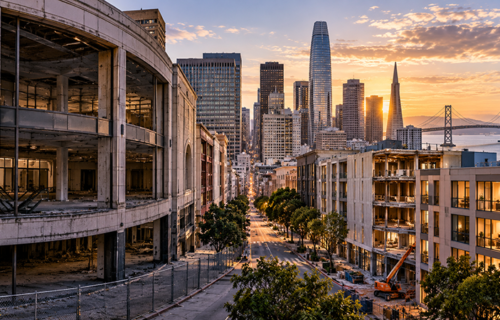
The former San Francisco Centre has become one of the clearest examples. The roughly 1.5 million sq ft shopping complex closed in early 2026 after years of declining occupancy and financial difficulties. Investors are now evaluating how the property could be repositioned, while the former Bloomingdale’s component, comprising roughly 350,000 sq ft, has separately attracted acquisition interest. The scale of the complex means replacing departed retailers alone is unlikely to provide a simple solution, potentially opening the way for subdivision, new uses or broader redevelopment.
This does not mean downtown retail has ceased to work. Union Square is showing signs of renewed retailer confidence, with international brands taking space and Uniqlo preparing to open a new Market Street store in October. The contrast illustrates an increasingly important feature of San Francisco’s property market: recovery is becoming highly selective. Well-positioned buildings and locations can attract new demand while properties designed around business models that have changed permanently may require far more fundamental intervention.
The same divide is appearing in offices. San Francisco entered 2026 with roughly 30 million sq ft of vacant office accommodation, yet demand from technology and artificial intelligence companies has subsequently strengthened considerably. Much of that demand is concentrating on better-quality properties. If the trend continues, citywide vacancy could decline significantly without solving the problems facing older buildings that require major investment or no longer provide the space modern occupiers want.
Residential conversion has long been presented as one solution, but progress has been slow. Earlier this year San Francisco still had no office-to-housing conversion under construction despite years of discussion and regulatory changes. By mid-2026, however, several schemes representing more than 300 potential homes were moving forward, including projects at 901 Market Street, 2300 Stockton Street and 150 Hayes Street. Tax incentives, simplified planning requirements and the Downtown Revitalization Financing District are intended to improve the financial case for these projects.
Conversion nevertheless works for only a portion of the available stock. Offices can have floorplates that are too deep for practical residential layouts, while adding kitchens, bathrooms, ventilation and other residential infrastructure can be expensive. Seismic requirements and construction costs create further complications. Even buildings that can physically accommodate apartments may remain financially unworkable if their acquisition price and conversion costs exceed the value of the completed housing. Some proposed conversions have already encountered financing difficulties before construction could begin.
Distressed sales may eventually help solve part of that equation. When commercial buildings change hands at substantially lower prices, new owners have more flexibility to invest in refurbishment or alternative uses. The acquisition of 2300 Stockton Street for conversion into housing illustrates how a building can acquire a new investment rationale once its value is no longer tied entirely to its former office use. For other properties, comprehensive redevelopment may ultimately prove more practical than attempting to preserve structures that are poorly suited to conversion.
San Francisco’s experience also suggests that there will be no single solution for obsolete commercial property. Some offices will recover as leasing strengthens, others will be renovated, and selected buildings will become apartments or mixed-use developments. Large retail properties could be divided or rebuilt, while some assets may remain vacant until falling values make redevelopment economically possible. Demolition may be appropriate in certain cases, although San Francisco’s high construction costs mean replacement is not automatically cheaper than adaptation.
The result is a new phase of the downtown recovery. During the downturn, the dominant question was how much office and retail space would become vacant. Increasingly, the question is what happens to the properties that remain empty even as demand returns elsewhere. A recovering market can make that distinction clearer because occupiers reveal which buildings they still value and which they are prepared to bypass.
San Francisco is therefore becoming a test case for how major cities deal with the physical legacy of structural changes in working, shopping and urban life. The next chapter of its recovery will not be measured only by falling vacancy or returning footfall. It will also depend on whether investors, lenders and city authorities can find economically viable new purposes for buildings whose previous role may never fully return.
Source: CIJ.World Research & Analysis Team