Monday, 21 September 2026
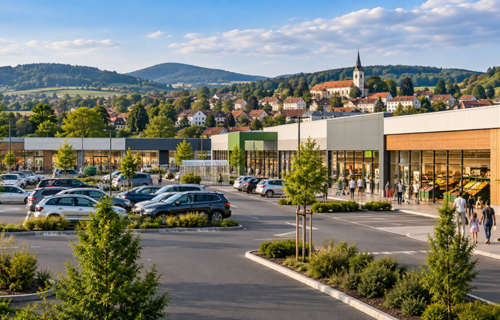
Retail property development in the Czech Republic is increasingly being shaped by smaller regional markets, as developers roll out compact shopping schemes in towns that previously attracted limited volumes of modern retail investment. Rather than concentrating new supply primarily in Prague, Brno and other large cities, the current pipeline shows growing interest in locations where relatively small projects can serve both local residents and surrounding communities.
The country’s modern retail stock stood at around 4.1 million sqm at the end of the second quarter of 2026, with approximately 146,800 sqm being developed. Retail parks have become an increasingly important part of this market, accounting for close to one-third of modern Czech retail space by the end of 2025. Approximately 82,400 sqm was added to the segment during 2025, while close to 90,000 sqm across 19 projects was expected to follow during 2026.
One of the most significant changes is the size of the locations now attracting development. Towns with populations of around 10,000 can support schemes of approximately 2,000 to 3,000 sqm, allowing developers to reach catchments that would never justify construction of a conventional shopping centre. The Ústí nad Labem and South Bohemian regions are among the areas with particularly active development pipelines, illustrating how new retail investment is spreading across the country.
The tenant mix helps explain why these smaller projects can work. Regional schemes are generally built around frequently used shops and services, including food retailers, drugstores, discount chains, household goods businesses, pharmacies and pet stores. Their accessibility by car and relatively simple layouts allow them to draw customers from surrounding villages as well as the host town, increasing the effective population served by each project.
Demand has so far supported continued expansion. Prime retail-park rents reached approximately €17 per sqm per month during the second quarter of 2026, following an increase from the previous quarter. Established regional portfolios also continue to report strong occupancy. At the same time, international retailers remain interested in the wider Czech market, with 16 foreign brands entering the country during the first half of the year, although these arrivals are not limited to retail parks.
Rapid expansion nevertheless makes the economics of individual locations increasingly important. Central Bohemia already has more than 50 retail parks, while several regions have relatively high levels of space compared with their populations. Higher provision does not automatically mean that a market has too much retail, particularly where populations are dispersed and larger shopping destinations are some distance away. However, as developers move into smaller towns, local spending power, competing stores, transport connections and the size of the surrounding catchment will become more important in determining whether further projects can be supported.
The rise of regional retail parks also does not appear to be coming at the expense of established shopping centres. Czech regional malls continue to record low vacancy and improving turnover, suggesting that the formats are increasingly occupying different positions in the market. Large centres remain important destinations for fashion, restaurants, entertainment and wider shopping trips, while smaller parks are extending modern convenience retail into communities beyond the main metropolitan areas. The next phase of Czech retail development could therefore be determined not by how many more parks can be built, but by how far developers can push into smaller regional catchments before the opportunities become increasingly selective.
Source: CIJ.World Research & Analysis Team