Sunday, 4 October 2026
Romania’s retail market entered 2026 from a position of considerable strength, with the country’s largest retail chains having generated more than €42 billion in sales last year. However, weaker household consumption, persistent inflation and slower economic activity are creating a more challenging operating environment, even as relatively low modern retail density continues to provide room for further property development.
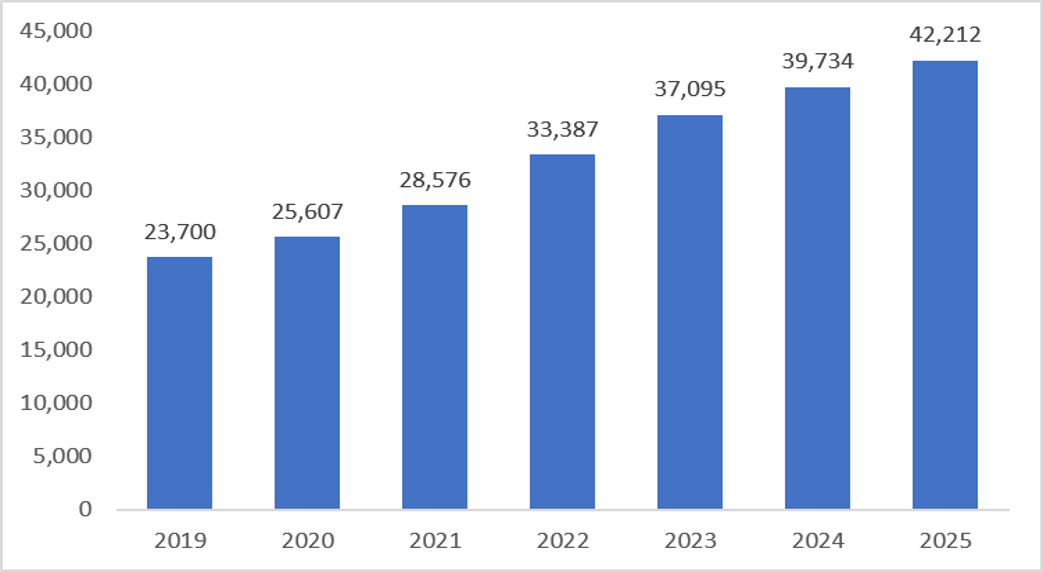
The 125 retailers analysed by Cushman & Wakefield Echinox generated combined turnover of approximately €42.2 billion in 2025, an increase of 5.6% compared with the previous year. Their revenues were around 77% higher than in 2019, demonstrating the scale of Romania’s consumer-market expansion during the past six years.
The longer-term development is particularly significant. Combined turnover among the companies covered by the research increased from €23.7 billion in 2019 to €25.6 billion in 2020 and €28.6 billion in 2021. Sales subsequently reached €33.4 billion in 2022, €37.1 billion in 2023 and €39.7 billion in 2024 before exceeding €42.2 billion last year.
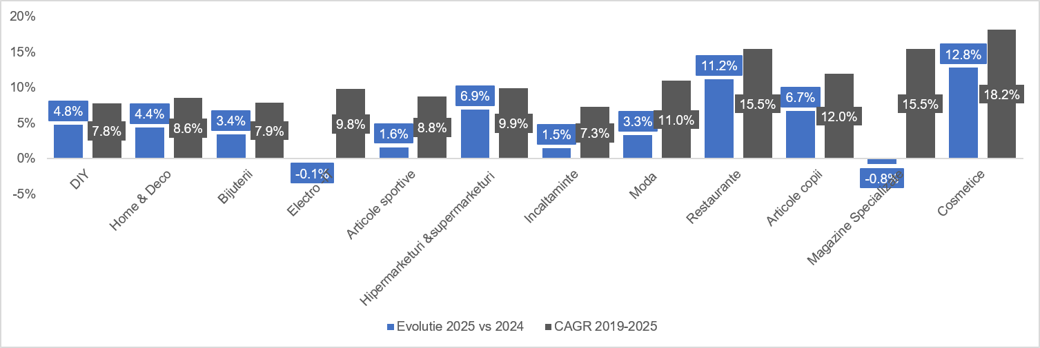
Food retail continues to dominate the market. Supermarkets and hypermarkets generated approximately €25.7 billion in 2025, representing growth of 6.9%. DIY retailers followed with around €4.2 billion, up 4.8%, while electronics and IT chains recorded approximately €3.6 billion and remained broadly stable. Fashion retailers generated approximately €2.7 billion, an increase of 3.3%.
Some of the strongest increases came from consumer categories outside essential retail. Cosmetics turnover expanded by 12.8%, while food and beverage operators recorded growth of 11.2%. Overall, 11 of the 13 categories examined by Cushman & Wakefield Echinox increased sales during the year.
The companies included in the study operate more than 8,000 stores across Romania, giving their performance considerable relevance for shopping centres, retail parks and other commercial property formats.
Retail property development has continued alongside the increase in consumer spending. Approximately 266,000 sqm of modern retail space was completed between the beginning of 2025 and the end of H1 2026, including new developments, extensions and major refurbishment projects. Around 60,000 sqm was delivered during the first six months of 2026 alone.
Romania’s modern retail stock consequently reached approximately 4.92 million sqm, of which around 1.34 million sqm is located in Bucharest.
Despite this expansion, Romania remains relatively underprovided with modern retail space compared with several Central European markets. Modern stock amounted to around 252 sqm per 1,000 inhabitants at the end of 2025, below the density levels recorded in markets including Czechia, Poland, Slovakia and Hungary.
This provides an important qualification to the weaker economic outlook. Romania may be experiencing a cyclical slowdown in consumption, but the structural case for additional modern retail development has not disappeared. Opportunities remain particularly relevant in regional cities and catchment areas where consumers have more limited access to contemporary shopping facilities.
Rental levels also indicate that demand for the strongest locations has remained resilient. Prime rents in Bucharest stood at approximately €90 per sqm per month during Q2 2026 for leading shopping-centre units and prime high-street locations on Calea Victoriei. Major regional cities recorded prime rents of around €50 to €65 per sqm per month.
The economic environment confronting retailers in 2026 is nevertheless substantially more difficult than the conditions behind their 2025 results.
Romania’s GDP contracted by 0.8% year-on-year during H1 2026 on the unadjusted series. Annual CPI inflation stood at approximately 10.4% in June, maintaining significant pressure on household purchasing power.
Retail activity has also weakened. The volume of retail turnover excluding motor vehicles and motorcycles declined by 5.6% on an unadjusted basis during H1 2026 compared with the same period last year.
This figure should be distinguished from the €42.2 billion generated by the retailers covered by the Cushman & Wakefield Echinox study. The 2025 figure represents nominal company revenues, while the H1 2026 decline measures changes in the volume of retail trade across the wider Romanian economy. They therefore illustrate different aspects of market performance rather than a direct reversal of the retailers’ 2025 revenue growth.
The distinction is particularly important in a high-inflation environment. Retailers can record higher nominal revenues as prices increase even when consumers purchase fewer goods in real terms. Consequently, turnover growth alone may provide an incomplete picture of the strength of household demand.
For landlords and developers, this makes tenant performance increasingly important. Retailers are likely to examine new locations more carefully if weaker consumption persists, placing greater emphasis on catchment populations, footfall, occupancy costs and individual store profitability.
The expansion of cosmetics, restaurants and other consumer categories also demonstrates how Romania’s modern retail market is evolving. Shopping destinations increasingly depend on combinations of retail, food, entertainment and services rather than simply functioning as locations for purchasing goods.
Physical stores remain central to this model despite the continued expansion of online sales. Cushman & Wakefield Echinox attributes the longer-term increase in retailer revenues to a combination of network development, improving performance from existing stores and online operations.
Regional markets are likely to remain particularly important for future development. Romania already has one of the larger modern retail inventories in Central and Eastern Europe in absolute terms, but its lower provision per inhabitant indicates that the market is not uniformly saturated.
This creates a more selective development environment. The question is increasingly not whether Romania requires additional retail space nationally, but which cities and catchment areas can support it and which formats are best suited to local purchasing power.
Developers may therefore continue expanding in markets where modern retail provision remains limited while becoming more cautious in locations already offering substantial competition.
The combination of inflation and weaker consumption could also widen differences between individual retailers. Grocery and other necessity-led operators may prove more defensive, while discretionary categories could be more exposed if households reduce expenditure.
For property owners, tenant mix will consequently become increasingly important. Shopping centres and retail parks with strong grocery anchors, diversified occupiers and significant food, leisure and service components may be better positioned to withstand fluctuations in discretionary spending.
Romania’s retail sector is therefore moving into a different stage of its development. The 2025 figures show an industry operating from a much larger revenue base than before the pandemic, supported by substantial expansion in retailer networks and modern property stock.
The first-half indicators for 2026 do not overturn that longer-term development story, but they do show that retailers are entering a materially more difficult consumer environment than the one that supported their 2025 performance.
With modern retail stock approaching 5 million sqm but provision per inhabitant still below several neighbouring Central European markets, Romania presents two contrasting trends: weaker short-term consumer conditions and continued structural potential for additional modern retail development.
The next phase is therefore likely to be more selective. Rather than expansion being supported broadly by rising consumption, successful projects will increasingly depend on location, purchasing power, tenant quality and the ability to capture demand in parts of the country where modern retail provision remains relatively limited.