Thursday, 1 October 2026
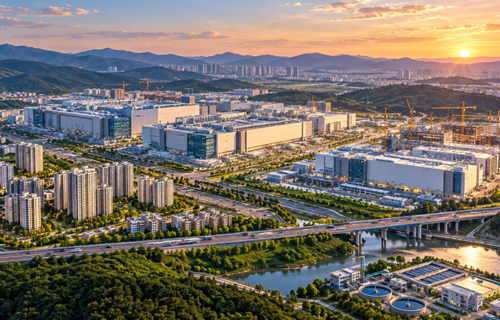
South Korea’s drive to expand semiconductor production is beginning to transform Yongin from a large satellite city south of Seoul into one of the country’s most important industrial development areas. Massive investment programmes led by Samsung Electronics and SK hynix are creating requirements extending well beyond semiconductor factories, bringing new demand for industrial sites, electricity infrastructure, water networks, housing and transport.
Samsung’s development is centred on the Yongin Advanced System Semiconductor National Industrial Complex. Six fabrication plants are planned as part of a programme associated with approximately KRW 360 trillion of private investment. The core development covers around 7.3 million sqm and is intended to accommodate more than 60 companies supplying semiconductor materials, components and production equipment alongside Samsung’s manufacturing operations. The first fab is now reported to be targeting operations from 2029, earlier than initially planned.
A separate development is taking shape at Wonsam in Yongin’s Cheoin-gu district, where SK hynix is establishing a semiconductor complex covering approximately 4.16 million sqm. Four major fabs are planned, supported by suppliers and related facilities. SK hynix has allocated around KRW 600 trillion to its long-term Yongin programme as it increases capacity for advanced memory products required by artificial-intelligence computing. The company has also accelerated its development timetable, with the first cleanroom stages of all four fabs now targeted for completion by 2033.
The scale of these investments is making access to utilities almost as important as the industrial land itself. Together, the Yongin semiconductor developments are expected eventually to require more than 10 GW of electricity. Meeting that demand will require major additions to transmission and power infrastructure, increasing the importance of coordination between manufacturers, government bodies, KEPCO and land-development organisations. For future industrial development, the availability of land without sufficient power capacity will increasingly be inadequate.
Water requirements present another infrastructure challenge. At full development, the two clusters are expected to need approximately 1.33 million tonnes of water each day. An integrated supply system is being developed to deliver around 1.07 million tonnes daily, with the first supplies expected from 2031. The requirement illustrates the extent to which semiconductor expansion has become a regional infrastructure project rather than simply a collection of privately financed factories.
Residential development is following the industrial investment. A new public housing district of approximately 2.28 million sqm is planned at Idong-eup, close to Samsung’s national complex, providing around 16,000 homes. Transport infrastructure is also being expanded to improve connections between the semiconductor districts and the wider Seoul metropolitan region. These investments are intended to accommodate a growing workforce while supporting the movement of materials and equipment through an increasingly concentrated industrial area.
Expectations surrounding the semiconductor projects are already being reflected in local property values. Official individual land prices in Cheoin-gu increased by 4.52% in 2026, exceeding the 3.11% increase recorded across Yongin as a whole. While individual locations will benefit differently and much of the investment programme stretches over decades, the figures indicate how industrial development expectations are beginning to influence the surrounding land market before the major complexes are fully operational.
The expansion should also broaden demand for specialised industrial property. Semiconductor production relies on extensive networks of equipment manufacturers, materials companies, engineering businesses and technology suppliers. Their facilities do not necessarily need to sit inside the principal fabrication sites, creating opportunities for additional industrial and research developments around Yongin and elsewhere in southern Gyeonggi Province.
Yongin is therefore becoming a test of how effectively South Korea can translate enormous technology investment into functioning urban and industrial development. Samsung and SK hynix can finance increasingly sophisticated semiconductor plants, but their success also depends on electricity, water, transport, suppliers and sufficient housing for the workforce. With long-term investment associated with the two Yongin programmes approaching KRW 1 quadrillion, the region’s property and infrastructure capacity will play an increasingly important role in determining how quickly South Korea can expand its position in global semiconductor manufacturing.
Source: © CIJ.World Research & Analysis Team