Thursday, 1 October 2026
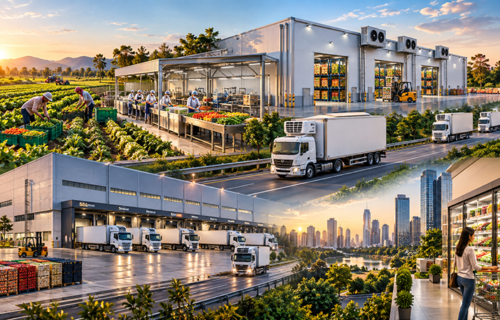
India’s cold-chain market is beginning to develop beyond its traditional role as a fragmented network of commodity storage facilities. The emerging investment opportunity is increasingly centred on connecting agricultural production with processing, refrigerated transport, distribution and the country’s rapidly expanding urban consumer markets. For industrial and logistics investors, this could turn temperature-controlled infrastructure into a more significant specialist real estate sector.
India already has considerable cold-storage capacity. Government data recorded 8,815 facilities with combined capacity of around 40.2 million tonnes as of June 2025. The challenge is therefore not simply to construct more refrigerated warehouses. Existing capacity is unevenly distributed geographically and remains heavily concentrated in bulk storage for particular agricultural commodities, especially potatoes. The next stage of development requires more modern facilities capable of handling different products and connecting efficiently with the wider food supply chain.
The economic case is reinforced by continuing post-harvest losses. The government’s most comprehensive recent study, based on 2020–21 agricultural production, estimated losses of approximately 7.36 million tonnes of fruit and 11.97 million tonnes of vegetables. While these figures should not be interpreted as measurements for 2026, they demonstrate the scale of value that can disappear between agricultural production and final consumption when appropriate handling, storage and distribution infrastructure is unavailable.
Cold storage alone cannot solve this problem. Perishable food may need to move from farms through collection centres, grading and packing facilities, pre-cooling, refrigerated storage, processing and temperature-controlled transport before reaching retailers, restaurants or consumers. Weakness at any point can interrupt the chain. This creates a wider property and infrastructure opportunity involving packhouses, multi-temperature warehouses, food-processing facilities, refrigerated distribution centres and specialist logistics operations.
For agricultural producers, better infrastructure can extend the commercial life of certain products and reduce the pressure to sell immediately during periods of peak supply. Grading and packing facilities can also separate produce according to quality and destination, allowing different products to move towards organised retail, foodservice, wholesale markets or processing. For buyers, more reliable temperature control can reduce deterioration and provide greater consistency when products travel long distances between production areas and consumption centres.
Urbanisation is adding another dimension to the market. India’s large metropolitan areas require increasingly sophisticated distribution networks for dairy products, meat, seafood, frozen foods, fruit, vegetables and processed products. Growth in organised retail, foodservice, e-commerce and quick commerce is increasing the importance of reliable distribution close to consumers. As a result, cold-chain property increasingly needs to connect large regional facilities with smaller urban distribution networks rather than operate as isolated agricultural storage.
Institutional capital is beginning to recognise this opportunity. India’s wider warehousing sector has already undergone significant professionalisation, with institutionally backed developers accounting for around a third of new logistics supply during the first half of 2026. Cold storage remains less mature, but investment is beginning to emerge. In August 2026, IFC committed ₹225 crore to NDR Smart Spaces to support the expansion of a logistics and cold-storage platform targeting approximately 20 million sq ft across 14 Indian cities. The transaction provides evidence that temperature-controlled infrastructure is beginning to form part of larger institutional logistics strategies.
Cold-chain property nevertheless carries different risks from conventional warehousing. Refrigeration systems require substantial capital investment and reliable electricity, while operating costs can be considerably higher. Returns depend on utilisation, energy efficiency, location, commodity mix, tenant quality and the ability to maintain temperature requirements throughout the distribution process. Modern facilities therefore need strong operating capabilities alongside suitable real estate.
India’s next cold-chain investment cycle is consequently unlikely to be defined simply by the number of refrigerated warehouses constructed. The larger opportunity is to transform a geographically uneven and commodity-focused storage system into an integrated network connecting farms and food processors with India’s major cities. If that transition continues, cold-chain infrastructure could develop from a specialised agricultural service into an increasingly investible part of India’s industrial and logistics real estate market.
Source: © CIJ.World India Research & Analysis Team