Tuesday, 15 September 2026
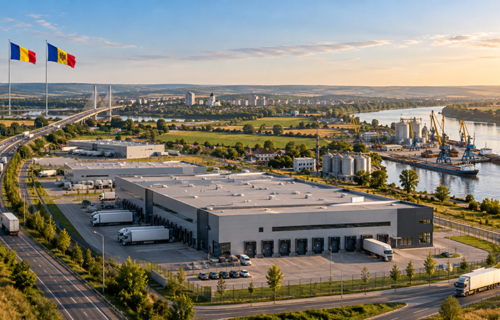
Moldova is moving steadily closer to the European economy, creating an opportunity to attract manufacturers and logistics companies looking for locations close to the EU without paying the operating costs associated with more established Central and Eastern European markets. But there is a problem that could become increasingly important as investment interest grows: Moldova still has a relatively shallow supply of modern factories, warehouses and development-ready industrial property.
The country’s economic relationship with the European Union is already substantial. The EU accounted for more than half of Moldova’s goods trade in 2025, generating turnover exceeding €7 billion. European capital has also become increasingly important to the country’s investment base, with accumulated EU investment reaching approximately €3.14 billion by the end of 2025.
Political integration is progressing alongside trade. Moldova formally opened negotiations on the first cluster of its EU accession process on 15 June 2026. A second cluster, covering external relations, followed in July. Membership remains a longer-term process, but regulatory alignment, investment programmes and closer economic integration are progressively reducing some of the barriers separating Moldova from the European single market.
For commercial real estate, this creates an important question. If more European companies decide to manufacture, assemble, process or distribute products from Moldova, where will they operate?
The answer is currently dominated by Chișinău. Moldova had approximately 1.09 million sqm of commercial logistics warehouse space at the end of 2025, with around 70% concentrated in the capital and its immediate surroundings. Demand for warehouse space has been stronger than for conventional production property, while companies unable to find suitable facilities have increasingly looked for land on which to develop their own buildings.
This reveals one of the structural weaknesses of the market. Moldova has industrial property, but relatively little of it resembles the large institutional logistics parks that have become common across Poland, the Czech Republic, Hungary and Romania.
The country’s largest recent warehouse and logistics development cited in Invest Moldova’s market research was a 21,000 sqm project developed near Chișinău by Moldretail Group. Estimated warehouse rental activity across Moldova during 2025 was approximately 65,000 sqm, while another roughly 60,000 sqm of activity involved newly constructed or purchased facilities, much of it associated with companies developing buildings for their own occupation.
That is a very different market from neighbouring Romania, where international developers can offer occupiers extensive portfolios of immediately available or build-to-suit industrial space. The difference matters when companies choose manufacturing locations.
A manufacturer considering Iași, for example, is not comparing labour costs alone with those in Moldova. It is comparing the entire operating environment: building availability, motorway access, electricity capacity, customs procedures, workforce, construction times, financing and the ability to expand. Moldova can be cheaper and still lose the investment if the required factory cannot be delivered quickly enough.
This is why Ungheni could become one of the country’s most important industrial property locations. The city sits directly beside Romania and is increasingly positioned along an improving cross-border transport corridor. New road and bridge infrastructure will connect the area more closely with Romania’s developing A8 motorway, improving access towards Iași and the wider European road network.
Nearby Berești could strengthen that position further. Plans for a multimodal logistics complex envisage an approximately 18-hectare site combining road and railway freight infrastructure with warehousing and container handling. Ungheni also already possesses an industrial base through its free economic zone.
Taken together, those ingredients create the possibility of something Moldova has not previously had at scale: an industrial location capable of functioning increasingly as part of a Romanian-Moldovan manufacturing corridor.
For some occupiers, the geography could become compelling. Production could take place in Moldova while suppliers, customers and logistics networks remain closely connected with Romania. Components could cross the border during different stages of manufacturing, while finished goods could move west towards EU markets.
But infrastructure alone will not create that market. International occupiers need serviced development sites. Electricity connections must provide sufficient capacity. Roads need to accommodate freight vehicles. Planning and construction procedures need to be predictable, and suitable buildings must either exist or be capable of rapid delivery.
Bălți starts from a different position. The northern city already has an established manufacturing economy, including automotive-component and industrial production supported by the Bălți Free Economic Zone. Manufacturing accounted for almost 18% of Moldova’s accumulated foreign direct investment at the end of 2025, demonstrating that the country already has a meaningful industrial investment base.
The opportunity in Bălți is therefore not to invent a manufacturing market but to deepen one. Existing producers can attract suppliers. Suppliers create demand for warehouses, packaging operations, component storage and specialist services. As the cluster grows, additional manufacturers gain another reason to locate nearby.
That process could eventually create a more investible industrial property market. For the moment, however, Moldova’s regional warehouse markets remain thin. Transactions outside Chișinău are irregular enough that consistent rental benchmarks can be difficult to establish. Some older regional warehouse properties can be rented extremely cheaply, but low rents frequently reflect building quality rather than an exceptional investment opportunity.
This distinction will matter increasingly as Moldova attempts to attract international occupiers. A manufacturer does not necessarily want the cheapest building. It wants a facility capable of supporting its production process reliably.
Giurgiulești represents another type of opportunity altogether. Moldova’s principal international port has become more closely connected with Romania following the acquisition of Danube Logistics, operator of Giurgiulești International Free Port, by Romania’s state-owned Port of Constanța.
The transaction gives Moldova’s main maritime gateway a strategic owner with direct interests in Black Sea trade. Giurgiulești already handles more than 70% of Moldova’s waterborne imports and exports, and the new owner’s plans include further infrastructure development, additional capacity, new berths and development of available land.
The property implications could be significant. Rather than competing with Chișinău for conventional distribution warehouses, Giurgiulești could develop a specialised cluster involving agricultural storage, food processing, bulk commodities, manufacturing, freight handling and industrial operations requiring access to port infrastructure.
Its Romanian comparison is therefore not Bucharest or Iași but the wider Galați-Constanța logistics system.
Cahul remains a more speculative proposition. Its southern location and proximity to Romania give it potential, particularly for food processing, agricultural industries and smaller manufacturing operations. But the modern industrial property market remains considerably less developed than in Chișinău, and the case for large-scale speculative logistics development has yet to be demonstrated.
That illustrates a wider challenge for Moldova. Industrial land can be inexpensive because there is little demand. Warehouses can offer very low rents because they are obsolete. Neither necessarily makes a location competitive for international investment.
The real comparison with Romania therefore needs to go beyond headline costs. Romanian industrial rents are higher, but occupiers gain access to an established development industry, institutional landlords, larger labour markets, EU infrastructure and a mature logistics ecosystem. Moldova must compensate for those disadvantages with some combination of lower operating costs, investment incentives, improving infrastructure and access to suitable property.
Government policy is increasingly designed to encourage that investment. Moldova introduced a regional state-aid programme for industrial projects in 2025, offering substantial support for qualifying investments. The programme forms part of the country’s wider industrialisation strategy and is intended to encourage manufacturing investment outside the traditional economic centres.
Property availability could determine how effective those incentives become. There is little benefit in attracting a manufacturer with financial support if the company then spends years securing land, obtaining infrastructure connections and constructing a factory.
That creates an opportunity for industrial developers. Instead of waiting for manufacturers to acquire sites and construct their own premises, developers could begin offering serviced industrial plots, smaller speculative production buildings and build-to-suit facilities around locations where occupier demand is most credible.
Chișinău would remain the safest market because it already has the greatest concentration of logistics demand. Ungheni could become the strongest cross-border development opportunity because of its connection with Romania and emerging transport infrastructure. Bălți offers the strongest existing manufacturing cluster outside the capital. Giurgiulești provides a specialised port-led proposition. Cahul remains a longer-term location where investment will probably need to follow proven occupier demand rather than precede it.
The types of companies Moldova can realistically attract also matter. Automotive components already provide a foundation. Electrical equipment and electronics assembly could build on similar advantages. Food processing is a natural opportunity given Moldova’s agricultural economy, while packaging, light manufacturing and selected pharmaceutical production could also benefit from competitive operating costs and increasing access to European markets.
Large regional e-commerce distribution centres are less obvious because Moldova’s domestic consumer market is relatively small. But warehouses serving cross-border trade with Romania and Ukraine could become increasingly relevant as transport connections improve.
Electricity may ultimately prove just as important as roads. Modern manufacturing can require substantial and reliable power capacity, while warehouses increasingly consume more electricity through automation, refrigeration, digital systems and vehicle charging. Moldova’s continuing investment in energy security and stronger connections with European electricity networks therefore has direct consequences for industrial land.
A cheap development plot without sufficient electricity is not necessarily cheap at all.
Labour presents a similar complication. Moldova retains a cost advantage over many EU locations, but years of outward migration mean investors must examine actual labour availability rather than assume an unlimited workforce. Locations with existing industrial skills and reasonable commuting populations may therefore have a considerable advantage over isolated sites offering cheaper land.
This is why Moldova’s industrial proposition should not be built simply around being less expensive than Romania. The more interesting opportunity is integration.
As Romania’s motorway, logistics and manufacturing geography extends towards its eastern border, Moldova could gradually become connected to the same production networks. Ungheni could interact increasingly with Iași, Giurgiulești with Galați and Constanța, while Moldovan manufacturers could become deeper suppliers to factories operating throughout Romania and the rest of the European Union.
That would change the country’s industrial property market. More international manufacturers would create demand for better buildings. More modern buildings would make Moldova easier for additional manufacturers to enter. Eventually, that cycle could attract institutional developers and investors willing to own industrial property rather than leaving companies to construct almost everything themselves.
Moldova is not at that stage yet. Its warehouse market remains heavily concentrated around Chișinău, regional property markets lack depth and much industrial development still depends on companies creating facilities for their own use.
But the country’s economic geography is changing. EU accession negotiations, closer trade integration, Romanian transport infrastructure, new border connections, industrial incentives and investment in Moldova’s energy network are gradually improving the conditions for manufacturing and logistics investment.
The next constraint may therefore be real estate itself. If Moldova wants to become part of the industrial geography developing across eastern Romania, attracting companies will only be half the challenge. It will also need somewhere modern for them to manufacture, store and distribute what they produce.
Source: CIJ.World Research & Analysis Team