Monday, 14 September 2026
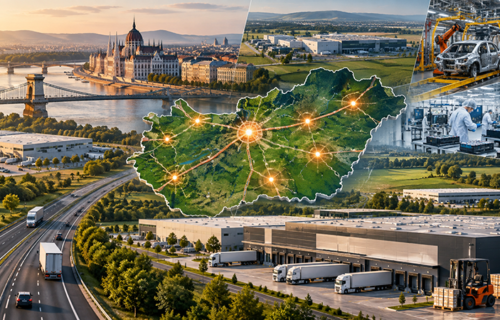
Hungary’s industrial property market is beginning to look less like a sector built around one dominant city and more like a network of manufacturing and logistics locations stretching across the country. Budapest remains at the centre of that network. It contains almost two-thirds of Hungary’s modern industrial and logistics property and continues to generate substantial leasing activity. But figures from the first half of 2026 reveal a growing difference between conditions around the capital and those in regional markets.
Hungary had approximately 6.51 million sqm of modern industrial and logistics space at the end of the second quarter. Around 4.18 million sqm was located in Greater Budapest, while approximately 2.33 million sqm was spread across the rest of the country. The availability of space differed considerably between the two markets. Around 14.8% of Greater Budapest’s stock was vacant at the end of June, representing more than 617,000 sqm. Regional Hungary had approximately 244,000 sqm available, equivalent to about 10.5% of its modern stock. Across the country as a whole, vacancy stood at 13.2%.
These figures do not mean that Budapest has stopped attracting occupiers. Quite the opposite. Leasing around the capital remained substantial during the first half of the year, and conditions improved during Q2 after a weaker opening quarter. What the numbers do show is that Budapest and regional Hungary are developing at different speeds.
During the first six months of 2026, the amount of occupied space around Budapest declined by approximately 33,600 sqm after additions and departures were taken into account. Outside the capital, occupied stock increased by almost 154,000 sqm over the same period. The second quarter itself was stronger around Budapest, with occupied space returning to growth and vacancy edging down from the previous quarter. This suggests that the capital is stabilising rather than entering a prolonged contraction.
Regional markets, however, continue to expand from a much smaller base. New construction illustrates the changing balance. Approximately 118,000 sqm of modern industrial and logistics property was completed across Hungary during Q2. About 29,000 sqm was delivered around Budapest, while approximately 89,000 sqm was added in regional locations, with the new regional buildings concentrated in the Northern Great Plain.
The significance of this shift extends beyond warehouse statistics. Hungary’s industrial economy is becoming increasingly distributed across several manufacturing centres. Major investments in automotive production, batteries, electronics and associated industries are creating property requirements far from Budapest.
Debrecen has become one of the most visible examples. Large industrial projects are transforming the economic scale of the city and creating requirements not only for factories but also for suppliers, storage, transport and supporting businesses. Nyíregyháza is attracting another wave of manufacturing investment, while Kecskemét already has a well-established automotive ecosystem. In western Hungary, Győr remains closely connected to the European automotive industry, while Tatabánya and Székesfehérvár combine manufacturing activity with strong road connections and relatively easy access to Budapest.
These cities are gradually creating their own property ecosystems. A large factory does not operate independently. Components must arrive at precise times, finished products must leave efficiently and suppliers often need facilities close enough to respond rapidly to changes in production. This can create demand for warehouses, light manufacturing buildings and supplier facilities that would make little sense in Greater Budapest.
The distinction is important because manufacturing companies choose locations differently from many traditional warehouse occupiers. A retailer distributing products across Hungary has strong reasons to operate close to Budapest. The capital provides access to the country’s largest consumer market and sits at the centre of the motorway network. A supplier serving an automotive or battery plant has another priority. For that company, being close to its customer may be considerably more valuable than being close to Budapest.
This helps explain why western Hungary and the M1 motorway direction are attracting greater development attention. The corridor provides access towards Austria and Germany while connecting several established Hungarian industrial locations. Eastern Hungary is developing according to another logic. Large manufacturing investments around Debrecen and Nyíregyháza are creating industrial concentrations that are increasingly capable of generating their own property demand.
The result is not one regional market replacing Budapest. It is several regional markets becoming more important alongside it. Greater Budapest continues to have advantages that regional locations cannot easily replicate. It has the deepest pool of occupiers, the country’s largest population concentration, extensive motorway connections and the greatest quantity of existing modern industrial property.
Its challenge is supply. More than 617,000 sqm was vacant around Budapest at the end of Q2. Even though not all of this accommodation is directly interchangeable, the volume means companies looking for space can often compare several alternatives. Developers considering further speculative construction around the capital must therefore assess how quickly existing vacant buildings can be absorbed before adding substantially more space.
Regional markets face a different calculation. Their modern stock is considerably smaller, while a single major manufacturer or supplier can create a requirement large enough to alter local market conditions. This can make selected regional developments attractive, particularly when space is secured by an occupier before construction.
Hungary had around half a million square metres of industrial and logistics property under construction during the first half of 2026. More than half of that space had already been committed to future occupiers, limiting some of the risk associated with the development pipeline. That approach may become particularly important outside Budapest.
Regional industrial markets can offer strong growth, but they can also depend heavily on individual employers. A factory delay, reduced production programme or cancelled investment can have a much larger effect on a smaller city than on the diversified Budapest market. Developers therefore need to look beyond announcements of major industrial investment.
Electricity availability, road and rail connections, labour supply and proximity to suppliers can determine whether a location can support a lasting industrial property market. Cheap land alone is not enough. The same applies to vacancy. Budapest’s 14.8% rate does not mean that every empty building is equally attractive. Industrial occupiers frequently require specific building heights, loading capacity, power supply, yard areas and locations. Some existing properties will therefore compete strongly for tenants while others may remain difficult to lease.
The national numbers nevertheless point towards an important structural change. For much of the modern warehouse market’s development, Budapest was the obvious starting point for investors and developers entering Hungary. Regional projects were often treated as secondary opportunities linked to individual factories or local occupiers. That hierarchy is becoming less clear.
Manufacturing investment is creating several locations where industrial property demand can increasingly stand on its own. At the same time, Greater Budapest already has a large existing stock and substantially more available accommodation than regional markets.
Hungary is therefore developing two complementary industrial property systems. One remains centred on Budapest and its role as the country’s principal distribution and consumption hub. The other follows manufacturing investment across a network of regional cities and transport corridors. The first is not disappearing. The second is simply becoming too important for property investors to ignore.
The question for Hungary’s next generation of industrial development is consequently changing. It is no longer enough to decide whether the country needs more warehouses. Developers increasingly need to determine which part of Hungary will need them next.
Source: CIJ.World Research & Analysis Team