Tuesday, 15 September 2026
Garbage trucks may appear an unlikely testing ground for artificial intelligence, but their combination of heavy vehicles, repetitive routes, complex urban environments and almost daily contact with city streets is creating an increasingly valuable platform for AI-powered safety and municipal data. At AI4 2026 in Las Vegas, Paul Marsolan, Chief Software Officer at Battle Motors, outlined how the US vocational truck manufacturer is integrating computer vision, onboard computing, fleet software and advanced driver-assistance technology directly into refuse vehicles. The objective extends well beyond making collection routes more efficient. Battle Motors is using the technology to identify fires, dangerous materials, pedestrians, recycling contamination and service problems, while exploring how the same vehicles could eventually gather information about wider urban infrastructure.
The approach illustrates an important development in industrial AI. Rather than relying entirely on large cloud-based models, Battle Motors is placing computing power directly inside the vehicle. Cameras surrounding the truck feed images into onboard processors capable of analysing the environment without waiting for a cellular connection. That is particularly important for refuse fleets because vehicles frequently operate in rural locations or other areas where network coverage cannot be guaranteed. Marsolan said the company’s models can respond locally in less than 200 milliseconds. For safety-critical applications, that difference matters. A system intended to identify smoke developing inside a refuse body cannot depend on the truck remaining connected to a mobile network before warning the driver.
Battle Motors is a US vocational truck manufacturer producing vehicles for heavy-duty and severe-service applications, including refuse. The company operates from New Philadelphia, Ohio, and its product strategy combines commercial vehicles with connected fleet-management technology. Its Fortris platform is designed to integrate safety, vehicle information and fleet operations rather than leaving operators to work across multiple aftermarket systems. That integration addresses a longstanding characteristic of the refuse industry. A commercial chassis may leave one manufacturer before being fitted with a specialised refuse body and subsequently receiving cameras, routing software, telematics and other equipment from several additional suppliers. The result can leave drivers surrounded by separate screens and systems that were never designed to operate together.
Battle Motors is attempting to bring more of that technology into the vehicle before it leaves the factory. Marsolan described an architecture incorporating multiple cameras, centralised driver displays and onboard AI. The company says its Fortris platform can also be fitted to existing fleets, creating a subscription-based software and hardware business alongside vehicle manufacturing. The most immediate use cases involve safety. Refuse trucks operate in unusually complicated environments. They move repeatedly between traffic lanes and kerbs, reverse frequently, interact with pedestrians and cyclists and operate large mechanical collection systems in residential neighbourhoods. Their blind spots and vehicle mass make even relatively low-speed accidents potentially serious.
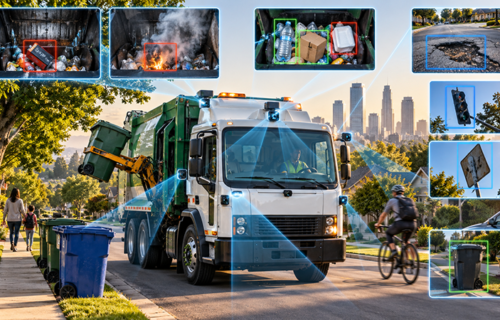
Vision systems can provide the driver with a wider view around the truck while AI models identify objects that may require immediate attention. Marsolan described systems designed to recognise people and other hazards around the vehicle and combine that information with advanced driver-assistance capabilities. The technology is also being used inside the refuse collection process itself. Cameras can analyse what enters the hopper when a bin is lifted, allowing the system to identify objects such as batteries, propane cylinders, electronic devices and other potentially hazardous materials.
Lithium-ion batteries and pressurised containers represent a particular problem for waste operators because they can ignite or explode after entering compaction equipment. A fire inside a refuse truck can escalate rapidly from a manageable incident into the loss of the entire vehicle and potentially create danger for surrounding properties. Battle Motors is therefore developing computer-vision models capable of identifying smoke and fire inside the collection body. The system is designed to alert the operator early enough to take action according to the fleet’s own emergency procedure.
Marsolan explained that Battle Motors deliberately accepts a greater risk of false alarms for fire detection because the consequence of missing a genuine fire is considerably more serious. However, the system also uses repeated image frames to distinguish sustained smoke or flame from temporary visual conditions such as dust or brightly coloured waste. Drivers remain part of the feedback loop. When the software identifies a potential fire, the operator can confirm whether the warning was correct. That information can subsequently become training data for improving the model. This human feedback is particularly important because refuse environments are visually difficult. Dust, steam, unusual lighting, plastic bags and hundreds of different waste materials can resemble hazards under particular conditions. An AI system that repeatedly generates unnecessary alarms could rapidly lose the confidence of drivers.
The same cameras can be used for another growing challenge in municipal waste management: contamination of recycling and organic waste streams. When inappropriate materials are placed in recycling or compost containers, the cost of processing increases and the value of the recovered material can fall. California provides one example of how regulation is increasing attention on contamination. Under the state’s organic-waste regime, local jurisdictions must conduct monitoring and provide education when contamination is detected. Jurisdictions can also introduce stricter local enforcement measures, including penalties in certain circumstances.
Computer vision potentially gives waste operators a much more detailed picture of where contamination originates. Rather than discovering problems only after an entire load reaches a processing facility, cameras on the collection vehicle can associate inappropriate material with individual stops. That creates opportunities for targeted education. A municipality or private operator could notify customers that a particular recycling container repeatedly contains unsuitable material rather than sending general information to an entire neighbourhood. However, this is also where the technology begins to intersect with public policy and privacy. Marsolan acknowledged that some municipalities are still considering whether and how information gathered by truck-mounted cameras should be used to contact residents or impose local charges.
Battle Motors says its system applies privacy measures such as obscuring identifiable information in captured images and retaining certain imagery for limited periods. The larger issue nevertheless extends beyond the technical platform. Municipalities need to determine what constitutes legitimate operational evidence, how residents should be informed and how automated observations can be challenged. Another application is proof of service. Disputes regularly arise when a resident reports that waste was not collected while the driver maintains that no container was placed outside.
A camera-equipped truck can potentially provide evidence showing whether the vehicle passed the address, whether a container was present and whether it was lifted. That could reduce customer-service disputes and allow operators to communicate proactively with customers rather than investigating complaints after they occur. Similar technology could identify overfilled containers, particularly in commercial waste collection where customers may be charged according to volume or service conditions. Instead of relying entirely on driver observations, vision models can gradually create a photographic and operational record associated with each collection point.
The resulting dataset becomes considerably more interesting when combined with routing information. A refuse truck already knows where it is, which address it is servicing and where it is travelling next. Adding computer vision means the vehicle can also begin to understand what it is seeing at each location. That creates a potential second role for the fleet beyond waste collection.
Garbage trucks travel through residential streets with a frequency few other municipal vehicles can match. Most neighbourhoods are visited at least weekly, while multiple waste streams can increase that frequency further. The vehicles therefore represent a recurring mobile observation network covering large parts of a city. Marsolan said Battle Motors has been discussing whether cameras already fitted to refuse trucks could identify problems including potholes, damaged traffic signals and missing road signs. Instead of sending a dedicated inspection vehicle around a municipality, information could be gathered passively during routes the city is already paying to operate.
The concept has significant implications for smart-city infrastructure. Municipal governments have invested for years in fixed sensors, connected street furniture and specialised inspection systems. A fleet of vehicles already travelling throughout the city could provide another source of continuously refreshed infrastructure information without requiring an entirely separate physical network. Pothole detection is an obvious example. Computer vision could identify deteriorating road surfaces and associate the observation with location data. Repeated observations from multiple vehicles could potentially help authorities distinguish isolated defects from rapidly worsening sections of road.
Traffic infrastructure could be monitored in a similar manner. Cameras could flag a damaged stop sign, malfunctioning light or obstructed road marking. Changes could then be sent to the relevant municipal department for inspection. The difficult part is no longer necessarily identifying the problem. As Marsolan observed, the harder question becomes what happens once the truck has found it. Municipal departments need workflows capable of receiving, verifying, prioritising and acting on the information.
That distinction is important for the wider smart-city market. AI can dramatically increase the volume of defects and anomalies a city can detect, but the economic value depends on whether municipal organisations can convert those observations into maintenance decisions. The Battle Motors architecture also demonstrates why edge computing is gaining importance in connected infrastructure. Sending continuous video from multiple cameras on thousands of vehicles to the cloud would create substantial bandwidth and computing costs. Much of the footage is also irrelevant.
Instead, the onboard system can determine when something significant is happening. During refuse collection, for example, the model can concentrate on the period when the mechanical arm is lifting and emptying a container rather than analysing every second of an entire route with the same intensity. Relevant events can then be transmitted to central systems for fleet analysis, model training and management reporting. The architecture distributes computing between the vehicle and the cloud rather than attempting to perform everything remotely.
Cost was one reason Battle Motors rejected a cloud-only approach. Connectivity was another. If an application is intended to protect a vehicle from fire or alert a driver to an immediate hazard, local processing offers a degree of resilience that a remote model cannot guarantee. The company is also creating a feedback loop between vehicles operating in the field and future versions of its models. Images collected during real-world operations can be processed centrally, labelled and used to improve object-recognition models before updated versions are validated and returned to vehicles.
A refuse truck can make hundreds of stops during a working day, potentially generating a substantial amount of relevant training material. Across a large fleet, that creates a continually expanding dataset of waste types, road environments, containers and operating conditions. The advantage for an original equipment manufacturer is that the digital system can be designed alongside the vehicle rather than added afterwards. Marsolan contrasted the traditional refuse cab, where separate displays may handle routing, cameras and operational instructions, with Battle Motors’ attempt to consolidate information onto two central screens.
Reducing the number of interfaces matters because drivers already perform a demanding job. Additional safety technology becomes counterproductive if it creates more distraction. The objective is therefore to provide contextual information only when it is relevant rather than forcing the driver to continuously monitor multiple systems. Battle Motors’ approach also points towards the changing economics of commercial vehicle manufacturing. Revenue historically centred overwhelmingly on selling the physical truck and aftermarket parts. Connected fleets create the possibility of recurring software revenue throughout the operating life of the vehicle.
Marsolan said Fortris is offered through a subscription model, with customers able to purchase the hardware or incorporate it into a recurring service arrangement. Battle Motors has separately promoted Fortris as a fleet-management platform with functions including route management, vehicle health, safety integration and fire detection. This turns the vehicle into an ongoing software platform rather than a product whose commercial relationship with the manufacturer largely ends after delivery.
For municipalities and private haulers, that creates both opportunities and new procurement questions. Connected trucks can provide operational intelligence that previously required several independent systems, but fleets must evaluate long-term software costs, data ownership, cybersecurity and whether information can be moved between platforms. Privacy will become particularly important as vehicles gather increasing amounts of street-level imagery. Refuse trucks operate directly outside homes and businesses, meaning cameras may encounter people, vehicles, licence plates and private property almost continuously.
Any attempt to extend the data beyond immediate fleet operations into municipal monitoring will therefore require clear rules around retention, access and permissible use. The technical ability to collect information does not automatically establish the public authority to use it for every possible purpose. The broader significance of Battle Motors’ strategy lies in how ordinary municipal equipment is becoming part of the digital infrastructure of cities.
A garbage truck was historically a specialised machine performing one physical task. Once cameras, connectivity, edge computing and AI are integrated into the vehicle, it can simultaneously become a safety system, waste-monitoring tool, customer-service record, fleet-management platform and potentially an infrastructure inspection vehicle. The same principle could eventually extend to buses, delivery vehicles, street sweepers, maintenance vans and other fleets that continuously travel through cities.
That may create a different model for smart-city investment. Instead of installing dedicated infrastructure for every new source of urban information, cities could increasingly extract intelligence from assets already circulating through the built environment. For Battle Motors, refuse trucks provide an unusually practical starting point because their routes are repetitive, geographically comprehensive and operationally predictable. For municipalities, the appeal is equally straightforward: an asset that already has to travel down almost every street could potentially perform additional digital work while it is there.
AI may therefore make the garbage truck considerably more important to the future of urban infrastructure than its traditional role suggests. The vehicle will still collect waste, but increasingly it may also help cities understand what is happening around it.
Source: CIJ.World Research & Analysis Team