Saturday, 12 September 2026
Riga’s industrial property market is developing an unusual split. Warehouse vacancy increased during the second quarter of 2026, yet developers continue investing in new logistics facilities around the Latvian capital. Industrial and logistics vacancy reached approximately 5.3% during Q2, up from around 4.5% three months earlier. The increase gives companies searching for premises considerably more choice than they had during tighter periods of the market.
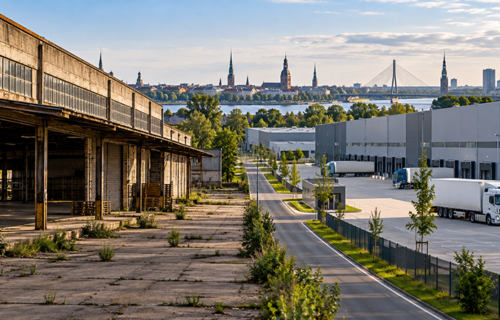
Normally, rising availability might encourage developers to delay new projects until existing properties have been absorbed. Riga is moving differently. New logistics parks are progressing, established schemes are expanding and developers continue to identify locations capable of supporting another generation of industrial property. The explanation may lie less in the quantity of warehouse space than in its quality.
Modern occupiers increasingly judge industrial properties according to the overall efficiency of their operations. Energy consumption, heating systems, loading arrangements, internal height, yard capacity, truck access and the ability to configure space around a company’s individual requirements can all influence a leasing decision. That creates a growing difference between modern logistics facilities and older industrial buildings.
A warehouse can technically be available while still being unsuitable for a major distributor, retailer or manufacturer. Older properties may offer cheaper rents, but the savings can become less attractive if a company faces higher energy expenditure, inefficient loading arrangements or operational limitations. Recent leasing activity provides evidence that this distinction matters.
At SIRIN’s developing logistics park in Dreiliņi, one incoming tenant is relocating from older B-class warehouse premises into newly constructed A-class space. The move provides a practical example of how modern developments can attract occupiers even while other industrial properties remain available elsewhere in Riga.
This process could become increasingly important as tenants gain greater bargaining power. With vacancy at 5.3%, occupiers can compare more alternatives and take longer over relocation decisions. Landlords are consequently competing not only through headline rents but also through incentives and lease terms. Prime asking rents remain around €5.50 per sqm per month at the upper end of the market, while rent-free periods have become a more common part of negotiations.
For owners of ageing warehouses, this creates a difficult competitive environment. Some older properties will continue performing well because they occupy strong locations or offer rents that newer developments cannot match. Smaller companies may also have little need for sophisticated logistics specifications. Other buildings face a more complicated future.
Owners may need to invest in insulation, heating, energy systems, loading infrastructure and internal layouts to keep their properties competitive. Where refurbishment becomes too expensive relative to achievable rents, alternative uses or eventual redevelopment may become more attractive.
Meanwhile, developers are creating new industrial locations. Dreiliņi is one of the clearest examples. SIRIN is developing approximately 27,000 sqm in the initial stage of its business park there, while VGP controls a site capable of accommodating roughly 36,000 sqm of development.
The attraction of Dreiliņi extends beyond the availability of land. Its position on the eastern side of Riga provides access to a large urban population and the city’s road network while allowing developers to create facilities designed specifically for modern distribution and light-industrial operations. This gives Riga another significant logistics cluster alongside the established airport and Mārupe corridor and other industrial locations around the capital.
The airport area demonstrates that demand for modern space remains present. SIRIN has completed another approximately 30,000 sqm phase of its logistics development near Riga Airport, taking the park to almost 60,000 sqm. Strong occupancy in the earlier phase suggests companies remain willing to commit to newer facilities despite the wider increase in market vacancy.
This is important because it changes how Riga’s industrial market should be assessed. A single city-wide vacancy figure treats every available square metre as though it were interchangeable. In practice, a recently completed distribution centre and an ageing warehouse can offer completely different propositions to an occupier.
Location adds another layer. A company distributing goods throughout Latvia may prioritise motorway access and efficient truck movements. An urban logistics operator may place greater value on proximity to Riga’s population. A manufacturer may require power capacity, labour availability and room for future expansion. The competition is therefore increasingly between combinations of buildings and locations rather than warehouse space alone.
For investors, this creates both opportunity and risk. Modern properties with strong transport connections, efficient building systems and flexible configurations may continue attracting tenants even if overall vacancy remains elevated. Older assets could require increasing capital expenditure to maintain occupancy and rents. The difference could eventually influence investment pricing.
Two industrial properties generating similar rental income today may have very different long-term values if one requires substantial modernisation while the other meets current occupier expectations. This is why continued development in Riga should not automatically be interpreted as evidence that developers are ignoring an oversupplied market.
The more important question is whether newly delivered projects are leasing successfully. If recently completed buildings continue securing occupiers while vacancies remain concentrated in older stock, Riga will increasingly resemble a market going through a replacement cycle. New properties will effectively be taking demand from buildings that no longer satisfy modern requirements.
If vacancy begins spreading significantly across newly constructed logistics parks as well, the interpretation changes. Riga would then face a more conventional problem of development running ahead of occupier demand. The next wave of completions should provide the answer.
For now, the evidence suggests that Riga’s industrial market is becoming increasingly selective. Companies have more options, negotiations are taking longer and landlords must work harder to secure tenants. Yet developers are still finding companies willing to move into modern facilities.
That is creating a dividing line across the market. The important measure of Riga’s warehouse sector may therefore no longer be simply how much space is vacant. Investors, developers and lenders increasingly need to know what kind of space is vacant.
Riga may have plenty of warehouses available, but that does not necessarily mean it has plenty of the warehouses today’s occupiers actually want.
Source: CIJ.World Research & Analysis Team