Monday, 21 September 2026
As Polish students collect their end-of-year certificates and graduates compete for university places, experts are increasingly questioning whether the country’s education system is adequately preparing young people for a rapidly evolving global economy.
The debate has intensified following the publication of the 2025 Shanghai Ranking, one of the world’s most closely watched university league tables. Poland placed seven universities among the world’s top 1,000 institutions, with the highest-ranked, the University of Warsaw, appearing in the 401–500 range. By comparison, China now has 222 universities in the top 1,000 and 13 institutions within the global top 100.
The contrast is even more striking when viewed over the past decade. In 2015, China had 32 universities in the Shanghai Ranking’s top 500 and was still widely regarded as a country catching up with Western academic and technological leaders. Today, it has emerged as one of the world’s strongest education and research powers, supported by substantial investment in science, technology and innovation.
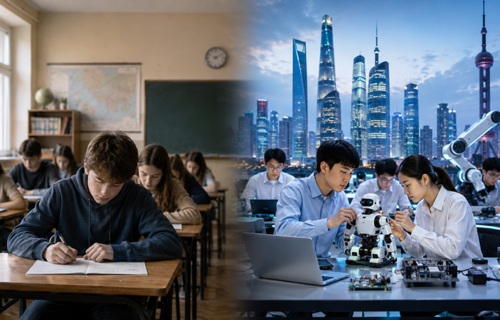
According to labour market specialists, the differing trajectories reflect broader differences in educational priorities. China has spent years strengthening mathematics, engineering, science and technology education while maintaining high academic standards. Its national university entrance examination, known as the Gaokao, remains one of the most demanding examinations globally and serves as a gateway to higher education for millions of students each year.
At the same time, China has invested heavily in research institutions and technology-focused universities, helping fuel growth in sectors such as artificial intelligence, semiconductors, robotics and electric mobility.
Krzysztof Inglot, labour market expert and founder of Personnel Service, argues that Poland’s education model remains heavily focused on memorisation and examination performance rather than developing practical skills and adaptability.
“The key question is what kind of world we are preparing young people for,” Inglot said. “The global economy increasingly rewards technological, analytical and problem-solving skills, while traditional education systems often continue to prioritise reproducing knowledge rather than creating it.”
The challenge is becoming more urgent as artificial intelligence and automation reshape labour market requirements. Employers are placing greater value on logical thinking, digital literacy, creativity and the ability to work alongside emerging technologies, while routine tasks are increasingly automated.
Experts warn that future labour market divides may be defined less by traditional distinctions between manual and office-based work and more by the gap between workers who can effectively use technology and those whose roles can be replaced by it.
Inglot argues that strengthening mathematics, programming, critical thinking and project-based learning should become central priorities if Poland hopes to remain competitive in attracting investment and creating high-value jobs.
While Poland has introduced various education reforms over recent years, analysts suggest that broader structural changes may be necessary if the country wants to narrow the gap with global leaders in higher education and innovation.
As international competition for talent, technology and investment intensifies, education policy is increasingly being viewed not only as a social issue but also as a strategic component of long-term economic competitiveness.
Source: Personnel Service