Wednesday, 23 September 2026
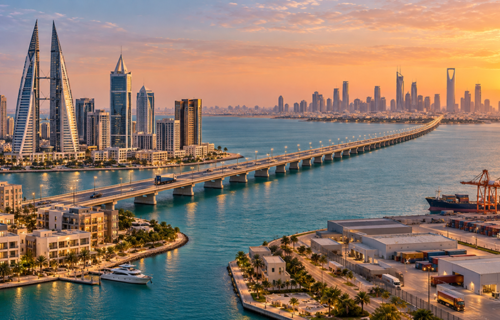
Bahrain is unlikely to compete with Saudi Arabia or Dubai by matching the volume of property they build. Its domestic market is smaller, its development pipeline is more limited and its ability to absorb large quantities of speculative real estate is correspondingly lower. That does not leave Bahrain without a compelling investment strategy. It suggests that the country needs a different one. One of Bahrain’s strongest advantages is its relationship with the much larger economy immediately to its west. The King Fahd Causeway provides a permanent physical connection with Saudi Arabia’s Eastern Province, placing Bahrain close to Dammam, Al Khobar, Dhahran and one of the kingdom’s largest concentrations of energy, industry and business activity. Rather than attempting to compete directly with this economic region, Bahrain has an opportunity to provide specialised property serving companies, workers and capital operating across both markets.
This changes the way Bahrain should be assessed by real estate investors. The country’s resident population alone does not necessarily define the potential demand available to every asset. A manufacturer can produce goods for customers across the Gulf, a logistics company can distribute into Saudi Arabia, a financial institution can serve regional clients and a hotel or shopping centre can attract visitors arriving across the causeway. The property may be located in Bahrain while part of its economic demand originates elsewhere.
Industrial and logistics real estate provides perhaps the clearest example. Bahrain has established industrial parks, logistics areas and port infrastructure designed to accommodate manufacturing, storage, distribution and internationally oriented businesses. The country’s compact geography means these locations can operate within relatively short distances of Khalifa Bin Salman Port, Bahrain International Airport, Manama and the connection to Saudi Arabia. For manufacturers, that concentration can be valuable because industrial property is only one component of operating costs. Companies also need transport, labour, utilities, port access, customs arrangements and reliable connections with suppliers and customers. Bahrain’s investment proposition therefore depends on whether the complete operating environment makes it commercially attractive to locate production or distribution on the island.
Saudi Arabia considerably enlarges the potential customer base available to such businesses. A company producing solely for Bahrain faces the limitations of a relatively small domestic market. A company using Bahrain as a production or distribution location while serving Saudi Arabia and other Gulf markets operates according to a very different economic equation. That does not mean Saudi growth will automatically produce a property boom in Bahrain. Saudi Arabia is investing heavily in its own industrial cities, ports, logistics facilities and special economic zones, giving businesses serving Saudi customers increasingly sophisticated alternatives within the kingdom itself. Bahrain must therefore provide a clear reason for companies to locate on its side of the causeway.
Specialisation is likely to be critical. Instead of competing for the largest land-intensive industrial projects, Bahrain can focus on activities where its infrastructure, business environment and regional connections provide an advantage. Manufacturing linked to regional supply chains, specialised distribution, processing and businesses requiring close interaction between industry and professional services could all fit this model. Successful manufacturing investment can also create property demand beyond the original factory. Suppliers need workshops and smaller industrial facilities, logistics operators require warehouses and yards, and employees need accommodation. Over time, industrial activity can support offices, retail, hospitality and other services around the employment it generates.
Bahrain’s established financial sector provides another important part of the strategy. Banking, insurance, investment management and related professional services have long formed a significant part of the country’s economy, giving Manama an established commercial identity that is different from property markets dependent primarily on government occupiers or large-scale corporate relocations. Saudi Arabia’s economic expansion could increase the value of that position. Financial institutions, advisers and specialist service companies operating across the Gulf may have reasons to maintain Bahrain operations while serving clients in the Eastern Province and elsewhere in Saudi Arabia.
This should not be interpreted as suggesting that Manama will challenge Riyadh for regional headquarters. Saudi Arabia’s domestic scale and policies encouraging multinational companies to establish regional operations in the kingdom give Riyadh substantial advantages. Bahrain’s opportunity is more focused: providing an efficient base for particular financial, professional and support activities whose business extends across national borders. That creates a corresponding office investment strategy. Bahrain does not require enormous speculative business districts to benefit from regional economic growth. It needs good buildings capable of attracting companies that specifically value operating from the country.
In a smaller office market, asset quality becomes particularly important. A limited number of modern, efficiently managed buildings can satisfy much of the strongest corporate demand, while excessive speculative construction can quickly create vacancy. Investors therefore need to examine individual buildings rather than assuming that broader Saudi growth will lift the entire Bahrain office market. Quality, operating efficiency, accessibility and management can matter more than the simple amount of floor space available.
Residential property could also benefit from the Saudi relationship, although the opportunity is more difficult to quantify. Some professionals, entrepreneurs and consultants have working lives that extend across both Bahrain and eastern Saudi Arabia. For these groups, Bahrain can potentially provide a residential base offering access to Manama while retaining road connectivity with the kingdom. The existing causeway makes this possible, but travel conditions matter. Congestion, border procedures and journey times can make daily commuting less predictable than movement within a conventional metropolitan area, so residential investors should avoid treating eastern Saudi Arabia as though it were simply another Bahrain employment district.
Nevertheless, cross-border mobility creates a source of potential housing demand that would not exist without the physical connection. Properties offering convenient access towards the causeway may appeal to some residents whose professional activities regularly take them into Saudi Arabia. The relationship is already relevant to hospitality, retail and leisure as well. Visitors arriving from Saudi Arabia enlarge the potential customer base available to hotels, restaurants, shopping centres and entertainment destinations. For some assets, the effective catchment therefore extends beyond Bahrain’s resident population.
This illustrates a wider investment principle. Bahrain’s relatively small size can be misleading if every property sector is measured solely through domestic demographics. Different assets can draw demand from regional trade, international businesses, tourism or cross-border movement. The important question for investors is not simply how many people live in Bahrain, but which economic activities individual properties are positioned to serve.
Future infrastructure could deepen those connections further. The proposed King Hamad Causeway is designed to add road and rail capacity between Bahrain and Saudi Arabia as part of the wider Gulf transport network. If ultimately completed, it could provide another route for passenger and freight movements while connecting Bahrain more closely with Saudi railway infrastructure. The potential industrial implications are significant. Rail access could provide manufacturers and distributors with another option for moving goods between Bahrain and the much larger Saudi market, while additional road capacity could improve the reliability of cross-border movement.
Property investors should nevertheless treat these benefits as future potential rather than current value. Major transport projects can require long development periods and remain subject to financing, procurement and construction schedules. Today’s investment case should therefore be based primarily on existing infrastructure, with future connections providing possible upside. The King Fahd Causeway already gives Bahrain a functioning economic link with Saudi Arabia. The more immediate question is how effectively the country can build property demand around what already exists.
This is particularly relevant to the Eastern Province. The concentration of energy, petrochemicals, manufacturing and professional services around Dammam, Dhahran and Al Khobar creates an economic market far larger than Bahrain’s domestic economy immediately across the water. Bahrain does not need to capture a large share of that activity for the property impact to become meaningful. A relatively small number of international manufacturers, logistics operators, financial institutions and professional-services companies can influence demand substantially within a compact property market.
Scale works differently in a country of Bahrain’s size. A logistics investment that would barely affect warehouse availability in Riyadh can have a much greater influence on Bahrain’s industrial market. Several corporate office requirements can materially change demand for the strongest buildings in Manama, while a successful manufacturing cluster can generate noticeable requirements for supporting industrial space and employee housing. This means Bahrain can potentially benefit from being selective.
Rather than maximising the amount of property constructed, development can be directed towards economic functions where there is identifiable demand. Modern logistics buildings, specialised industrial facilities, high-quality offices and professionally managed residential property may offer stronger long-term propositions than large speculative pipelines. For institutional investors, this also changes what constitutes an attractive asset. The strongest opportunities may be buildings connected to specific economic activity rather than properties relying on general market expansion.
An industrial facility leased to an established manufacturer serving regional customers provides a clearly identifiable source of income. A warehouse occupied by a logistics company distributing into Saudi Arabia has a business rationale extending beyond local consumption. An office leased to a financial institution with regional operations similarly draws its underlying demand from a wider economic area. These characteristics become especially important because Bahrain’s property investment market is less liquid than Dubai’s and smaller than the emerging institutional market in Saudi Arabia. Investors need confidence not only in current rental income but in the future relevance of the property and the potential buyer pool when the asset is eventually sold.
Long leases, strong occupiers, professional management and high building standards can therefore carry particular importance. Over time, more professionally managed property and investment structures could help broaden Bahrain’s institutional market. Portfolio transactions, funds and other vehicles could allow regional capital to participate without requiring investors to acquire individual buildings directly. Bahrain’s wider strategy, however, does not depend on becoming a smaller version of Dubai. Its competitive advantage may lie precisely in avoiding that comparison.
Dubai has built a global property market around international business, tourism, aviation and investment. Saudi Arabia is creating an enormous domestic development market through population scale, economic diversification and government-backed investment. Bahrain occupies a different position. It is compact, established, financially sophisticated and physically connected to Saudi Arabia. Those characteristics suggest a property strategy based less on development volume and more on regional economic integration.
Industrial property can support companies selling into neighbouring markets. Logistics facilities can participate in cross-border supply chains. Offices can accommodate financial and professional businesses serving Gulf clients. Residential, hospitality and retail assets can benefit from people moving between Bahrain and Saudi Arabia. Future transport investment could strengthen that model, but the underlying relationship already exists.
For investors, the key question is therefore not whether Bahrain can build enough property to compete with Riyadh or Dubai. It is whether individual Bahraini assets can capture economic demand generated by a market much larger than Bahrain itself. If the country can do that consistently, its relatively small size becomes less of a disadvantage. Property does not need millions of additional domestic consumers when its tenants are manufacturers, logistics companies, financial institutions and service businesses operating regionally.
Bahrain’s next property opportunity may therefore depend on looking west rather than upward. The measure of success will not be how dramatically the Manama skyline changes or how many millions of square metres are added to the development pipeline. It will be whether Bahrain can convert its proximity to Saudi Arabia into sustained demand for the buildings it already has and the specialised property it chooses to develop next. Bahrain does not need to match its neighbours in scale. Its stronger strategy may be to make its connection to them economically valuable.
Source: CIJ.World Research & Analysis Team