Wednesday, 23 September 2026
Competition authorities could increasingly use automated analysis of corporate communications to identify signs of possible coordination between competitors, according to research from DIW Berlin developed with experts from the European Commission. The approach examines statements made publicly by companies rather than relying solely on evidence obtained through investigations or information supplied by whistleblowers.
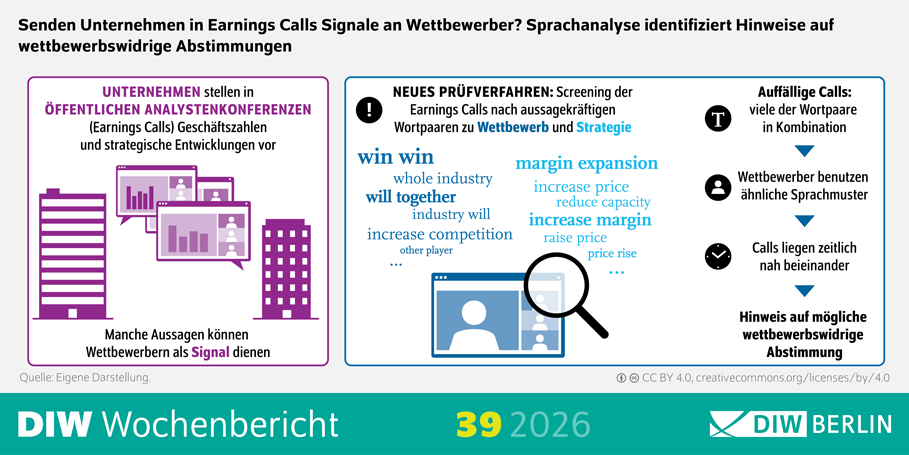
The research focuses particularly on earnings calls, where listed companies regularly discuss financial results and business strategy with investors and analysts. Researchers examined around 367,000 calls involving approximately 15,000 companies worldwide between 2004 and 2022, searching for combinations of language relating to strategic decisions, competitors and wider industry behaviour.
Individual statements are not treated as evidence of wrongdoing. Instead, the method looks for situations in which several competing companies repeatedly use similar language within a relatively short period. References to pricing, margins or controlling capacity can become more relevant to investigators when competitors are discussing comparable strategies at approximately the same time.
DIW researchers found that around one fifth of the earnings calls analysed contained language referring both to corporate strategy and competitive conditions. Research into the US airline industry provided one example of how such communication could warrant closer examination, with capacity subsequently declining on routes where competing airlines had discussed limiting capacity during the same period.
The methodology has already attracted the attention of European competition authorities. DIW says results from the screening contributed to European Commission inspections of several tyre manufacturers in January 2024. The Commission was examining whether public communications between manufacturers could have played a role in possible price coordination. Such inspections form part of an investigation and do not themselves establish that competition rules have been breached.
For competition regulators, automated language analysis could substantially reduce the amount of material that needs to be reviewed manually. Instead of examining enormous collections of transcripts, announcements and other corporate communications individually, screening technology can identify unusual patterns for further assessment. DIW stresses that the results are indicators rather than proof and that specialist economic and legal examination remains necessary.
The development could have implications beyond the industries examined in the research. Listed real estate companies, developers, construction groups and building-material manufacturers regularly discuss rents, prices, margins, development pipelines, capacity and market conditions with investors. The DIW research does not establish anti-competitive behaviour in these sectors, but the growing ability of regulators to analyse public corporate communications means that statements made during earnings calls and other investor discussions could increasingly become part of competition-law screening.