Monday, 5 October 2026
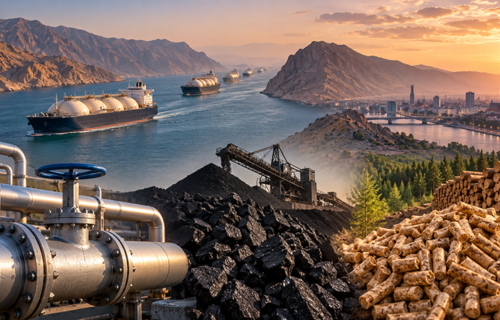
European natural gas prices remained more than twice their pre-crisis level at the end of September, while coal and wood pellets recorded considerably smaller increases, highlighting how differently energy markets have responded to disruption around the Strait of Hormuz.
Dutch TTF gas traded at around EUR 32/MWh immediately before the conflict escalated at the end of February. By late September, the European benchmark was close to EUR 70/MWh, leaving wholesale gas prices more than 100% above their pre-crisis level.
The increase followed a severe disruption to global LNG supply. Before the conflict, almost one-fifth of international LNG volumes passed through the Strait of Hormuz. The International Energy Agency says the effective closure of the waterway created a significant supply shock, pushing European and Asian gas prices sharply higher. Although prices subsequently retreated from their initial peaks, European gas remained well above 2025 levels.
Shipping conditions have recently started to improve, but LNG movements remain far from normal. S&P Global Energy recorded 19 LNG cargoes leaving the strait during September, while Kpler counted 21. If the stronger pace recorded towards the end of the month continues, shipments could recover to around a quarter of their pre-conflict level.
Qatar’s reduced exports remain particularly important for the European market. By the end of August, only 18 Qatari LNG cargoes had been delivered compared with 509 during the equivalent period of 2025, according to ICIS data reported by Reuters. QatarEnergy has also extended supply interruptions affecting customers in Europe and Asia, increasing competition for replacement LNG as the winter heating season approaches.
Coal has also become more expensive, although its exposure to the crisis has been less direct. The ARA thermal coal benchmark cited by ResInvest Commodities increased from USD 106.25 per tonne on 27 February to USD 136.05 at the end of September, equivalent to approximately 28%. The IEA says virtually no coal moves through Hormuz, but higher gas prices have encouraged greater coal use in some markets, creating an indirect link between the Middle East disruption and coal demand.
German wood-pellet prices have moved much less. The DEPV benchmark for a six-tonne delivery increased from EUR 395.07 per tonne in February to EUR 424.50 in September, a rise of EUR 29.43 or 7.45%. The benchmark measures the average German price for bulk-delivered ENplus A1 pellets and includes associated delivery costs but excludes VAT.
The pellet market has nevertheless experienced considerable movement during the year. Prices declined to EUR 352.12 per tonne in June before rising again during the third quarter, reaching EUR 399.74 in August and EUR 424.50 in September. This indicates that the February-to-September increase should not be interpreted as a steady upward trend following the Hormuz crisis.
The three price measures are also not directly equivalent. TTF gas and ARA coal are internationally traded market benchmarks capable of reacting rapidly to geopolitical developments, whereas the DEPV figure represents a monthly German physical-delivery price. The comparison therefore demonstrates the different scale of price movements rather than proving that one fuel is inherently more resistant to geopolitical shocks.
For European property owners, the divergence illustrates the increasing importance of energy sourcing to building operating costs. Properties dependent on natural gas remain exposed to international LNG availability, shipping routes and competition between Europe and Asia. Biomass is influenced more by European production and regional supply chains, although manufacturing, transport and raw-material costs can still push prices higher.
Seven months after the initial disruption, European energy markets therefore remain far from their pre-crisis position. LNG traffic through Hormuz is beginning to recover, but continuing restrictions on Gulf exports mean that gas remains particularly exposed as Europe moves towards winter, while the much smaller increase in German pellet prices demonstrates how unevenly the energy shock has spread across different fuels.