Friday, 2 October 2026
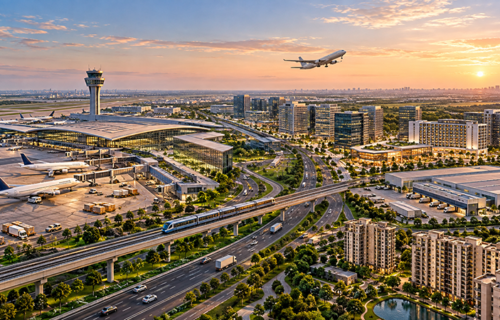
India’s expanding aviation network is beginning to influence where the country’s next commercial and logistics districts are developed. Airports are increasingly being planned not simply as transport infrastructure but as anchors around which offices, hotels, logistics facilities, industrial developments, retail and eventually residential communities can grow. For real estate investors, selected airport corridors are therefore emerging as a new layer of India’s urban property market.
The scale of India’s aviation expansion provides the foundation for this development. Passenger traffic increased from around 190 million in FY2015 to 412 million in FY2025, while the government expects volumes to reach approximately 665 million by FY2031. The operational airport network has expanded even faster, increasing from 74 airports in 2014 to 165 by July 2026. Air cargo has also grown, rising from approximately 2.53 million tonnes in FY2015 to 3.72 million tonnes ten years later. Together, these trends are creating greater demand for commercial activity around the country’s busiest aviation hubs.
Delhi Aerocity provides one of the clearest examples of what this can mean for property. Developed on more than 230 acres adjoining Indira Gandhi International Airport, the district already includes more than 4,000 hotel rooms alongside offices, restaurants, retail and corporate occupiers. Further development is expected to take the area’s office, retail and mixed-use inventory to approximately 18 million sq ft by 2029. What began primarily as an airport hospitality location is increasingly functioning as a substantial commercial district in its own right.
Other airports are pursuing development on an even larger scale. Hyderabad’s airport-related development extends across roughly 1,500 acres, with around 5 million sq ft already developed and land allocated to industrial and logistics activities alongside commercial, hospitality and other uses. Bengaluru Airport City, meanwhile, is targeting more than 45 million sq ft of development by 2040. These projects demonstrate how airport land can evolve into long-term real estate platforms rather than remaining limited to terminals, parking and aviation services.
The next generation of airport-led development is particularly visible around Noida International Airport and the wider Yamuna Expressway corridor. Planning for the area includes logistics and warehousing, offices, hotels, serviced accommodation, technology facilities, data centres, aerospace activities, retail and housing. Rather than allowing development to emerge incrementally after the airport becomes established, the surrounding district is being planned as part of a much larger industrial and urban growth corridor.
Cargo could become an equally important driver of airport-related property. Growth in manufacturing, pharmaceuticals, electronics, perishables, e-commerce and other time-sensitive supply chains increases the value of locations offering rapid access to air freight. This can create opportunities for logistics parks, distribution centres, temperature-controlled facilities, specialised warehouses and manufacturing operations around airports, particularly where aviation infrastructure is connected efficiently with expressways and industrial corridors.
Residential development represents a secondary effect rather than the starting point of the airport property story. Large airport districts can generate employment across aviation, hospitality, logistics, offices, manufacturing and services, eventually supporting housing demand within practical commuting distance. Navi Mumbai and Panvel illustrate the potential. Residential values have risen strongly as Navi Mumbai International Airport and major transport infrastructure have progressed, although the airport is only one of several factors reshaping the wider corridor.
Airport development therefore does not guarantee a property boom. Smaller airports with limited passenger traffic, weak cargo volumes or poor surface connectivity may generate relatively little surrounding commercial development. Successful airport districts require sufficient demand, developable land, road and public transport connections, supportive planning and an economic base capable of attracting businesses beyond aviation itself. Property appreciation based only on expectations of a future airport can consequently carry considerable risk.
India’s airport expansion nevertheless has the potential to alter the country’s investment map. Delhi demonstrates that an established airport can support a major commercial district, Hyderabad and Bengaluru are extending the concept across much larger mixed-use developments, while Noida is integrating airport-led growth into the planning of an entirely new economic corridor. As passenger volumes, cargo flows and airport infrastructure continue to expand, selected airports could become increasingly important anchors for India’s next generation of offices, hotels, logistics facilities, industrial property and supporting residential development.
Source: © CIJ.World India Research & Analysis Team