Tuesday, 20 October 2026
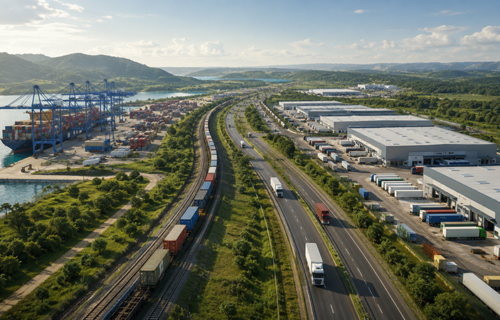
Africa’s investment in ports, railways and highways is beginning to produce a second, potentially much larger, opportunity for investors. As major transport routes improve, attention is shifting towards the warehouses, industrial parks, manufacturing sites, inland terminals and distribution centres that could develop around them. This represents an important change in how African infrastructure can be viewed from a commercial real estate perspective. A railway connecting a mineral-producing region to a port, or a highway linking several national markets, has value beyond the movement of freight. Where sufficient trade volumes develop, these connections can change the economics of surrounding land and create new locations for industrial and logistics investment.
The African Continental Free Trade Area could accelerate this process. Greater movement of goods between African economies will require additional storage, processing and distribution capacity. This means the property opportunity is unlikely to remain concentrated around traditional seaports and capital cities. Railway terminals, border crossings, industrial zones and major highway intersections could increasingly become investment locations in their own right.
One of the most closely watched examples is the Lobito Corridor, connecting Angola’s Atlantic coast with the mineral-producing areas of the Democratic Republic of Congo and, through planned extensions, Zambia. The project gained considerable momentum during 2026, including major financing for the Lobito Atlantic Railway and additional development funding supporting Zambia’s participation in the wider corridor programme.
Copper and cobalt provide much of the immediate commercial rationale, particularly as global demand for minerals used in electrification and advanced technologies continues to grow. The longer-term opportunity, however, is whether better transport connections encourage more economic activity to remain within the corridor rather than simply making raw-material exports faster. That could support logistics facilities, mineral processing, agricultural storage, light manufacturing and industrial development at several points between the Copperbelt and Angola’s Atlantic coast. Lobito itself could attract additional port-related property investment, while inland locations may become increasingly viable as freight volumes and regional connections improve.
This distinction is important. The greatest economic return from new infrastructure may not come from moving commodities more efficiently from mine to ship, but from creating locations where goods can be processed, stored and manufactured before reaching their final markets.
East Africa provides a more mature illustration of this relationship. The Northern Corridor connects the Port of Mombasa with Nairobi and extends towards Uganda, Rwanda, the Democratic Republic of Congo and other inland markets. The route already carries substantial regional trade and incorporates roads, railway infrastructure and inland freight facilities. Kenya’s current strategy is aimed at improving the corridor’s competitiveness through the end of the decade. For industrial property, this could reinforce an investment pattern already visible around Nairobi, where logistics development has increasingly moved beyond older industrial districts towards peripheral locations offering larger development sites and improved highway connections.
The Mombasa-Nairobi axis remains particularly important. Improvements in freight handling and inland distribution could support additional warehousing, container facilities and industrial parks, while Nairobi’s role as East Africa’s main corporate and consumer market provides occupier demand that many emerging African logistics locations still lack.
Tanzania’s Central Corridor is simultaneously becoming a stronger competitor for inland East African trade. Dar es Salaam provides maritime access for several landlocked economies, including Rwanda, Burundi and parts of the Democratic Republic of Congo. Tanzania’s continuing investment in standard-gauge railway infrastructure has the potential to improve the competitiveness of this route and create new development opportunities around inland freight terminals. The commercial property consequences could extend well beyond Dar es Salaam. Railway junctions and inland terminals with reliable electricity, road connections and development land could attract warehousing, agricultural processing and manufacturing facilities as freight movements increase.
Competition between the Northern and Central Corridors may ultimately benefit the region. Landlocked businesses can increasingly compare alternative routes according to transport cost, reliability, border processing and port efficiency. Investment should consequently favour the locations that provide the most dependable connection between production centres and international markets.
Southern Africa already demonstrates how an established transport route can support a broader industrial economy. The Maputo Development Corridor connects Mozambique’s principal port with South Africa’s industrial heartland. Road, rail and border infrastructure link Maputo with Gauteng and important mining and manufacturing regions along the route. Unlike newer corridor initiatives, this is already an operating economic system with significant freight volumes. Continued expansion of the Port of Maputo could strengthen demand for storage, distribution, transport services and industrial property on both sides of the border.
Maputo’s longer-term development plans envisage considerably greater cargo throughput by the early 2030s. Achieving that growth would require supporting infrastructure outside the port itself, potentially strengthening industrial and logistics locations around Maputo and along the route towards South Africa.
West Africa could eventually produce an even larger property story through the proposed Abidjan-Lagos corridor. The approximately 1,000-kilometre route would connect Côte d’Ivoire, Ghana, Togo, Benin and Nigeria, bringing together some of West Africa’s largest ports, cities and consumer markets. Rather than functioning simply as an international motorway, plans for the corridor envisage accompanying economic development, including logistics and industrial locations.
The potential scale is significant. Abidjan, Accra, Lomé, Cotonou and Lagos form an increasingly important coastal economic belt. Better road connections between them could allow manufacturers and distributors to serve several national markets from larger regional facilities instead of maintaining fragmented operations in individual countries. This could create opportunities for distribution centres, cold storage, truck terminals, manufacturing facilities and modern logistics parks around metropolitan fringes and strategic border locations.
For commercial real estate investors, however, infrastructure announcements alone are not sufficient to make these locations investible. A modern logistics park requires dependable electricity, water, telecommunications infrastructure, road access and secure land ownership. International occupiers also require appropriate fire protection, security, loading facilities and building specifications that are still unavailable across much of Africa’s existing industrial stock.
Border efficiency presents another challenge. A modern highway provides limited commercial benefit when trucks subsequently spend excessive periods waiting for customs clearance. Improvements to border processing, digital documentation and inland customs facilities will therefore influence which corridors become genuinely competitive. This creates a potentially important role for inland ports and freight terminals, where containers can be cleared, transferred, stored and redistributed while reducing pressure on coastal gateways and encouraging logistics development further inland.
Special economic zones could provide another route for converting infrastructure investment into commercial property development. By combining serviced land with utilities, customs arrangements and transport connections, these locations can remove some of the barriers that otherwise discourage international occupiers. The development around Lekki in Nigeria illustrates the model. The Lagos Free Zone sits alongside the Lekki Deep Sea Port and combines industrial development with direct access to maritime infrastructure. International institutional investment in the project demonstrates that capital can be attracted when industrial property and major transport infrastructure form part of the same development strategy.
The implications for land investment could be considerable. As freight corridors mature, sites close to railway terminals, highway interchanges, ports and industrial zones can become substantially more useful for commercial development. Locations previously regarded as peripheral may consequently become important distribution or manufacturing centres. But the risks are equally clear. Infrastructure projects can be delayed for years, financing can change, planned railway alignments can be altered and expected cargo volumes may never materialise. Purchasing land beside a proposed corridor therefore carries a very different risk profile from investing around established infrastructure with proven freight demand.
The strongest opportunities are likely to emerge where several factors converge: functioning transport infrastructure, growing cargo volumes, reliable utilities, clear land ownership and an established or rapidly developing occupier base. That produces a varied investment picture across Africa.
The Northern Corridor and Maputo already connect substantial existing economies and therefore offer relatively established industrial and logistics opportunities. Tanzania’s Central Corridor is becoming increasingly significant as railway investment progresses. Lobito offers potentially transformational development linked to Central Africa’s mineral economy, but much of its wider property opportunity remains at an earlier stage. The Abidjan-Lagos route could eventually become one of the continent’s most important logistics and manufacturing belts because of the scale of the cities and consumer markets it would connect, although its commercial real estate potential will depend heavily on execution and genuine improvements in cross-border movement.
AfCFTA adds a common thread to all these projects. If African economies succeed in reducing the practical barriers to trading with each other, distribution networks will gradually need to be reorganised around regional rather than purely national markets. That could change warehouse requirements fundamentally. Larger regional distribution centres may become viable, manufacturers could locate closer to transport corridors serving several countries, and logistics operators could consolidate activities into purpose-built facilities.
For property investors, Africa’s infrastructure programme therefore presents an opportunity that extends considerably beyond roads, railways and ports. The critical locations to watch are where transport infrastructure intersects with population, production, energy and developable land. These are the places where freight routes have the greatest chance of becoming industrial economies rather than simply transit routes.
By the end of the decade, some of Africa’s most interesting logistics property markets may consequently be found not in today’s established commercial districts, but around the ports, inland terminals, railway junctions and highway corridors that are now reshaping the continent’s trade geography.
Source: © CIJ.World Africa Research & Analysis Team