Thursday, 8 October 2026
Mexico City’s retail property sector remained relatively stable during the second quarter of 2026, with established shopping centres maintaining high occupancy and retailers continuing to pursue selected expansion opportunities. The underlying consumer picture became less consistent as the quarter progressed, however, increasing the importance of location, visitor numbers and the overall quality of individual retail destinations.
The capital and its surrounding metropolitan area remain Mexico’s largest concentration of modern retail property. Market estimates indicate that the region contains approximately 8.1 million square metres of shopping-centre space, representing close to one third of the national total. This scale gives Mexico City a substantially larger retail base than any other Mexican metropolitan area and continues to make it the principal destination for brands entering or expanding within the country.
Occupancy among the stronger institutional shopping-centre portfolios remains high. Large property owners with significant exposure to Mexico City are generally reporting levels of around 94% to 95%. Across the wider Mexican retail market, occupancy is estimated at approximately 90%, suggesting that established centres in the capital are performing above the broader national market.
New construction continues but is more measured than in previous expansion periods. More than 800,000 square metres of retail property is currently being developed across Mexico, with part of this pipeline located in Mexico City and its metropolitan area. New supply increasingly forms part of larger developments combining shops with offices, residential accommodation, restaurants, entertainment and services.
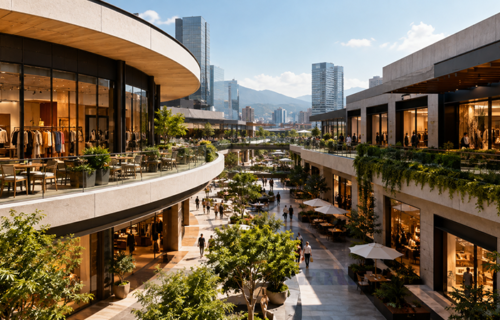
This approach reflects changing consumer habits. Shopping centres are increasingly expected to provide reasons to visit beyond purchasing clothing or household goods. Restaurants, cafés, fitness facilities, entertainment, health services and everyday conveniences are becoming more important components of successful projects, helping landlords generate regular visits throughout the week.
Retailers continue to open stores, although expansion is becoming more targeted. Grocery operators, restaurants, specialist retailers and businesses connected with health, wellness and personal services have remained active. Brands are paying closer attention to local population density, household spending power, accessibility and existing visitor flows before committing to additional locations.
Rental levels continue to differ substantially according to property type and location. The average advertised retail rent across Mexico was approximately USD 28.93 per square metre per month at the end of the second quarter. The figure is a national benchmark rather than a Mexico City average, and the capital contains both significantly more expensive premium locations and considerably cheaper secondary space.
Polanco and Avenida Presidente Masaryk remain among the strongest destinations for luxury and international brands, benefiting from affluent local customers, tourism and a concentration of restaurants and hotels. Large regional shopping centres elsewhere in the metropolitan area rely more heavily on extensive residential catchments and their ability to combine shopping with entertainment and dining.
While property occupancy remained relatively strong, consumer spending became noticeably softer during the quarter. Comparable sales among retailers belonging to ANTAD increased 4.3% year on year in April before slowing to 0.8% in May and declining 1.6% in June.
Sales including recently opened stores performed better, increasing 6.6% in April, 3.0% in May and 0.6% in June. This indicates that continued store openings helped maintain overall revenue growth even as existing locations experienced more difficult trading conditions.
During the first six months of 2026, comparable sales increased by approximately 1.5%, while total sales including new stores grew by around 3.7%. ANTAD members generated approximately MXN 814 billion in sales during the period. Although these figures cover Mexico as a whole rather than Mexico City specifically, they provide an important measure of the consumer environment affecting retailers operating in the capital.
Performance also differed considerably between retail categories. Specialist businesses performed relatively well during parts of the quarter, while department stores experienced greater fluctuations. Consumers therefore appear to be adjusting their spending rather than reducing it evenly across all categories.
For property owners, this creates a greater need to manage the mix of businesses within their centres. Food, entertainment, fitness, healthcare and services can generate visits even when discretionary spending on products becomes more cautious. The ability to combine these uses with traditional shops is becoming increasingly important to maintaining customer numbers.
The result is a widening difference between successful centres and less competitive properties. Modern schemes in strong locations with established visitor flows are retaining retailers and attracting new concepts. Older centres that lack a clear identity, convenient access or a strong food and leisure offer face greater pressure to modernise and reposition.
Investment interest nevertheless remains present. Retail was identified as a preferred property sector by around 18% of respondents in a 2026 Mexican real estate investor survey, while Mexico City continued to rank as the country’s leading destination for property investment.
The outlook for the second half of 2026 is therefore one of stability rather than rapid expansion. Mexico City benefits from its enormous consumer base, concentration of higher-income households and continued interest from domestic and international retailers. High occupancy among established centres also limits the immediate risk of a significant increase in empty space.
Slower growth in consumer spending means landlords and retailers are likely to remain cautious. New stores will increasingly need to justify themselves through strong locations and reliable customer flows, while significant rental increases may be difficult to achieve outside the best-performing properties.
Mexico City’s retail market is consequently becoming less about adding shopping space and more about improving what already exists. The strongest properties are evolving into mixed destinations where shopping sits alongside restaurants, entertainment, fitness and everyday services. As this transition continues, the gap between centres capable of attracting regular visitors and those dependent on traditional shopping alone is likely to become one of the defining features of the market through the remainder of 2026.
Research & Analysis: CIJ.World