Wednesday, 7 October 2026
Germany’s move towards higher public spending could make European Central Bank interest-rate increases less effective at slowing inflation across the eurozone, according to research from the German Institute for Economic Research (DIW Berlin). The study suggests that the effect of monetary tightening depends partly on whether national governments respond to higher financing costs by cutting expenditure or borrowing more.
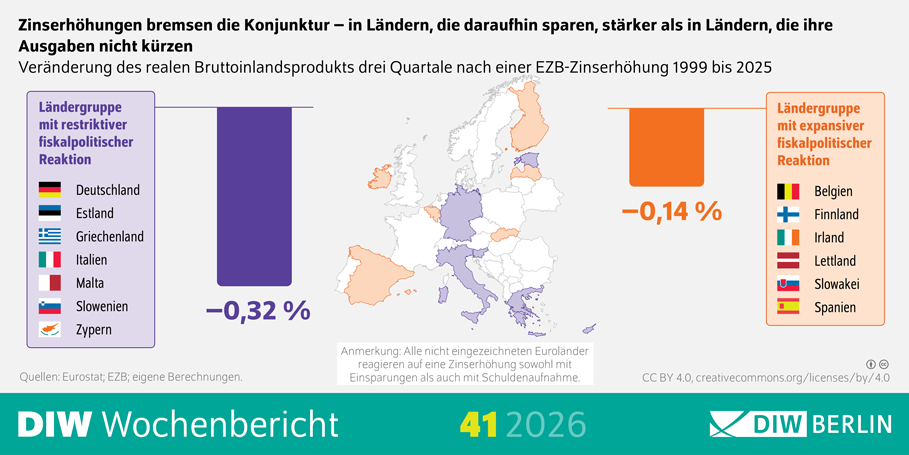
Using Eurostat data covering the period from 1999 to 2025, DIW researchers examined how fiscal policy interacted with increases in ECB rates. In countries where governments generally tightened their budgets following higher interest rates, real GDP was estimated to be 0.32% lower three quarters after a monetary-policy increase. Among countries where governments maintained expenditure and accepted additional borrowing, the corresponding decline was 0.14%.
The smaller economic contraction comes with a trade-off. DIW found that inflation eventually declined less in countries pursuing the more expansionary fiscal approach. Government borrowing can therefore absorb some of the pressure that higher interest rates place on economic activity, while simultaneously reducing the effectiveness of monetary tightening in bringing price growth down.
Germany historically belonged to the first group, alongside countries including Italy, Greece and Estonia. Its fiscal framework, particularly the debt brake, limited the government’s ability to compensate for higher financing costs through additional borrowing. DIW argues that this relationship is now likely to change following Germany’s 2025 fiscal reforms and increased commitments to infrastructure and defence.
The change is particularly important because Germany is the eurozone’s largest economy. If German government expenditure remains elevated while the ECB is attempting to restrict demand, part of the impact of higher rates could be offset by fiscal policy. DIW consequently argues that the ECB may need to pay greater attention to government spending decisions when determining the scale and duration of monetary tightening.
The study comes as the ECB faces renewed inflationary pressure following the economic disruption associated with the Iran war. DIW considers it possible that a more expansionary German fiscal position could contribute to a situation in which interest rates need to remain restrictive for longer, or monetary policy has to be tightened further, to achieve the same effect on eurozone inflation. This is a potential consequence identified by the researchers rather than a forecast of future ECB decisions.
For European property markets, the interaction between fiscal and monetary policy has implications beyond government finances. A longer period of restrictive interest rates would continue to influence bank lending, bond yields, refinancing costs and property valuations. At the same time, Germany’s increased infrastructure expenditure could support construction and economic activity, meaning the fiscal shift could have different effects across individual real estate sectors.
Germany’s policy change therefore introduces another variable into the outlook for European financing conditions. Monetary policy does not operate independently of national budgets, and the DIW research indicates that fiscal expansion in the eurozone’s largest economy could alter how strongly future ECB decisions pass through to growth and inflation.