Wednesday, 7 October 2026
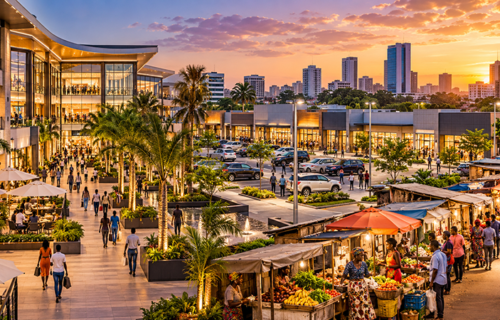
Africa’s retail property market is becoming increasingly difficult to define by a single development model. Large destination malls remain important in many cities, but investment and expansion are increasingly spreading across neighbourhood centres, grocery-led schemes and smaller formats located closer to where consumers live. At the same time, traditional independent retailers continue to handle a substantial part of everyday spending in many African markets.
The change is particularly visible in East Africa. In Kenya, developers have become more selective about adding large volumes of shopping-centre space following earlier periods of rapid expansion. Smaller neighbourhood projects and mixed-use developments are becoming more prominent, while supermarket operators are extending their networks into residential catchments. By the end of 2025, Naivas had 113 stores, while Quickmart operated 63 locations and Carrefour 34, illustrating how competition for everyday consumer spending is spreading well beyond the largest shopping destinations.
This does not mean that established malls are becoming obsolete. Nairobi’s leading shopping centres continue to record occupancy above 90%, showing that well-positioned destinations can coexist with the expansion of smaller formats. The emerging distinction is increasingly between centres with strong locations, tenant mixes and established catchments and weaker properties that struggle to give shoppers sufficient reason to travel.
South Africa provides an even clearer example of this divide. Retail property attracted R7.5 billion of investment during 2024, accounting for around 30% of commercial real estate transaction volumes that year. Smaller convenience centres were frequently traded, demonstrating investor interest in assets serving everyday local demand. Yet the latest performance figures show that large shopping centres remain highly competitive. During the first quarter of 2026, super-regional centres produced some of the strongest growth in trading densities in the market.
New development is consequently taking several forms rather than converging on one model. Grocery-led centres remain attractive because food, pharmacy, services and other frequently purchased goods generate repeat visits from surrounding residential areas. South Africa’s R650 million GrandWest Mall development, where construction started in 2026, demonstrates that investors are still prepared to commit significant capital to convenience-oriented projects when the surrounding catchment and tenant demand support them.
Lagos is showing a similar movement towards proximity. Limited additions to the city’s conventional mall stock have coincided with greater attention to retail serving residential communities. In a market where household budgets and transport costs can strongly influence purchasing decisions, locations that allow consumers to combine grocery shopping, services and other everyday requirements within shorter journeys have an obvious advantage.
Alongside formal property development sits another part of the African retail economy that cannot be ignored. Independent shops, markets and neighbourhood traders remain central to consumer distribution in many countries. Their strength comes partly from their proximity to customers, ability to sell in small quantities and deep integration within local communities. Rather than disappearing as formal retail expands, these businesses are increasingly likely to exist alongside supermarkets, shopping centres and digital commerce.
There is also no single African retail model. Cairo, for example, continues to attract larger lifestyle and mixed-use developments combining shopping with restaurants, entertainment and leisure. South Africa supports both highly established regional malls and smaller community centres, while markets such as Kenya and Nigeria are seeing stronger interest in formats embedded within residential areas. What works in one city may therefore be unsuitable for another.
For property investors, this makes understanding the individual catchment increasingly important. Population density, household incomes, transport patterns, competing retail supply and the strength of informal commerce can matter as much as the overall size of a city. A smaller centre positioned around frequent household spending may outperform a larger development in one location, while a dominant regional mall can continue attracting consumers and international brands in another.
Africa’s retail story is therefore becoming less about replacing the shopping mall and more about building a wider range of formats around how people actually shop. The strongest opportunities are likely to emerge where developers match the scale, tenant mix and accessibility of a project to local spending patterns. In an increasingly diverse retail market, proximity and convenience are becoming more valuable, but the best destination malls remain firmly part of the investment landscape.
Source: © CIJ.World Africa Research & Analysis Team