Sunday, 4 October 2026
Extreme weather is increasingly affecting European companies beyond the immediate cost of damaged infrastructure or interrupted transport. Disruptions to supply chains, commodity markets and industrial production are beginning to feed through into corporate liquidity, working-capital requirements and payment behaviour, adding another layer of risk for businesses already operating in an uncertain economic environment.
The strengthening El Niño weather pattern is adding to those concerns. International climate forecasts indicate that the event is likely to intensify during the second half of 2026, with NOAA estimating a greater than 90% probability that it will become very strong during the Northern Hemisphere autumn and winter of 2026–27. Current projections suggest its influence could continue into spring 2027.
For European companies, the significance lies less in the climate phenomenon itself than in its potential economic consequences. Changes in rainfall and temperatures across major agricultural regions can affect harvests and the availability of commodities such as coffee, cocoa, soy, sugar, rice and palm oil. The effects vary substantially between crops and producing countries, but greater uncertainty over output can translate into volatile prices and more complicated procurement decisions.
Germany is particularly exposed to this type of disruption because of the importance of international trade to its economy and its dependence on imported raw materials. Manufacturers can face higher purchasing and transportation costs at the same time as customers in affected export markets experience their own financial pressures.
Frank Liebold, Country Director Germany at Atradius, said increasingly severe weather events are becoming a multi-dimensional economic issue, affecting growth, international trade and ultimately the way companies manage payments and financial risk.
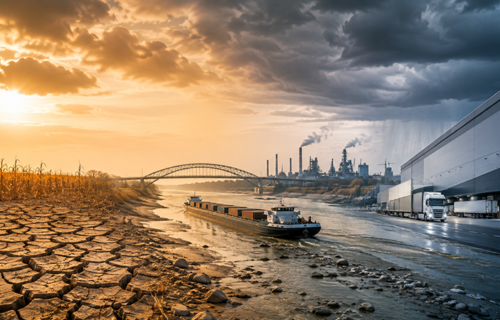
The present situation on the Rhine demonstrates how quickly environmental conditions can become an industrial and financial problem.
Low water levels during the summer have restricted freight movements along one of Europe’s most important transport corridors. Reduced vessel capacity has increased transportation costs and forced some companies to move freight onto rail and road networks. Chemical producers, steelmakers, energy companies and other industrial users dependent on the river have been among the businesses facing disruption.
These conditions should not be attributed directly to El Niño. The Rhine’s low water levels reflect European heat and rainfall patterns influenced by several climatic factors. Nevertheless, the situation provides a clear example of how physical disruption can eventually affect corporate finances.
When normal transport capacity becomes unavailable, companies may have to pay more for alternative logistics, maintain larger inventories or wait longer for essential materials. Deliveries can be delayed while capital remains tied up in goods that have not yet reached customers. Businesses may therefore experience higher costs at precisely the same time that revenues are being postponed.
For companies with limited financial headroom, prolonged disruption can put pressure on working capital. Suppliers may be asked for longer payment periods, companies may require additional short-term financing and payments to creditors can begin to slow.
This is where climate-related disruption becomes relevant to credit risk.
The timing is significant because German companies are already operating in an environment of elevated insolvency and payment concerns. Atradius research for 2026 points to continued caution among businesses when extending trade credit, while companies remain concerned about the financial condition of customers and the possibility of further corporate failures.
Weather-related disruption should not therefore be regarded as an independent explanation for rising insolvencies. Instead, it represents an additional pressure capable of aggravating existing problems caused by weak economic growth, financing costs, geopolitical uncertainty, energy prices and international trade disruption.
The interaction between these risks is becoming increasingly important. Geopolitical instability affecting shipping routes and energy markets can raise transportation and production costs, while weather events can simultaneously disrupt agricultural production and inland logistics. Companies can consequently face several different supply-side pressures at the same time.
For the commercial property sector, the implications extend beyond the physical resilience of individual buildings.
Industrial and logistics occupiers depend on transport networks, energy infrastructure, suppliers and international distribution systems. A warehouse or production facility may suffer no physical damage from an extreme weather event while the company operating inside it experiences substantial financial disruption because materials cannot arrive or finished products cannot reach customers.
This changes the way climate exposure needs to be considered by property owners, investors and lenders. Assessing whether a building can withstand heat, flooding or other extreme conditions remains important, but the resilience of the occupier’s wider business model is becoming increasingly relevant as well.
Logistics operators may need alternative transportation routes, while manufacturers could maintain larger inventories of strategically important materials. Companies dependent on rivers, ports or individual overseas suppliers may increasingly have to diversify their supply networks. These changes can affect demand for warehouse space, inventory strategies and the location of future industrial investment.
Buildings themselves are also becoming more expensive to operate in some circumstances. Higher cooling requirements during prolonged heat, greater investment in resilience, rising insurance costs and the need to protect water and energy supplies can all add to occupiers’ expenditure.
The financial consequences can therefore extend throughout the property relationship. Higher operating costs affect tenants, weaker occupier finances increase risk for landlords, and changes in tenant credit quality can ultimately influence lenders and investors.
Climate resilience is consequently developing from a predominantly environmental and technical consideration into a broader financial issue.
The same shift is becoming visible elsewhere in the real estate industry, where insurers, banks and investors are paying greater attention to the potential effect of physical climate exposure on operating costs, financing conditions, asset liquidity and future property values.
For companies, the lesson from the current period is not that every drought, heatwave or El Niño cycle will lead to financial distress. The greater concern is the cumulative effect of repeated disruptions occurring alongside other economic pressures.
A delayed shipment may initially be a logistics problem. If the disruption persists, it can become an inventory and cost problem. If revenues are delayed while expenses continue rising, it becomes a liquidity issue. When that pressure begins affecting the ability of companies to pay suppliers and creditors, the consequences move into the financial system.
For investors, developers, landlords and lenders, understanding climate risk therefore increasingly means looking beyond the physical condition and location of a property. The ability of the businesses occupying those buildings to maintain production, secure supplies, move goods and meet their financial obligations during periods of disruption is becoming another component of real estate risk.