Sunday, 4 October 2026
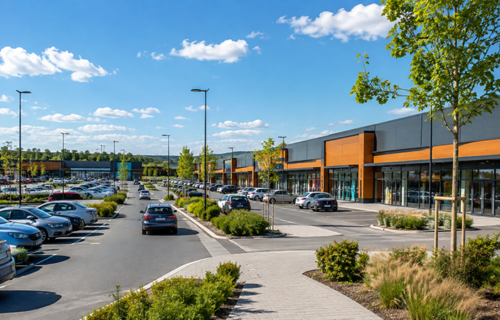
Poland’s modern retail market continued to expand during the first half of 2026, with more than 200,000 sqm of new space taking total stock above 14 million sqm, according to Colliers. Development remains heavily concentrated in retail parks, particularly in smaller cities and around the edges of the country’s largest metropolitan areas.
By the end of June, Poland had 738 modern retail properties, while market density reached approximately 374 sqm per 1,000 inhabitants.
Development accelerated during the second quarter, when almost 150,000 sqm was added. Ten new properties opened and seven existing schemes were extended during the period, with every project delivered in the retail park format.
The pipeline indicates that this pattern will continue. More than 600,000 sqm is currently under construction, according to Colliers, and retail parks represent approximately 95% of that volume. Most of the space is scheduled for completion during 2026.
Smaller cities accounted for a significant proportion of recent development. Almost 60% of the new retail space completed during the first half was delivered in cities with fewer than 100,000 residents.
Among the largest openings were BIG Dzierżoniów, with 16,800 sqm, and M Park Zawiercie, providing 15,500 sqm.
Developers are also targeting satellite locations around Poland’s major cities. Recent projects have been delivered in Niepołomice near Kraków, Kosakowo in the Tricity metropolitan area and Ozorków around Łódź. The Stara Papiernia retail complex in Konstancin-Jeziorna, outside Warsaw, also completed an extension in June.
Further suburban developments are planned, including the approximately 23,000 sqm Świderek project in Otwock and new retail properties in Pruszcz Gdański.
Another part of the development cycle involves the conversion of older shopping centres, particularly properties originally designed around large hypermarket anchors.
During the second quarter, the former Glinki shopping centre in Bydgoszcz was redeveloped into the approximately 16,000 sqm Comfy Park. Similar conversions are under way in Kalisz and Rybnik.
Europa Centralna in Gliwice is also undergoing significant redevelopment. Following demolition works, the former shopping-centre format is being replaced with a retail park that will provide approximately 10,000 sqm.
Wojciech Wojtowicz, Senior Analyst in Colliers’ Market Insights department, said the redevelopment of former hypermarket-led schemes remains an important feature of the market, with further conversions expected before the end of the year.
At the same time, Poland is seeing some older shopping properties disappear entirely as land is redirected towards other uses. Demolition of Arkady Wrocławskie is under way, while a shopping centre in Gdańsk’s Chełm district closed at the end of June.
Further closures or withdrawals have been announced for properties including Galeria Bemowo in Warsaw, Alfa Centrum in Gdańsk and Krokus in Kraków.
Retailer expansion is continuing alongside the development pipeline.
Several brands made their Polish physical-store debuts during the second quarter. The Leather Trading Company and Ksisters opened at Złote Tarasy in Warsaw, while Danish retailer Søstrene Grene entered Westfield Arkadia.
The area around Arkadia also gained Poland’s first PadelCity courts, illustrating the increasing integration of leisure concepts with established retail destinations.
At the premium end of the market, Swiss watchmaker IWC Schaffhausen opened its first Polish boutique at Plac Trzech Krzyży in Warsaw in cooperation with W.Kruk.
Trussardi, meanwhile, returned to Poland after a three-year absence through an outlet store at Designer Outlet in Piaseczno.
Marta Cegielnik, Co-Managing Director of Retail Agency at Colliers, said Poland continues to attract concepts ranging from value retail and fast food through to premium and luxury brands.
Warsaw’s strongest shopping centres remain the preferred starting point for many international entrants, although some operators are increasingly testing regional cities first. Recent examples include food concepts iLunch and Burgermeister, while fashion brand kay/day entered Poland through Kraków in July.
Outlet centres are also continuing to provide a route into the country for returning international brands.
Poland’s expanding retail park market is also changing the type of occupiers developers are seeking.
Fitness, sport and recreational operators are taking a larger role as landlords attempt to broaden schemes beyond conventional shopping.
KNOX opened a 420 sqm high-intensity interval training studio at Fabryka Norblina, while San Padel joined the Mysiadło retail park. Xtreme Fitness opened locations including new facilities in retail parks in Bydgoszcz and Ozorków, and Zdrofit added a gym at the Kłobucka Street retail park in Warsaw.
Centrumrowerowe.pl joined M1 Zabrze and Comfy Park Bydgoszcz, while Decathlon expanded its store at Galeria Bronowice in Kraków.
Anna Radecka-Łysiak, Co-Managing Director of Retail Agency at Colliers, said increasing competition means developers can no longer rely primarily on location, accessibility and the size of the local population to differentiate new retail parks.
Tenant composition is becoming more important, combining everyday retail with destination operators such as DIY, home furnishings and drive-through restaurants, while sport, wellness, recreation and educational-entertainment concepts are increasingly being used to distinguish individual projects.
Architecture and the quality of common areas are also gaining importance as the retail park format develops beyond its earlier emphasis on relatively simple, convenience-led properties.
Discount and off-price retailers remain another source of expansion. TK Maxx, for example, opened new stores during the second quarter at Galeria Kazimierz in Kraków and Pasaż Grunwaldzki in Wrocław.
The first-half figures point to a Polish retail development market that remains active but is changing considerably in structure. Rather than another cycle dominated by large enclosed shopping centres, most new construction is being directed towards smaller retail parks, suburban catchments and regional cities.
With more than 600,000 sqm still under construction and 95% of that pipeline represented by retail parks, the format is set to strengthen its position further during the second half of 2026. At the same time, the conversion and removal of ageing shopping centres suggests that growth in Poland’s overall retail stock is increasingly occurring alongside a broader restructuring of the country’s existing retail property base.