Sunday, 4 October 2026
European logistics property markets showed further signs of stabilisation during the first half of 2026, with Asian companies becoming an increasingly important source of warehouse and industrial demand across several countries, according to the latest GARBE PYRAMID MAP.
The research covers 122 logistics submarkets across 25 European countries and points to a market in which rental levels are proving relatively resilient despite geopolitical uncertainty, higher energy costs and changing expectations for interest rates.
One of the more significant changes identified by GARBE is the growing role of Chinese and other Asian companies establishing logistics and production infrastructure directly in Europe. Demand is coming not only from e-commerce operators, but increasingly from businesses connected with batteries, electric vehicles and semiconductor supply chains.
The shift reflects a broader restructuring of how Asian companies serve European customers. Instead of relying predominantly on international parcel shipments and a limited number of European distribution points, some businesses are holding more inventory within Europe and building regional supply networks.
“In an ever larger number of European markets, Chinese companies are quickly becoming an autonomous driver of demand for warehouse space,” said Tobias Kassner, Head of Research and Member of the Executive Board at GARBE Industrial.
According to GARBE, Poland is particularly exposed to this trend through e-commerce. After relatively subdued letting activity last year, the sector has contributed to stronger take-up during 2026, with Asian occupiers responsible for part of the increase.
Germany, France and the UK are also attracting enquiries connected with e-commerce distribution. Existing buildings that can be occupied relatively quickly are particularly attractive to this group of tenants.
The Rotterdam-Duisburg-North Rhine-Westphalia corridor remains important for distributing goods into Germany and the wider European market. In the Netherlands, proximity to major ports is also supporting requirements associated with batteries and energy storage, while UK enquiries include both battery-related facilities and companies considering more localised manufacturing and supply chains.
GARBE cautions, however, that these trends differ considerably between countries and should not yet be interpreted as a uniform European shift.
The additional occupier activity is beginning to affect availability, although it has not produced widespread rental increases.
After vacancy increased in several European logistics markets as projects completed into weaker leasing conditions, GARBE sees evidence that the situation is starting to stabilise. Existing space is being absorbed in some locations while developers have become more cautious about starting speculative schemes.
The result is a more balanced relationship between new construction and occupier demand than during the earlier adjustment period.
Defence-related investment could provide another source of industrial and logistics demand over the longer term. GARBE expects the effect to develop gradually because major European defence programmes will take time to translate into property requirements. Some activity may also remain difficult to identify because of confidentiality or because requirements are recorded within other industrial categories.
Rental movements during the first six months of 2026 illustrate the increasingly differentiated nature of the European market.
Of the 122 locations monitored by GARBE, prime rents were unchanged in 79. Another 29 recorded increases, while rents declined in 14 markets.
Average prime rent across the surveyed locations stood at €7.52 per sqm per month at the end of June.
Rental growth was concentrated mainly in tighter markets in Northern, Western and Southern Europe. Many Central and Eastern European locations recorded little movement, with some experiencing modest decreases.
Investment pricing moved in a somewhat different direction.
Prime net initial yields increased in 62 of the markets covered, remained unchanged in 51 and compressed in only nine. Across the survey, yields moved outwards by an average eight basis points during the first half, reaching an average of approximately 5.6%.
The movement reverses part of the yield compression recorded during the second half of 2025.
GARBE attributes the change principally to geopolitical uncertainty, energy prices and altered expectations surrounding interest rates rather than a fundamental weakening of investor interest in logistics property.
Spain and selected regional UK markets currently offer some of the more favourable combinations of rental growth and improving investment pricing identified by GARBE.
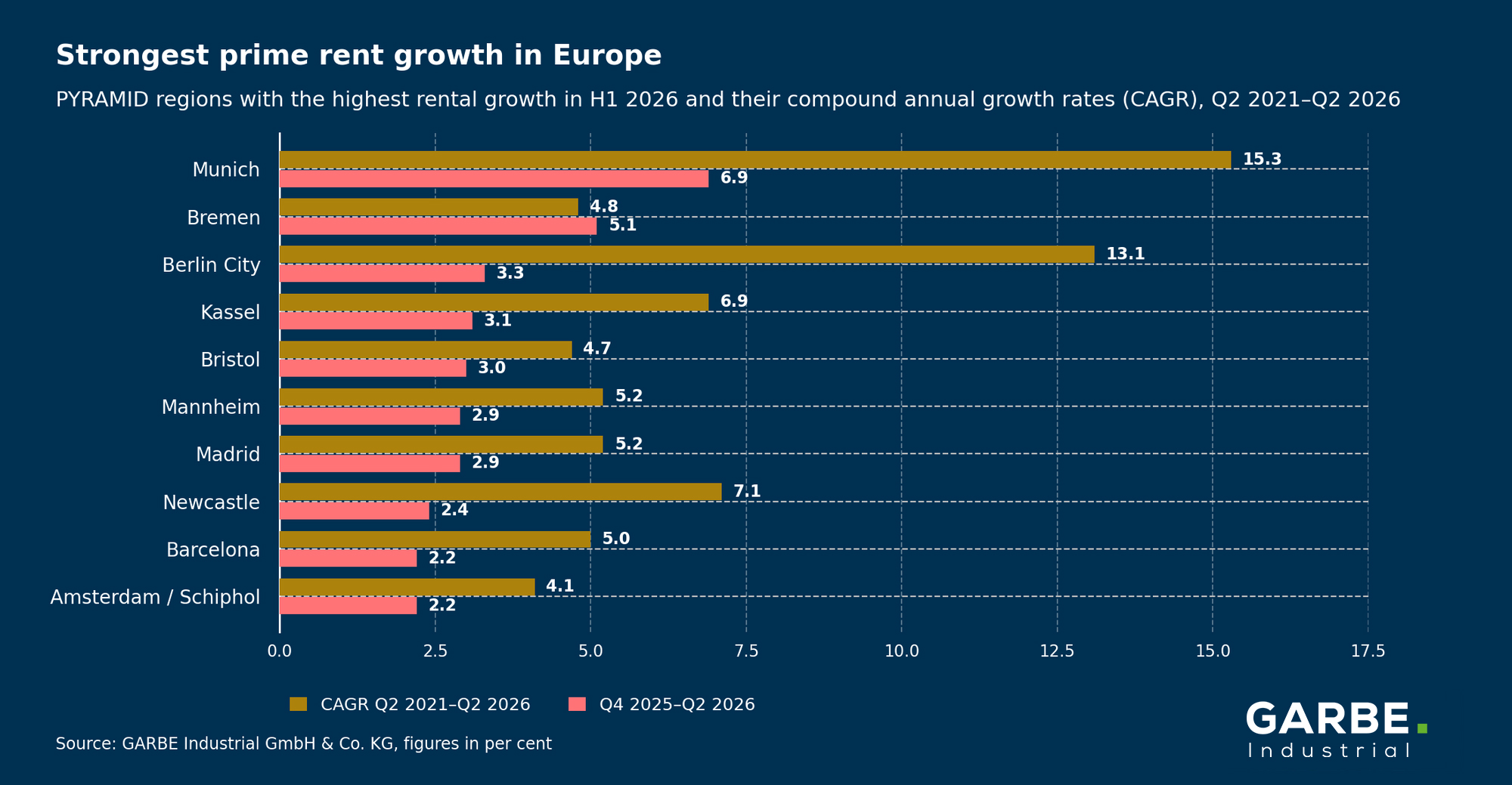
Barcelona recorded a €0.20 per sqm increase in prime rents during the first half while prime yields compressed by ten basis points. Zaragoza registered rental growth of €0.10 per sqm alongside a 20-basis-point reduction in yields.
Newcastle followed a similar pattern, with rents increasing by €0.20 per sqm and yields tightening by ten basis points.
This represents a change from 2025, when some of Germany’s largest logistics markets offered a particularly strong combination of rental and yield movements.
Munich and central Berlin nevertheless continued to record significant rental growth. Prime rents increased by 6.9% in Munich and 3.3% in Berlin City compared with the end of 2025.
Over five years, GARBE calculates average annual rental growth of 15.3% in Munich and 13.1% in central Berlin. Conditions on Berlin’s outskirts have been less tight because occupiers have a larger selection of available warehouse space.
The findings suggest Europe’s logistics market is moving away from the broad repricing phase that followed the interest-rate shock and towards a more location-specific cycle. Rental performance, investment yields and occupier demand increasingly depend on local supply conditions and the industries driving requirements.
At the same time, the expansion of Asian e-commerce, technology and manufacturing companies is adding another dimension to European logistics demand. If the localisation of inventories and supply chains continues, requirements from Asian occupiers could become an increasingly important influence on development and leasing strategies in Poland, Germany, the Netherlands, France, the UK and other major distribution markets.