Trei Delivers First 330 Apartments at UP2U Rental Housing Project in Poznań

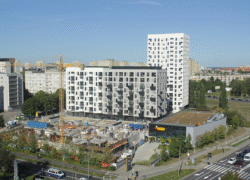
Trei Real Estate has completed the first phase of its UP2U rental housing development in Poznań, Poland. The project, with an investment volume of approximately €51 million, will provide 460 furnished apartments and 875 square metres of commercial space by 2026.

The newly completed phase includes 330 apartments ranging from one- to three-room units, each between 26 and 65 square metres in size. The flats are fully furnished, and the scheme also offers underground parking and landscaped courtyards. The first tenants are expected to move in from October 2025.

“Poland’s private rental market is still at an early stage of development, particularly in large cities such as Poznań, where demand consistently outpaces supply,” said Pepijn Morshuis, CEO of Trei Real Estate. “We are pleased to have completed the first stage of the project on schedule and to see such strong tenant interest.”

Sustainability has been built into the development. Planned features include photovoltaic panels, rainwater collection for irrigation, and infrastructure for cycling. The project has already secured BREEAM certification with a “Very Good” rating.

Located in Poznań’s Winiary district, the site benefits from good transport links to the city centre and proximity to retail, including a supermarket operated by Biedronka, which is part of Trei’s portfolio.

“The UP2U concept reflects the principles of the 15-minute city, combining modern architecture, functional living spaces and sustainable technologies,” said Mariusz Cegielski, Managing Director of Trei Real Estate Poland. “We believe it will contribute positively to the district’s development and attractiveness.”

Catella Research: European logistics markets show stable yields and moderate rent growth

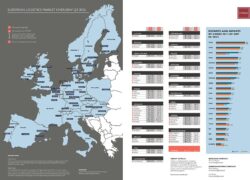
Catella has released its European Logistics Market Overview Q2 2025, analysing 50 logistics markets across 21 countries. The report highlights steady demand for warehouse space, shaped by supply chain shifts, alongside stabilising yields and elevated rental levels.

According to Catella, nearshoring and reshoring continue to drive demand as companies seek shorter supply chains and greater proximity to end markets amid trade tensions and global economic uncertainties. The trend is reinforcing the sector’s position as a core part of the European commercial real estate market.

“Prime rents for logistics properties had already been rising for years before accelerating with the outbreak of the war in Ukraine,” said Dr. Lars Vandrei, Head of Research at Catella Investment Management. “Although investment activity slowed after interest rate changes, logistics assets have since reached the same investment relevance as offices and remain central to the sector.”

Yields: steady with selective compression
The unweighted average prime yield across the surveyed markets was reported at 5.42%. While stability is expected overall, slight yield compression remains possible in selected locations, including Lyon, Marseille, Lille, Berlin, Munich, Warsaw, Wrocław, Budapest, and Ljubljana. Among the highest yields are Ljubljana at 8.75% and Oulu in Finland at 8.25%.

Rents: strong in metropolitan markets
Average prime rents across Europe stand at €8.10 per sqm per month. London leads with €27.50, followed by Zurich (€16.50) and Oslo (€15.50). At the lower end, Wrocław reports prime rents of €4.50. Catella notes that rents remain elevated in major metropolitan areas, reflecting strong occupier demand and limited supply.

Trade dependency: significant contrasts across Europe
The report also assessed the degree of trade dependency by country. Slovakia shows the highest export ratio at 75.5% of GDP, followed by Slovenia (63.0%) and Ireland (58.2%). Slovakia also tops import dependency at 75.8%. In contrast, the United Kingdom shows the lowest export share of GDP (14.1%) and more moderate import reliance (22.4%), despite recording the highest logistics rents and largest transaction volumes in Europe.

“Overall, we are seeing stabilisation in the markets,” said Marten Helms, Senior Fund Manager Europe at CIM. “Monitoring trade flows closely and identifying regions with potential remain key, particularly under current global uncertainties. We also see opportunities for counter-cyclical investment in sustainable logistics assets.”

Source: Catella
Download: Logistics Map on the below link:

Knihobot to Relocate to New Warehouse in Prague’s Hostivař

Knihobot, the second-hand book retailer, will expand its operations by relocating to new warehouse premises in Logicor Prague Průmyslová, in the Hostivař district. The company has signed a long-term lease for a 10,400 sqm facility, with the move scheduled for January 2026. The transaction was brokered by Savills.

The new space will function as a distribution centre for Knihobot’s markets, including the Czech Republic, Germany, Slovakia, Austria, France, Italy, Spain, the Netherlands, and Belgium. The company currently handles more than 7,000 parcels a day and expects about 10 million books to pass through its system this year.

According to CEO Ladislav Bárta, the relocation is intended to meet rising demand and allow for gradual implementation of automation technologies. The company employs more than 1,000 people, many of them students, and offers flexible shifts.

Logicor stated that the site is designed to accommodate urban logistics and last-mile delivery. Its Hostivař location offers access to public transport as well as Czech highway connections.

Knihobot to Relocate to New Warehouse in Prague’s Hostivař

Knihobot, the second-hand book retailer, will expand its operations by relocating to new warehouse premises in Logicor Prague Průmyslová, in the Hostivař district. The company has signed a long-term lease for a 10,400 sqm facility, with the move scheduled for January 2026. The transaction was brokered by Savills.

The new space will function as a distribution centre for Knihobot’s markets, including the Czech Republic, Germany, Slovakia, Austria, France, Italy, Spain, the Netherlands, and Belgium. The company currently handles more than 7,000 parcels a day and expects about 10 million books to pass through its system this year.

According to CEO Ladislav Bárta, the relocation is intended to meet rising demand and allow for gradual implementation of automation technologies. The company employs more than 1,000 people, many of them students, and offers flexible shifts.

Logicor stated that the site is designed to accommodate urban logistics and last-mile delivery. Its Hostivař location offers access to public transport as well as Czech highway connections.

Brama Jury Shopping Centre in Zawiercie to Open in November

Master Management Group has announced that the Brama Jury shopping and entertainment centre in Zawiercie will open on 14 November 2025.

The new complex combines features of a traditional shopping mall with a retail park and will offer 16,400 sqm of retail and service space. The centre’s tenant mix includes grocery, fashion, entertainment, fitness, and service operators.

Among the anchor tenants are H&M, Sinsay, New Yorker, Diverse, Big Star, Ochnik, Sizeer, Wojas, and 4F. The centre will also host jewellery and cosmetics retailers such as W. Kruk, Apart, Briju, Douglas, Rossmann, and Hebe. Other brands include Empik, Agata, Dr Materac, and Maxi Zoo.

For everyday needs, an Intermarché grocery store has been confirmed. Service tenants include all four major mobile operators—Plus, Play, Orange, and T-Mobile—as well as travel agencies Itaka and TUI.

The project also introduces a four-screen Planet Cinema, a One Gym fitness club, and a food court with cafés and restaurants.

Located at 4 Zagłębiowska Street, the development sits close to national road No. 78 and the A1 motorway, providing regional accessibility. A parking lot with 525 spaces has been built for visitors.

According to Master Management Group, the tenant portfolio was developed based on the company’s experience with retail properties across Poland.

River Park 2 nears final approvals as Bratislava waterfront makeover advances

Bratislava’s long-planned extension of the River Park development is moving into its last permitting steps, with separate phases now in formal building proceedings and a redesigned public square set to replace the once-proposed planetarium.

In mid-August 2025, the “Waterside” sector (CPR-A), led by Cresco Real Estate, entered construction permitting, described as the final administrative hurdle before works can begin. The move follows years of preparatory procedures on the former PKO site along the Danube.

At the same time, the adjoining blocks CPR-B and CPR-C—prepared by J&T Real Estate (JTRE) and Cresco through their joint vehicle WOAL—also progressed. Proceedings tied to technical infrastructure for the CPR-B/C buildings have started, and municipal notices indicate that the wider build process for these sections formally opened in September.

A key design change this year is the confirmed shift from a planned planetarium to a new public space named Lanfranconi Square, intended to anchor the eastern part of the site and extend the river promenade with landscaping and amenities. Project materials and reporting frame the square as the focal point for the next phase of the waterfront’s renewal.

Developers and the city expect a phased rollout once permits are granted, with the Waterside/CPR-A component positioned to move first, followed by work on the CPR-B/C blocks and associated infrastructure. While detailed unit counts, parking totals and fit-outs have not been disclosed in 2025 public filings, the scheme is consistently described as mixed-use—combining housing, offices and ground-floor retail—aimed at stitching an upgraded promenade into the existing River Park frontage.

Market context in Bratislava has been broadly supportive for new urban waterfront projects this year. New-build apartment pricing has held firm through mid-2025, with prime schemes continuing to draw interest despite tighter financing conditions. That backdrop, combined with visible site-level permitting progress, suggests a clearer path to breaking ground than at any point in recent years.

With CPR-A in building proceedings and CPR-B/C infrastructure procedures underway, the project team is targeting the issuance of final permits needed to launch construction. The public realm redesign—centered on Lanfranconi Square—remains the most notable update, recasting the former planetarium plot as a landscaped gateway to the river.

Photo: River Park 1, 2010 Completed, JTRE

River Park 2 nears final approvals as Bratislava waterfront makeover advances

Bratislava’s long-planned extension of the River Park development is moving into its last permitting steps, with separate phases now in formal building proceedings and a redesigned public square set to replace the once-proposed planetarium.

In mid-August 2025, the “Waterside” sector (CPR-A), led by Cresco Real Estate, entered construction permitting, described as the final administrative hurdle before works can begin. The move follows years of preparatory procedures on the former PKO site along the Danube.

At the same time, the adjoining blocks CPR-B and CPR-C—prepared by J&T Real Estate (JTRE) and Cresco through their joint vehicle WOAL—also progressed. Proceedings tied to technical infrastructure for the CPR-B/C buildings have started, and municipal notices indicate that the wider build process for these sections formally opened in September.

A key design change this year is the confirmed shift from a planned planetarium to a new public space named Lanfranconi Square, intended to anchor the eastern part of the site and extend the river promenade with landscaping and amenities. Project materials and reporting frame the square as the focal point for the next phase of the waterfront’s renewal.

Developers and the city expect a phased rollout once permits are granted, with the Waterside/CPR-A component positioned to move first, followed by work on the CPR-B/C blocks and associated infrastructure. While detailed unit counts, parking totals and fit-outs have not been disclosed in 2025 public filings, the scheme is consistently described as mixed-use—combining housing, offices and ground-floor retail—aimed at stitching an upgraded promenade into the existing River Park frontage.

Market context in Bratislava has been broadly supportive for new urban waterfront projects this year. New-build apartment pricing has held firm through mid-2025, with prime schemes continuing to draw interest despite tighter financing conditions. That backdrop, combined with visible site-level permitting progress, suggests a clearer path to breaking ground than at any point in recent years.

With CPR-A in building proceedings and CPR-B/C infrastructure procedures underway, the project team is targeting the issuance of final permits needed to launch construction. The public realm redesign—centered on Lanfranconi Square—remains the most notable update, recasting the former planetarium plot as a landscaped gateway to the river.

Photo: River Park 1, 2010 Completed, JTRE

EU Asset Transparency Gaps Persist as Dirty Money Risks Grow

Despite renewed regulations, law enforcement and financial investigators in the European Union continue to face serious obstacles in tracing who really owns what — especially when it comes to assets held through complex structures. A recent report from Transparency International finds that registers of legal ownership are often incomplete, fragmented, or out of sync with registers of beneficial ownership. This leaves significant loopholes that corrupt actors and financial criminals can exploit.

Investigators in several EU countries report that while major asset types — real estate, motor vehicles, watercraft, aircraft — may be registered, details such as transaction price, beneficial ownership, and ownership through companies or trusts are frequently missing or hard to access. Under current rules, only the registered legal owner is listed in many systems. If the asset is held indirectly, critical information about the person benefitting most is often inaccessible or only discoverable through difficult cross-referencing. Delays in access, lack of standard formats or machine-readable registers, and restrictive jurisdictions complicate efforts to investigate illicit flows.

The problem is compounded by weak oversight for “professional enablers” — lawyers, accountants, corporate service providers, real estate brokers — who can help establish opaque ownership chains. Transparency International’s priorities emphasize that these actors must be subject to stronger regulation, clearer duties to check and report suspicious structures, and robust sanctions for failing to do so. Golden visa and golden passport schemes are cited as especially vulnerable: investors abroad can gain residency or citizenship in exchange for real estate investment under frameworks that have sometimes allowed weak checks on the ultimate beneficiary of the investment.

While EU legislation has made advances — such as the 6th Anti-Money Laundering Directive (AMLD6) and the updated Anti-Money Laundering Regulation — which expand requirements for registering beneficial ownership and broaden reporting obligations (including those for crypto assets and certain asset classes like watercraft or aircraft), member states’ implementation remains inconsistent. Some are ahead, having laws and registers largely compliant; others still lag in transposing rules or filling transparency gaps, especially around assets held through foreign companies or trusts.

Investigators also report that even when registers exist, their utility is limited by poor digitalization, incomplete data sharing between registries, and insufficient tools for data analysis. Authorities in several countries say they lack full access to ownership registers, whether due to legal restrictions, national law, or lack of interoperability. Transparency International’s research argues that for anti-corruption and asset recovery efforts to be effective, public authorities need fast, reliable access to comprehensive ownership and transactional data, ideally via centralized and interlinked registers.

The “Dirty Money” agenda underlines several areas where enforcement is also weak: inadequate sanctions for misuse, lack of clarity in legislation governing beneficial ownership and real estate ownership, and limited resources for law enforcement, financial intelligence units, and asset recovery offices. According to Transparency International, only a fraction of assets stolen and hidden globally are ever seized, let alone returned.

To strengthen the EU’s ability to trace and recover illicit assets, the report calls for harmonized minimum standards across all member states, full transparency in ownership of real estate, vehicles, aircraft, and vessels, mandatory reporting of beneficial owners for all types of legal entities, and greater powers for authorities and civil society to access and scrutinize data. Strong, enforceable oversight and meaningful penalties for noncompliance are also highlighted as essential.

In short, while European law has moved forward in closing some gaps, much of the framework remains untested in practice. The effectiveness of recent reforms will depend heavily on how quickly and thoroughly member states overcome technical, legal, and institutional barriers — and how seriously they treat the risk posed by dirty money.

Source: Transparency International

EU Asset Transparency Gaps Persist as Dirty Money Risks Grow

Despite renewed regulations, law enforcement and financial investigators in the European Union continue to face serious obstacles in tracing who really owns what — especially when it comes to assets held through complex structures. A recent report from Transparency International finds that registers of legal ownership are often incomplete, fragmented, or out of sync with registers of beneficial ownership. This leaves significant loopholes that corrupt actors and financial criminals can exploit.

Investigators in several EU countries report that while major asset types — real estate, motor vehicles, watercraft, aircraft — may be registered, details such as transaction price, beneficial ownership, and ownership through companies or trusts are frequently missing or hard to access. Under current rules, only the registered legal owner is listed in many systems. If the asset is held indirectly, critical information about the person benefitting most is often inaccessible or only discoverable through difficult cross-referencing. Delays in access, lack of standard formats or machine-readable registers, and restrictive jurisdictions complicate efforts to investigate illicit flows.

The problem is compounded by weak oversight for “professional enablers” — lawyers, accountants, corporate service providers, real estate brokers — who can help establish opaque ownership chains. Transparency International’s priorities emphasize that these actors must be subject to stronger regulation, clearer duties to check and report suspicious structures, and robust sanctions for failing to do so. Golden visa and golden passport schemes are cited as especially vulnerable: investors abroad can gain residency or citizenship in exchange for real estate investment under frameworks that have sometimes allowed weak checks on the ultimate beneficiary of the investment.

While EU legislation has made advances — such as the 6th Anti-Money Laundering Directive (AMLD6) and the updated Anti-Money Laundering Regulation — which expand requirements for registering beneficial ownership and broaden reporting obligations (including those for crypto assets and certain asset classes like watercraft or aircraft), member states’ implementation remains inconsistent. Some are ahead, having laws and registers largely compliant; others still lag in transposing rules or filling transparency gaps, especially around assets held through foreign companies or trusts.

Investigators also report that even when registers exist, their utility is limited by poor digitalization, incomplete data sharing between registries, and insufficient tools for data analysis. Authorities in several countries say they lack full access to ownership registers, whether due to legal restrictions, national law, or lack of interoperability. Transparency International’s research argues that for anti-corruption and asset recovery efforts to be effective, public authorities need fast, reliable access to comprehensive ownership and transactional data, ideally via centralized and interlinked registers.

The “Dirty Money” agenda underlines several areas where enforcement is also weak: inadequate sanctions for misuse, lack of clarity in legislation governing beneficial ownership and real estate ownership, and limited resources for law enforcement, financial intelligence units, and asset recovery offices. According to Transparency International, only a fraction of assets stolen and hidden globally are ever seized, let alone returned.

To strengthen the EU’s ability to trace and recover illicit assets, the report calls for harmonized minimum standards across all member states, full transparency in ownership of real estate, vehicles, aircraft, and vessels, mandatory reporting of beneficial owners for all types of legal entities, and greater powers for authorities and civil society to access and scrutinize data. Strong, enforceable oversight and meaningful penalties for noncompliance are also highlighted as essential.

In short, while European law has moved forward in closing some gaps, much of the framework remains untested in practice. The effectiveness of recent reforms will depend heavily on how quickly and thoroughly member states overcome technical, legal, and institutional barriers — and how seriously they treat the risk posed by dirty money.

Source: Transparency International

Slovakia to Roll Out EU Entry/Exit System on 12 October, Full Operation Due by 10 April 2026

Slovakia will join other Schengen members in launching the European Union’s new Entry/Exit System (EES) at external borders on 12 October 2025. The system will gradually replace passport stamping for short-stay non-EU travellers with electronic registration, including biometric checks. Full operation across all participating states is scheduled for 10 April 2026.

The EES will record travellers’ identity data along with entry, exit and refusal events, and will capture biometric identifiers such as facial images and fingerprints. It is designed to make border checks faster and more consistent, help detect identity fraud and overstays, and strengthen efforts against terrorism and serious crime. Slovakia’s Ministry of Interior has confirmed the country’s readiness for the phased introduction.

The system will apply to third-country nationals entering the Schengen area for short stays, whether under visa-free arrangements or with a visa. It will not apply to people holding residence permits or residence cards, including qualifying family members of EU citizens. Ireland and Cyprus are not participating in the scheme.

During the first months of implementation, some border points will continue using stamps as the new infrastructure is introduced. Travellers are advised to allow additional time for checks, particularly at their first entry after launch, when biometric enrolment may be required.

At the EU level, the central EES platform is managed by the agency eu-LISA. Member states are responsible for deploying the system nationally, which involves installing biometric kiosks, upgrading IT infrastructure, and training staff. While Slovakia has described its preparations, it has not published specific cost estimates for the rollout.

The introduction of the EES will precede the separate ETIAS travel authorisation system, which is expected to follow once EES is fully operational, likely in late 2026. Until then, travellers should continue to check official EU and Slovak government channels for updates on border procedures.

Source: minv

LATEST NEWS