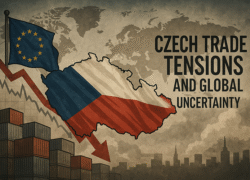
Czech Banking Association lowers economic growth forecast amid trade tensions and global uncertainty

The Czech Banking Association (CBA) has revised its economic outlook for the Czech Republic, projecting GDP growth of 1.7% for 2025 and a moderate increase to 2.0% in 2026. This marks a downward adjustment from the February forecast, which had anticipated growth of 2.1% this year and 2.4% next year. Economists attribute the revised outlook primarily to escalating global trade tensions, particularly the anticipated imposition of U.S. tariffs on European goods, which are expected to average 12% in 2026. These tariffs are forecast to reduce Czech GDP by 0.8 percentage points over two years.

Despite this, the Czech economy entered 2025 with slightly stronger momentum than initially anticipated. Labour market conditions remain stable, and inflation appears to be under control, limiting the need for aggressive monetary or fiscal intervention. Real wages are expected to return to pre-pandemic levels in 2026.

Consumer price growth is forecast to slow to 2.3% in 2025 and 2.2% in 2026. Nominal wages are expected to rise by 5.9% this year and remain below 5% next year. This supports real wage growth of 3.5% in 2025 and 2.7% in 2026, a slightly more optimistic trajectory than earlier forecasts suggested. The labour market is expected to remain stable, with unemployment rising only modestly to 4.2% in 2025 before easing slightly to 4.1% in 2026.

The Czech National Bank (CNB) is likely to continue reducing its key interest rates gradually. One more rate cut to 3.25% is expected this year, followed by a further decline to 3.0% in 2026. The forecast for the koruna exchange rate suggests modest strengthening from CZK 25 per euro at the end of 2025 to CZK 24.7 by the end of 2026, supported by interest rate differentials and weakening of the U.S. dollar.

In the broader European context, the eurozone is expected to grow by only 0.9% in 2025 and 1.2% in 2026, with Germany in particular facing stagnation. As a result, the European Central Bank is forecast to cut its refinancing and deposit rates more aggressively than previously assumed, to 1.9% and 1.75% respectively by the end of the year.

The CBA poll also revealed divided expectations regarding inflationary and disinflationary pressures stemming from global trade disruptions, with half of economists expecting some disinflation in Czech prices as a result of the U.S.–China tariff conflict.

The composition of economic growth in the Czech Republic is expected to rely increasingly on domestic consumption. Household consumption rose 2% year-on-year in 2024 and is projected to increase by 3% in 2025 and 2.5% in 2026. Government spending, supported by defense investments and the electoral cycle, will also contribute, with a 2.5% increase expected in 2025 following a flood-related 3.3% increase in 2024.

Fixed investment remains weak due to uncertainties linked to global trade and structural challenges such as high energy prices and international competition. A recovery in private investment is not expected until 2026. Export growth is also projected to remain subdued, rising just 1.5% in 2025 and 3% in 2026—lower than previously forecast—partly due to earlier frontloading of U.S.-bound shipments and weakening global demand.

While inflationary pressures from energy and fuel prices have eased, core inflation remains elevated due to persistent service sector wage growth and high rents. Consumer price inflation is expected to remain slightly above the CNB’s target, with core inflation forecast at 2.6% in 2025 and 2.3% in 2026. As a result, the CNB is likely to maintain a cautious approach to further interest rate cuts.

Despite mild economic growth, the structure of credit activity is evolving. Mortgage lending and consumer loans have stabilized near long-term averages, while corporate credit growth has slowed slightly. Credit to households is projected to grow over 6% this year and next, with business loans rising just over 5%. Deposit growth is expected to decelerate to below 6% this year and under 5% in 2026, reflecting slower lending growth and a decline in household savings.

The fiscal outlook has improved, with last year’s government deficit narrowing to -2.2% of GDP, ahead of expectations. A modest deterioration to -2.3% is forecast for 2025 and 2026, driven by increased defense spending and the political cycle. Government debt is projected to rise to 44.8% of GDP in 2026, still well below the EU average.

Overall, while the Czech economy is set to continue its recovery, it will do so at a slower pace than initially expected, shaped by global trade disruptions, a shift toward consumption-led growth, and continued structural challenges in investment and productivity.
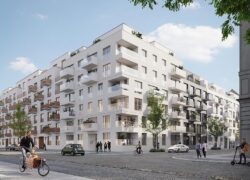

OTTO WULFF sells residential project “Quedlinburger Straße 10” in Berlin-Charlottenburg

OTTO WULFF has completed the sale of its residential development project “Quedlinburger Straße 10” in Berlin-Charlottenburg to a German family office. The transaction marks another significant milestone for the long-established company in the capital’s residential market.

The project, developed by OTTO WULFF Projektentwicklung GmbH, is located on a 3,354-square-metre site in the Mierendorff Island area of Charlottenburg. Once completed, it will comprise 129 modern residential units along with 17 parking spaces in an underground garage. The development is designed as a closed perimeter block, allowing it to integrate seamlessly into the surrounding urban fabric.

The architectural concept has been designed by the firms KSP Jürgen Engel Architekten and Rohdecan Architekten, featuring a clear geometric structure, refined facade treatments, and generous courtyard areas that enhance the project’s aesthetic and functional appeal.

A strong emphasis has been placed on sustainability. The project is being developed in accordance with version 3.1 of the NaWoh quality seal criteria and is also certified with the state-level Quality Seal for Sustainable Building (QNG), reflecting a commitment to high environmental and building performance standards.

The location offers excellent infrastructure, situated close to the Spree River and Charlottenburg Palace Park. Residents will benefit from access to public transport, schools, shopping facilities, and various recreational options, all within walking distance.

In addition to residential space, the development includes communal areas and two landscaped courtyards. Completion is scheduled for early 2027, with construction progressing on track. The sale of “Quedlinburger Straße 10” reinforces OTTO WULFF’s strategic presence in the Berlin housing market and its continued focus on high-quality urban development.

European commercial real estate: Stability conceals regional divergences

Following a rebound in investment volumes during 2024, the European commercial real estate market entered the first quarter of 2025 on a relatively stable footing. However, this apparent stability conceals notable differences across regions, reflecting a still uneven and fragmented recovery.

Despite ongoing interest rate cuts by the European Central Bank (ECB), several underlying tensions continue to restrict the pace of recovery. These constraints are preventing a sustained decline in long-term rates, which remains essential for meaningful yield compression in real estate markets. That said, the ECB’s more accommodative stance has contributed to a steepening yield curve, which in turn enhances the relative attractiveness of real estate investments.

Investment Trends Reflect Regional Imbalances

In the first quarter of 2025, total commercial real estate investment across Europe reached €36.6 billion, bringing the 12-month rolling volume to €165 billion. The market appears to have entered a consolidation phase, following the recalibrations experienced in 2023 and 2024. European investors are gradually increasing their share of activity, now representing around 40% of total invested volumes. In contrast, capital flows from North America are slowing, influenced by ongoing geopolitical uncertainty.

Performance varied significantly by region. France recorded a 41% year-on-year increase in investment activity, while Germany and the United Kingdom saw declines of 7% and 31% respectively. Sector-wise, the retail and office segments posted quarterly investment increases of 17% and 25%, respectively, reflecting a recovery after recent repricing.

Selective Yield Compression in Prime Offices

Yields for prime office assets across Europe edged down slightly in early 2025, indicating renewed investor interest following significant value corrections and a more favourable financing environment.

As of the end of March 2025, prime office yields in major European capitals ranged from 4% to 5%, with Paris and London at 4%, Milan at 4.5%, Amsterdam at 5%, Berlin at 4.8%, and Madrid at 4.85%. In major regional cities, yields ranged higher—from 5.5% to 6.5%—with Lille at 5.85% and Lyon at 5.5%.

Investors remain highly discerning, with preference given to assets in prime locations that meet the latest environmental and technical standards. Meanwhile, secondary properties continue to face pricing pressure, with elevated yields and subdued demand.

While the broader market outlook has stabilized, caution remains the prevailing sentiment among market participants. Yield compression is occurring, but selectively, and market recovery continues to be shaped by regional and sector-specific dynamics.

By Virginie Wallut, Director of Real Estate Research and Sustainable Investment, La Française Real Estate Managers

German economy expands by 0.4% in first quarter, avoids recession

Germany’s economy grew by 0.4% in the first quarter of 2025, according to revised figures from the Federal Statistical Office, outperforming the preliminary estimate of 0.2%. The stronger-than-expected performance allowed the country to avoid a technical recession, defined as two consecutive quarters of economic contraction. In the final quarter of 2024, Germany’s GDP had declined by 0.2%.

The improved growth figures are attributed primarily to a robust upswing in March. Ruth Brand, President of the Statistical Office, highlighted that industrial production and exports, particularly in the automotive and pharmaceutical sectors, performed better than initially projected. Analysts link this export growth partly to anticipatory purchases by international customers concerned about upcoming trade barriers, particularly in the United States.

Carsten Brzeski, an economist at ING, commented that the data marks a rare positive surprise for the German economy. However, he cautioned that the improvement is likely temporary, driven by efforts to mitigate the impact of potential new U.S. tariffs under the administration of President Donald Trump.

Despite this, some economists remain cautiously optimistic. Cyrus de la Rubia of Hamburg Commercial Bank noted that there are reasons to believe the economy’s upward trend could continue. Brzeski also pointed to the newly announced infrastructure investment package by Chancellor Friedrich Merz’s government, which allocates €500 billion for development projects. This could serve as a long-term stimulus for economic growth.

Nevertheless, Germany’s economic outlook remains uncertain. The government’s advisory body, known as the Council of Economic Experts, downgraded its forecast this week and now predicts no growth for 2025. This represents a sharp revision from the 0.4% growth forecast issued in November and the 1.1% estimate made in October last year. The German government itself also lowered its projection to stagnation, revising its January estimate of 0.3%.

Germany, the largest economy in the European Union and the Czech Republic’s main trading partner, saw its GDP shrink by 0.2% in 2024 and by 0.3% in 2023. As many Czech businesses depend on Germany’s economic performance, developments in the German market continue to have significant regional implications.

Poland advances offshore wind energy with Baltic Towers launch

Prime Minister Donald Tusk visited the soon-to-be-operational Baltic Towers facility in Gdańsk, set to become the largest and most advanced offshore wind tower factory in Europe. Production at the site is scheduled to begin next week, marking a significant step in Poland’s strategy to expand renewable energy and enhance national energy security. The investment is expected to create 500 specialized jobs and strengthen domestic manufacturing capabilities within the offshore wind supply chain.

Baltic Towers was established in 2023 as a joint venture between the Polish Industrial Development Agency (ARP) and Spain’s GRI Renewable Industries. This Polish-Spanish collaboration was designed to support the development of offshore wind energy in the Baltic Sea and position Poland as a leading player in the European wind sector. The factory is located on Ostrów Island in Gdańsk and will reach full production capacity by the end of November 2026, with the capability to produce over 150 wind turbine towers annually.

During the visit, Prime Minister Tusk emphasized the strategic importance of domestic involvement in such projects, stating that if Poland is to be a European leader in offshore energy, it must produce critical components locally. He highlighted the investment’s alignment with national interests, including energy affordability, technology development, and employment.

The project also reflects Poland’s growing presence in the global offshore wind sector. According to the Wind Industry Hub Foundation, Polish workers already account for 3% of the global offshore wind workforce. As the third-largest wind energy market in the EU, behind only Denmark and Germany, Poland benefits from favorable conditions such as steady wind speeds, shallow waters, low salinity, and minimal social or environmental conflict.

Baltic Towers’ CEO Jakub Wnuczyński noted that the offshore wind sector is highly demanding, and Poland’s ability to deliver key components locally enhances the resilience and independence of its supply chain. The new facility will reduce risks for offshore projects by securing domestic production of vital infrastructure.

Wojciech Balczun, President of ARP, stressed the importance of public-private cooperation in executing complex industrial projects. He expressed confidence in Poland’s capacity to support its economy through such strategic ventures, stating that the country possesses the tools needed to strengthen local industry and contribute to broader economic development.

Prime Minister Tusk also addressed broader security considerations, noting that the government will work to safeguard infrastructure investments, including military dimensions, amid rising concerns over potential sabotage activities in the Baltic region. His visit began with a stop at the Naval Operations Center in Gdynia, where he discussed security issues with defense officials, including monitoring activities near undersea energy cables connecting Poland and Sweden.

The Baltic Towers project is a milestone in the development of Poland’s offshore wind industry and illustrates the country’s growing ambition to secure a leadership position in the European energy transition.

Czech office market remains driven by domestic investors amid low foreign interest

The Czech office real estate market continues to be dominated by domestic investors, with international capital largely absent from major transactions in recent years. Since early 2021, there has been no significant acquisition of a Prague office building by a foreign investor, reflecting a broader shift in investment preferences and structural market factors.

Several conditions contribute to this trend. High office occupancy levels in Prague have kept vacancy rates low and helped the market avoid the sharp price corrections seen in many Western European countries following the pandemic. At the same time, foreign investors have shown limited interest in the Czech market, citing factors such as the absence of the euro, geopolitical concerns stemming from the war in Ukraine, and complicated permitting procedures that slow down the development of new projects.

“The main reason domestic capital continues to dominate the Czech office market is the comparable investment returns available in other regions,” said Radek Procházka, Managing Partner at Prochazka & Partners. “Foreign funds can often achieve similar returns in their home markets and have increasingly shifted their focus to sectors such as industrial and logistics properties.”

The last notable international acquisition occurred in 2021 when Germany’s Deka Immobilien purchased the Parkview office building from Skanska. Since then, domestic buyers have driven market activity.

In terms of development, Brno currently shows more momentum than Prague. Only around 24,000 square metres of new office space is expected to be completed in the capital this year—well below historical averages. This slowdown reflects ongoing challenges such as high construction costs, tougher financing conditions, and shifting investor priorities toward industrial and residential segments.

The office vacancy rate remains stable at around 8%, supporting landlord leverage and contributing to rent increases, particularly in prime locations. Tenant mobility is limited, with contract renegotiations accounting for more than half of all leasing activity in 2024. This reflects a constrained supply and a preference among occupiers to extend existing leases.

New large-scale office deliveries in Prague are not expected until 2027–2028, suggesting that the market will continue to see modest development activity in the near term.

Source: Prochazka & Partners

BIK: Mixed signals in Poland’s credit market in April 2025

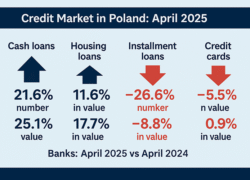
In April 2025, the Polish credit market showed mixed trends across various loan segments, according to data released by the Credit Information Bureau (BIK). While cash and housing loans continued to expand, installment loans and credit card activity recorded declines.

Growth in Cash and Housing Loans

Compared to April 2024, the number of cash loans granted rose by 21.6%, and their total value increased by 25.1%. The average cash loan reached PLN 26,864, up 2.9% year-on-year. Analysts attribute this growth to high-value loan consolidation, where borrowers combine multiple liabilities into a single loan, often with extended terms or lower interest rates, enhancing affordability.

The housing loan segment also showed recovery, with the number of loans increasing by 11.6% compared to April 2024, and by 3.7% from the previous month. In value terms, housing loans rose 17.7% year-on-year and 5.7% month-on-month. The total value reached PLN 8.13 billion, a level not seen since 2021, excluding the months influenced by the government’s “Safe Loan 2%” program. The average housing loan amount was PLN 436,870, representing a 5.5% increase over the year.

Sharp Decline in Installment Loans

Installment loans saw a significant decline. The number of such loans dropped by 26.6%, and their value fell by 8.8% compared to April 2024. The average installment loan, however, rose to PLN 2,275, an increase of 24.3% year-on-year. According to BIK Chief Analyst Prof. Waldemar Rogowski, the drop in volume is partly due to a reduction in low-value transactions linked to buy-now-pay-later (BNPL) conversions from the non-banking to banking sector, a process that has now slowed. While high-value loans for major purchases helped offset the decline, the outlook for this segment remains uncertain amid economic and political uncertainty.

Credit Card Activity Dips

In April 2025, the number of credit cards issued fell by 5.5%, although the value of credit card limits increased slightly by 0.9%. Over the January–April period, the number of credit cards issued declined by 6.2% year-on-year, while the value rose by 3.8%.

January–April 2025 Summary

Over the first four months of 2025, cash loans remained the only category showing growth in both volume and value. The number of cash loans rose 25.1%, and their value surged by 35.6%. In contrast, installment loans declined 28.6% in volume and 11.5% in value. Housing loans fell 17.3% in volume and 14.9% in value. Credit card issuance also declined.

Credit Quality Improves

The BIK credit quality indices for all four credit products showed improvement year-on-year and month-on-month. According to Prof. Rogowski, credit quality remains at a safe level and continues to improve. He cautioned, however, that while classic credit risk remains contained, legal risks related to both housing and consumer loans pose a growing concern for the banking sector.

Overall, the April 2025 credit market data reflects strong consumer demand for cash and housing loans, subdued activity in installment and credit card lending, and continued improvements in credit quality. The market’s future direction may hinge on further interest rate changes and the broader economic climate.

EU unemployment reaches historic low in 2024

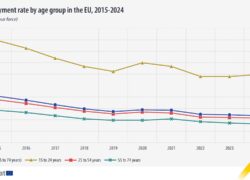
The unemployment rate in the European Union reached a record low in 2024, with just 5.9% of people aged 15 to 74 out of work. This marks the lowest annual unemployment rate recorded since the data series began in 2009, according to the latest figures from Eurostat.

Long-term unemployment also dropped to its lowest level in the available time series, falling to 1.9% of the labour force. This measure reflects individuals who have been unemployed for 12 months or more.

Despite this overall improvement, long-term unemployment remained relatively high in certain countries. Greece reported the highest rate at 5.4%, followed by Spain (3.8%) and Slovakia (3.5%). In contrast, the lowest long-term unemployment rates were seen in the Netherlands (0.5%), Malta (0.7%), and Czechia, Denmark, and Poland (each at 0.8%).

Youth unemployment, however, continued to pose challenges. Among individuals aged 15 to 24, the unemployment rate rose slightly to 14.9% in 2024, an increase of 0.4 percentage points from the previous year.

Unemployment rates for older age groups showed modest declines. For those aged 25 to 54, the rate dropped to 5.4% (down 0.1 percentage points), while the rate for those aged 55 to 74 declined to 4.1% (down 0.2 percentage points).

Overall, the EU labour market showed signs of continued resilience in 2024, with improvements across most categories and historic lows in both general and long-term unemployment.

Source: Eurostat

Construction prices in Poland increase in March 2025 across all categories

According to Statistics Poland’s latest report on construction and assembly work prices, March 2025 saw a general increase in costs across the Polish construction sector. The findings, based on data collected from construction entities, show that prices for nearly all observed types of works and construction categories rose compared to the previous month.

The total price index for construction and assembly production increased by 0.5% in March. All subcategories of activity recorded growth:
• Building construction: +0.5%
• Civil engineering structures: +0.4%
• Specialist construction works: +0.4%

Price indices for selected construction and assembly works also showed upward movement:
• Timber roof structures: +0.8%
• Sanitary installations: +0.7%
• Insulation and painting: +0.6%
• Masonry and external cladding: +0.5%

Construction costs for various building types experienced similar growth. For instance:
• Detached single-family houses without basements: +0.5%
• Multi-family residential buildings (4 and 5-storey): +0.5%
• Multi-level garages: +0.4%
• Production halls: +0.4%

Road construction projects also saw moderate price increases:
• Expressways (Class “S”): +0.5%
• District urban roads (Class “G”): +0.5%
• Motorways and local streets: +0.4%

In bridge construction, prices rose slightly compared to February 2025:
• Road viaducts with monolithic reinforced concrete: +0.5%
• Flat slab bridges and T-beam viaducts: +0.4%

The report also confirms that all observed building types experienced price growth. This includes residential, commercial, industrial, and public-use facilities. These price indices serve multiple functions beyond tracking inflation. They are used for adjusting investment costs, valuing contractual work between investors and contractors, recalculating cost estimates, and verifying bids in public tenders.

Overall, the March 2025 report underscores a consistent trend of moderate construction cost inflation, affecting both material and labour-intensive works, with implications for developers, investors, and policymakers alike.

Czech Senate approves pension fund investment in housing sector

Pension funds in the Czech Republic will soon be permitted to invest in the housing sector, following Senate approval of a legislative amendment linked to the government’s broader housing support initiative. The bill, which is now pending presidential signature, also includes several measures intended to bolster residential development and improve housing market functionality.

Under the new rules, pension funds will be allowed to invest up to 20% of their total assets in housing-related projects. This can be done through real estate funds or legal entities such as special purpose vehicles (SPVs), which may issue bonds that pension funds can purchase. However, investments in any single SPV or qualified investor fund will be limited to 10% of a pension fund’s assets.

According to Aleš Poklop, president of the Czech Association of Pension Companies, the amendment will not only enhance portfolio diversification for pension scheme participants but will also contribute to the expansion of the local housing market. Finance Minister Zbyněk Stanjura (ODS) previously estimated that pension fund investments could reach up to CZK 9 billion by the end of this year and CZK 20 billion within five years, potentially resulting in the construction of thousands of new housing units.

The legislation also introduces a tax incentive for cooperative housing members. Taxpayers who are members of a housing cooperative will be allowed to deduct interest payments on loans taken out by the cooperative from their income tax base, provided they contribute to these payments and the interest is properly allocated to members. This provision was added through an amendment supported by Minister Stanjura and ODS MP Jiří Havránek.

Another key change in the legislation is a provision aimed at expediting the eviction process for illegally occupied apartments. The law introduces a court-ordered eviction mechanism designed to give landlords more efficient legal recourse when tenants fail to vacate a property at the end of a lease term. The government stated in its explanatory memorandum that the measure should encourage long-term rental agreements by improving legal certainty for property owners.

Additionally, the amendment includes a rule allowing housing cooperatives and owners’ associations to suspend services to unit owners who default on payments for at least three months, provided certain conditions are met.

The legislative package forms part of the government’s ongoing effort to address housing shortages and improve market access, particularly by leveraging private capital to stimulate residential construction.

Source: CTK

LATEST NEWS