Saturday, 19 September 2026
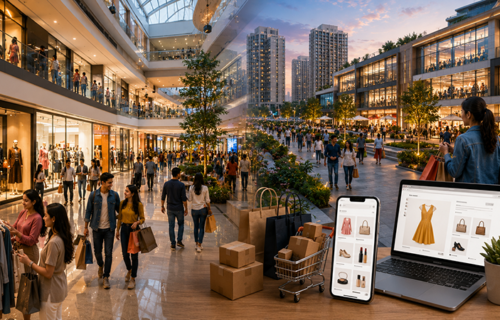
India’s retail sector is undergoing a profound transformation, but not in the way many predicted. While e-commerce has expanded rapidly and become an integral part of daily life for millions of consumers, organised retail and shopping malls continue to grow at a strong pace. Rather than competing directly, online and offline channels are increasingly working together to serve evolving consumer preferences.
The growth of e-commerce has undoubtedly changed shopping behaviour. Consumers today enjoy greater convenience, wider product choices and easier price comparisons than ever before. Digital platforms have also created opportunities for small businesses and entrepreneurs to access customers across the country. However, the rise of online shopping has not reduced demand for physical retail. Instead, it has accelerated the evolution of stores, malls and retail destinations into more experience-driven environments.
India’s retail market is expected to continue expanding significantly over the coming years, supported by rising incomes, urbanisation and increasing consumer spending. Although e-commerce is projected to capture a larger share of retail sales, physical stores are expected to remain the dominant channel for the foreseeable future. This reflects the scale and diversity of India’s consumer market, where shopping remains both an economic activity and a social experience.
Organised retail continues to attract significant investment. Shopping mall stock across India’s leading cities has expanded steadily, while domestic and international brands continue to lease space in high-quality retail centres. Direct-to-consumer brands that initially built their businesses online are increasingly opening physical stores to strengthen customer engagement and improve brand visibility. Companies such as Nykaa demonstrate how digital-first businesses are using physical retail to complement their online operations and reach new customer segments.
One of the key drivers behind this expansion is India’s growing consumer base. Rising disposable incomes and a rapidly expanding middle class are supporting demand across categories such as fashion, electronics, beauty products, home furnishings and lifestyle goods. Urbanisation is further contributing to retail growth by creating larger concentrations of consumers with higher purchasing power.
India’s demographic profile remains another major advantage. With one of the world’s youngest populations and a large working-age demographic, the country continues to generate new consumers entering the formal economy each year. Younger consumers are often highly brand-conscious and increasingly willing to spend on experiences, convenience and premium products.
The role of shopping malls has also evolved significantly. Modern retail centres are no longer focused solely on shopping. They increasingly serve as lifestyle destinations that combine retail, dining, entertainment, cinemas, wellness facilities and social experiences. This experiential element provides an advantage that purely digital platforms cannot fully replicate and helps maintain strong footfall across many organised retail destinations.
Perhaps the most important development is the rise of omnichannel retailing. Leading retailers increasingly recognise that consumers do not distinguish sharply between online and offline shopping. Instead, they expect a seamless experience across both channels. Customers may research products online, visit a store to experience them in person and complete purchases through either platform. Retailers are responding by integrating digital and physical operations, allowing customers to browse, purchase, collect or return products through multiple touchpoints.
Government initiatives such as the Open Network for Digital Commerce (ONDC) are also helping create a more open digital ecosystem by expanding access for smaller retailers and merchants. These developments support greater integration between traditional retail businesses and online commerce platforms.
Challenges remain. Rising real estate costs, supply chain complexities and changing consumer expectations continue to pressure retailers. Nevertheless, the long-term outlook remains positive. The future of Indian retail is unlikely to be defined by a contest between e-commerce and physical stores. Instead, growth is increasingly being driven by a combination of both, with successful retailers using omnichannel strategies to create more convenient, personalised and engaging customer experiences.
As consumption continues to rise and organised retail expands into Tier-2 and Tier-3 cities, physical retail and shopping malls are expected to remain central components of India’s retail landscape, even as digital commerce continues its rapid growth.
Source: CIJ.World India Research & Analysis Team