Saturday, 19 September 2026
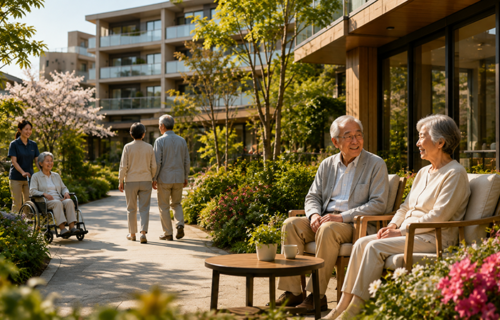
Japan’s changing population profile is reshaping the country’s real estate market in ways that extend far beyond residential housing. As the proportion of older citizens continues to increase, developers, investors and healthcare providers are expanding their focus toward properties designed specifically for later-life living.
What was once regarded as a niche segment has become an increasingly important part of the investment landscape. Demand for accommodation that combines independence, accessibility and healthcare support is rising steadily, making senior-focused real estate one of the country’s most resilient long-term asset classes.
Demographic change reshapes property demand
Japan remains one of the world’s oldest societies, with nearly one-third of its population now aged 65 or above. Improvements in healthcare have extended life expectancy, while decades of low birth rates have reduced the size of younger generations entering the housing market.
This demographic transition is influencing every part of the property sector. Traditional family housing is experiencing weaker demand in many rural communities, while the need for homes that accommodate older residents continues to expand.
For developers, the opportunity extends beyond nursing facilities. Many retirees are seeking modern apartments that allow them to maintain an independent lifestyle while providing easy access to medical services, public transport and everyday amenities.
A broader range of senior housing
Japan’s senior living sector has diversified significantly over the past decade. Instead of relying solely on conventional care homes, the market now includes retirement communities, assisted-living residences, age-friendly rental apartments and mixed-use developments that integrate healthcare, retail and recreational facilities.
This evolution reflects changing expectations among older residents, many of whom remain active for longer and are looking for accommodation that supports independence rather than institutional care.
Properties designed with step-free access, wider living spaces, emergency response systems and shared community facilities are becoming increasingly attractive to both residents and investors.
Cities remain the primary growth markets
The strongest demand continues to be concentrated in major metropolitan areas, particularly Tokyo, Osaka and Nagoya, where access to hospitals, specialist healthcare and public transport is readily available.
High land values make development more expensive in these locations, but occupancy levels remain strong as older residents increasingly choose to live close to essential services and family members.
At the same time, suburban districts with excellent transport connections are emerging as attractive alternatives, offering larger development sites while maintaining convenient access to urban healthcare networks.
Labour remains the sector’s greatest challenge
While demand for senior accommodation continues to grow, expanding capacity is becoming increasingly difficult because of labour shortages.
Care providers across Japan face ongoing challenges in recruiting qualified staff, with competition for healthcare workers intensifying as the population ages. This has encouraged operators to invest in technology that can improve efficiency without compromising resident care.
Digital monitoring systems, automated administrative processes and assistive technologies are becoming common features in newly developed facilities. Although these innovations cannot replace skilled caregivers, they are helping operators manage rising demand more effectively.
Investors look beyond traditional residential assets
Institutional investors are increasingly viewing senior housing as a long-term defensive investment supported by structural demographic trends rather than short-term economic cycles.
Unlike conventional residential property, these assets combine real estate with operational expertise. Success depends not only on the quality of the building but also on the financial strength of the operator, the availability of qualified staff and the ability to deliver consistent care services.
As a result, investors are paying greater attention to operator performance, local demographics and healthcare infrastructure when assessing acquisition opportunities.
Vacant homes present selective redevelopment opportunities
Japan’s large inventory of vacant residential properties has prompted discussion about their potential role in addressing future accommodation needs for older residents.
In some communities, former family homes are being renovated and adapted into small-scale care facilities or community housing. These projects can preserve existing buildings while creating new uses that support ageing populations.
However, many empty homes are located in areas with limited healthcare services and declining populations, making large-scale conversion economically challenging. Successful redevelopment is therefore most likely where local demand, transport links and medical infrastructure already exist.
Looking ahead
Japan’s ageing population will remain one of the defining influences on its real estate market for decades to come. As demographic trends continue to reshape housing demand, the senior living sector is expected to attract increasing levels of development and institutional investment.
Future projects are likely to place greater emphasis on sustainability, accessibility and technology while creating environments that allow residents to remain independent for as long as possible.
For the property industry, the growth of senior living represents more than a response to demographic change. It reflects the emergence of a specialised real estate sector where healthcare, residential development and long-term investment strategies increasingly converge. As Japan continues to adapt to an ageing society, senior-focused housing is expected to play an increasingly important role in the country’s evolving property market.
Source: © CIJ.World Japan Research & Analysis Team