Monday, 26 October 2026
Germany’s energy transition continued to make progress during the first half of 2026, but the pace of deployment remains insufficient in several key areas, according to the latest Energy Transition Monitor published by the German Institute for Economic Research (DIW Berlin).
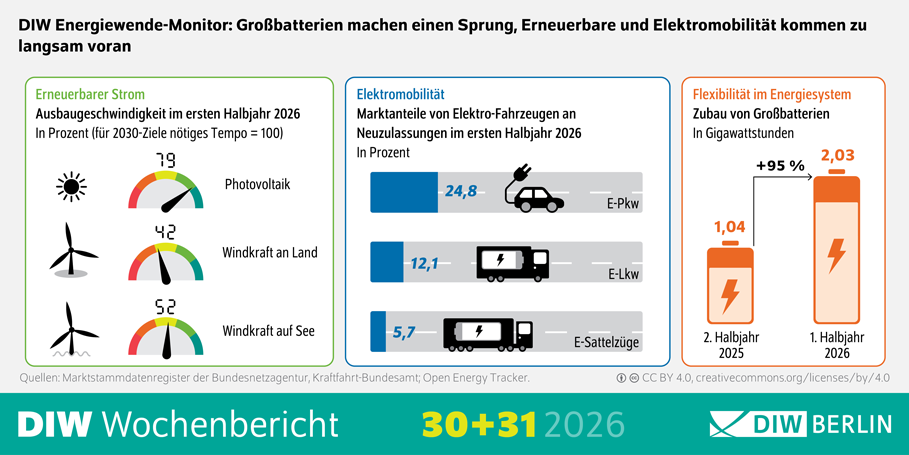
The report finds that solar power, which exceeded expansion targets in 2023 and 2024, is now losing momentum as installation rates fail to keep pace with increasingly ambitious capacity goals for 2030. Onshore wind development also remains below the required level, while offshore wind has accelerated following the commissioning of several large projects, although long development timelines and slower investment continue to pose challenges.
“The energy transition is continuing, but not quickly enough in most areas. Heat pumps and electric vehicles, in particular, have yet to achieve the breakthrough needed to significantly reduce Germany’s dependence on oil and gas imports,” said Wolf-Peter Schill, Head of the Transformation of the Energy Economy research division at DIW Berlin and lead author of the report.
The report notes that heat pumps strengthened their position in the heating market, accounting for almost half of all new heating systems sold during the first quarter of 2026. Battery electric vehicles also continued to gain market share, representing nearly one in four new passenger car registrations during the first half of the year. However, fossil fuel heating systems and internal combustion engine vehicles continue to dominate new sales.
DIW argues that the electrification of heating and transport remains essential for achieving Germany’s climate neutrality targets. However, it suggests that the country’s new Building Modernisation Act is unlikely to significantly accelerate heat pump adoption, while ongoing political debate over future combustion engine regulations may slow the transition to electric mobility.
The report also highlights increasing pressure on Germany’s electricity system as renewable generation expands. During the first half of 2026, wholesale electricity prices turned negative for 291 hours, compared with 184 hours during the second half of 2025. Although this was below the 389 hours recorded in the first half of last year, the financial impact reached a record level, with estimated generation losses of around €430 million during periods of negative pricing.
According to DIW, growing solar generation continues to push electricity prices lower during midday hours while evening prices remain comparatively high, underlining the need for greater system flexibility.
Large-scale battery storage capacity expanded significantly during the first six months of the year, with newly installed capacity nearly doubling compared with the previous six-month period and total installed storage increasing by around 50%. However, DIW believes deployment could accelerate further if grid connection processes were streamlined.
The institute concludes that stronger efforts to expand renewable energy, electricity storage and the electrification of heating and transport will be necessary if Germany is to meet its climate objectives while reducing its dependence on imported fossil fuels.
Source: DIW