Saturday, 19 September 2026
India’s real estate market is entering a new phase of development in which growth is no longer concentrated exclusively in the country’s largest metropolitan areas. While Tier-1 cities such as Mumbai, Delhi-NCR, Bengaluru, Hyderabad, Chennai and Pune continue to dominate office leasing and institutional investment activity, a growing number of emerging urban centres are beginning to attract occupiers, developers and investors seeking new opportunities for expansion.
This shift does not signal the decline of India’s major cities. Rather, it reflects the broadening of the country’s economic geography as infrastructure investment, urbanisation and corporate expansion create new growth corridors beyond traditional metropolitan markets.
India’s office sector remains one of the strongest globally. Leasing activity reached record or near-record levels in 2025, driven by robust demand from Global Capability Centres, technology companies, engineering firms, financial institutions and flexible workspace operators. Major metropolitan markets continue to account for the majority of this activity, supported by deep talent pools, mature business ecosystems and extensive Grade A office supply.
However, the nature of occupier demand is gradually evolving. Companies are increasingly looking beyond the largest cities as they seek access to skilled talent, lower operating costs and improved business continuity. This has led to growing interest in emerging urban centres such as Ahmedabad, Indore, Coimbatore, Kochi, Jaipur, Chandigarh and Bhubaneswar, among others.
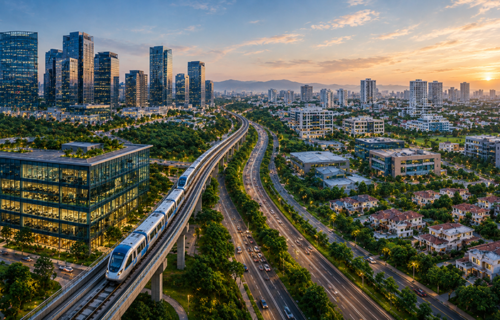
One of the most significant drivers behind this trend is infrastructure development. Large-scale investments in highways, expressways, airports, metro systems, logistics corridors and regional rail networks are improving connectivity across India and reducing the traditional advantages held by major metropolitan centres. Improved transportation networks make it easier for businesses to operate across multiple locations while giving employees greater mobility and access to employment opportunities.
Government policy is also playing an important role. Recent initiatives aimed at strengthening regional economic development and improving urban infrastructure in Tier-2 and Tier-3 cities reflect a broader strategy of promoting more balanced growth across the country. The concept of developing stronger economic regions beyond the largest metros aligns with market trends already underway.
The expansion of Global Capability Centres has become particularly important. Multinational companies continue to view India as a strategic destination for technology, engineering, research, finance and business support functions. While Bengaluru, Hyderabad and Pune remain major GCC hubs, companies are increasingly evaluating secondary cities that offer competitive costs, strong educational institutions and growing infrastructure networks.
Real estate developers are responding accordingly. Office parks, mixed-use developments, residential communities and logistics facilities are increasingly being planned in emerging markets where land remains more affordable and development opportunities are less constrained than in established metropolitan districts.
Residential migration is also contributing to this shift. Rising housing costs, traffic congestion and quality-of-life concerns in some major cities have encouraged both individuals and companies to consider alternative locations. The growth of hybrid working models has further increased the attractiveness of cities that can offer lower living costs while maintaining access to employment opportunities and modern infrastructure.
Despite these trends, Tier-1 cities remain central to India’s economic growth story. They continue to attract the majority of foreign investment, office leasing activity and large corporate occupiers. What is changing is not their importance, but the emergence of complementary growth centres that can support India’s expanding economy.
The future of Indian real estate is therefore likely to be characterised by a more distributed urban network rather than a simple shift away from metropolitan centres. Infrastructure expansion, corporate diversification and demographic growth are creating new opportunities across a wider range of cities. As connectivity continues to improve, emerging urban centres are poised to play an increasingly important role in shaping the next chapter of India’s real estate and economic development story.
Copyright: CIJ.World India Research & Analysis Team