Wednesday, 7 October 2026
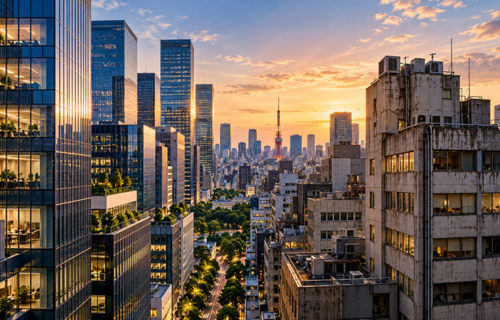
Tokyo’s office market is enjoying exceptionally strong conditions, but beneath low vacancy and rapidly rising rents a longer-term challenge is developing. Much of the city’s commercial stock is ageing while occupiers increasingly favour efficient, modern and well-equipped workplaces. Strong demand is currently supporting buildings across different quality levels, but the gap between properties that can be successfully modernised and those that cannot could become increasingly important for investors.
Current leasing figures give little impression of an immediate obsolescence problem. Grade A vacancy in Tokyo stood at approximately 0.6% in the second quarter of 2026, compared with 1.9% for Grade A-minus and around 1.3% for Grade B. Rents increased across all three categories, with Grade A up more than 17% year-on-year and Grade B around 10%. With available space scarce, demand is spreading beyond the newest buildings and supporting secondary stock.
Age nevertheless has a measurable effect on property economics. Research published by the Bank of Japan in 2026 found that office rents tend to decline as buildings get older after other property characteristics are taken into account. The study estimated an age-related effect of around 1.4% annually during approximately the first 25 years of a building’s life before the pace moderates. This suggests that a property can remain occupied while gradually losing competitiveness against newer alternatives.
The issue is particularly relevant because Tokyo offices can remain in use for decades. Research covering more than 11,000 office buildings across the city’s 23 wards estimated a median lifespan of approximately 58 years. At the same time, occupier requirements are evolving. Companies increasingly consider workplace quality, energy performance, flexible layouts, building systems, resilience and employee experience when choosing offices, strengthening demand for newer or comprehensively upgraded properties.
Replacing ageing buildings is becoming more difficult, however. High construction costs, labour shortages and longer delivery periods are making redevelopment more expensive, while Tokyo’s expected new office supply over the coming years remains below its longer-term average. Paradoxically, these constraints are also supporting existing buildings because tenants have fewer alternatives. An older office in a strong location can therefore continue achieving high occupancy and rental growth even when it lacks the specifications of the newest developments.
This makes refurbishment increasingly important. Owners can extend the competitive life of existing buildings by upgrading mechanical systems, interiors, common areas and energy performance rather than pursuing complete redevelopment. Japan already provides support for certain energy-efficiency improvements to existing commercial properties. The investment case nevertheless depends on whether higher rents and longer occupancy can justify the capital required.
A widening divide could consequently emerge within older office stock. Prime modern buildings should continue attracting the strongest tenants, while well-located older properties with suitable structures can remain competitive through investment. The greatest risk lies with buildings that still generate rental income but require increasingly large amounts of capital to meet occupier expectations without offering sufficient potential for higher rents or values.
Alternative uses will provide solutions for some properties, but conversion is not straightforward. Transforming offices into apartments or hotels depends on floor configuration, daylight, plumbing, planning and construction economics, while data centres require substantial power, cooling, connectivity and structural capacity. For much of Tokyo’s ageing stock, continued office use combined with selective modernisation is likely to remain more practical than wholesale conversion.
Tokyo’s current boom is therefore buying owners time rather than eliminating the obsolescence issue. With Grade B vacancy around 1.3%, even secondary buildings can perform strongly today. The real test will come when supply and demand become more balanced and occupiers regain greater choice. Japan’s longer-term challenge is unlikely to appear suddenly as thousands of empty offices; it is more likely to emerge through widening differences in rents, capital requirements and asset values, separating older buildings worth upgrading from those where another renovation cycle can no longer produce an adequate return.
Source: © CIJ.World Japan Research & Analysis Team