Tuesday, 6 October 2026
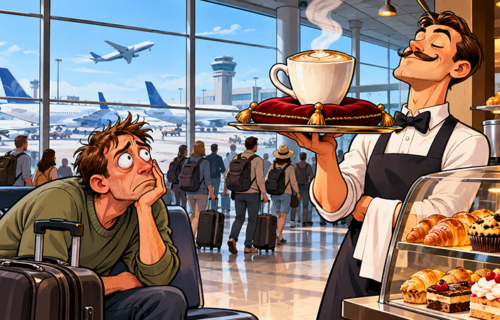
There is a moment at Warsaw Chopin Airport when you realise that you are no longer participating in the normal economy. It usually happens somewhere between security and Gate 26, when you look at the menu and discover that a latte costs PLN 29.50. For that price, you briefly wonder whether the coffee has also checked in, received priority boarding and been given access to the lounge. Unfortunately not. It is still coffee. You are simply at the airport.
To be fair to Chopin, there are plenty of customers available to buy it. The airport handled 24.1 million passenger journeys in 2025, 13% more than a year earlier, while revenue reached PLN 1.77 billion. Once you put that many people through the same building, commercial space becomes rather valuable. The airlines deliver the passengers, security makes sure they cannot wander too far away, and eventually somebody looks at a sandwich for PLN 34.50 and thinks: “Well, boarding isn’t for another hour.”
Warsaw is not alone in discovering this remarkable branch of economics. Budapest handled 19.63 million passengers in 2025, Prague 17.75 million and Bucharest’s Henri Coandă just over 17 million. Even Bratislava, the cheerful smaller cousin at the family gathering, reached 2.44 million. Between the five capitals there were more than 80 million passenger journeys during the year. That is an impressive number of people temporarily separated from reasonably priced coffee.
Prague has become particularly good at turning the terminal into something more than somewhere to catch an aircraft. Its airport generated CZK 7.1 billion from aviation activities in 2025 and another CZK 3.7 billion from business outside aviation. It also opened 18 new shops and restaurants. This is perhaps the modern airport philosophy in its purest form: if passengers are going to spend two hours waiting for their flight, it seems financially irresponsible to provide them only with chairs.
Budapest has almost 20 million annual passenger journeys, while Bucharest’s two airports together reached 17.7 million in 2025. Their public accounts do not give us sufficiently comparable figures to calculate exactly how effectively every hungry passenger is converted into commercial revenue, so it would be wrong to pretend otherwise. What we can safely conclude is that millions of people pass through these terminals every year carrying passports, credit cards and the dangerous belief that they might just buy something small before boarding.
Then there is Bratislava, proving that you do not need Heathrow-sized crowds to discover the attractions of the non-flying passenger. The airport generated €29.88 million from aviation activities in 2025 and €10.03 million from business outside aviation, with the latter increasing 13%. Property leasing, parking and other services all contributed. Bratislava has even made expanding these activities part of reducing its dependence on the seasonal nature of flying. In other words, aircraft may come and go, but somebody can always be persuaded to pay for parking.
There are, of course, perfectly serious reasons why things cost more at airports. Restaurants have complicated deliveries, employees require controlled access, businesses operate unusually long hours and fitting out premises inside a secure terminal is hardly the same as renting a neighbourhood café. Nobody should therefore imagine that the PLN 11.50 difference between a PLN 29.50 airport latte and a roughly PLN 18 comparable Warsaw coffee goes directly into somebody’s pocket. Without the concession agreement and the café’s accounts, we simply do not know who gets what. Somewhere between the coffee bean and the boarding gate, however, the latte has undergone an extraordinary financial transformation.
The real magic happens after security. If somebody asks PLN 29.50 for coffee in central Warsaw, you possess a powerful negotiating tool known as legs. You can walk away. At an airport, the situation is different. You have removed your belt, displayed your liquids, possibly surrendered a perfectly innocent bottle of water and successfully reached the other side. You are not going back into Warsaw because the cappuccino seems expensive. The airport has achieved something most shopping centres can only dream about: millions of customers who arrive voluntarily and then become extremely reluctant to leave.
This is why CEE airports should increasingly be viewed as commercial property as well as transport infrastructure. Warsaw provides 24 million passenger journeys, Budapest nearly 20 million, Prague almost 18 million and Bucharest more than 17 million, while Bratislava shows that the model works at a much smaller scale. Aircraft bring the people, terminals concentrate them and retailers compete for the opportunity to sell to them. The passenger may believe the purpose of the building is to get from Warsaw to London. Commercially speaking, there is also plenty of time between security and boarding to discover that a piece of cheesecake has somehow acquired the financial characteristics of prime real estate.
So the next time you stand at Chopin staring at a PLN 29.50 latte, do not become angry. Appreciate what you are looking at. It is not merely coffee. It is aviation infrastructure, commercial property, restricted consumer choice, passenger growth and retail economics served together in a cardboard cup. The only thing apparently missing is the seat belt.
Author: Mitzilinka (Turning grim reality into comic relief-without losing the truth)