Friday, 23 October 2026
Airports are extraordinary places. They are among the most technologically sophisticated pieces of infrastructure on earth, capable of identifying a suspicious passenger remarkably quickly, moving thousands of bags between aircraft and tracking people across terminals. Yet they can still make you remove your belt because somebody tried something unpleasant with an aeroplane more than twenty years ago.
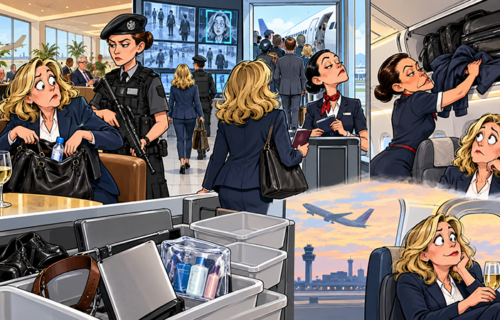
My latest encounter with this curious mixture of Minority Report and village-hall bureaucracy began in an executive lounge. I was approached by an armed border officer who asked whether she could inspect my bag. Certainly. There was, however, a complication. I had to open it myself because she was apparently not allowed to touch it.
“Self-service security,” I observed.
While dutifully rummaging through my own belongings on behalf of the authorities, I asked what had happened. Someone had apparently stolen a bottle of wine from the lounge. I immediately confessed. “I stole a bottle of water.” She laughed. “That is acceptable.” And so, having admitted to the lesser offence of hydration, I was released back into society.
What happened next was rather more interesting. Later, while waiting at the departure gate, I saw the same officer appear. She approached a woman sitting nearby, asked to look inside her bag, completed whatever check she needed and disappeared towards another gate.
Whatever system was operating behind the scenes, the speed with which security personnel appeared able to identify and locate people who had recently left the lounge was impressive. Whether that involved CCTV, lounge access records, passenger information, human observation or some combination of systems wasn’t clear to me. But it demonstrated something passengers rarely appreciate: modern airport security can be remarkably sophisticated when it wants to be.
Then boarding started. Or rather, boarding nearly started. There were three five-minute delays, which in airline mathematics apparently constitute something entirely different from a fifteen-minute delay.
Eventually we reached the ceremonial scanning of boarding cards and passports, an airport ritual that can range from a pleasant “good morning” to an encounter with someone who appears to have been temporarily granted control of a small Balkan republic. There is a particular species of gate employee who understands that possession of a barcode scanner represents absolute constitutional authority. Every instruction arrives with just enough irritation to remind passengers that although they may have purchased the ticket, checked in online, passed security, produced a passport and arrived at the correct gate, they remain fundamentally disappointing human beings.
Once onboard, I made the apparently extravagant request to hang up my business jacket in the compartment provided for precisely that purpose. This, it turned out, was optimistic.
The compartment was already approximately 99 per cent occupied by cabin-crew luggage. The air hostess nevertheless accepted my jacket and, rather than hanging it, proceeded to cram and stuff it into the remaining geological fault line between the crew bags. I watched as a perfectly respectable business jacket was converted into something resembling a napkin retrieved from underneath a Sunday roast.
There is something wonderfully aviation about providing a dedicated wardrobe and then filling virtually the entire thing with staff luggage. It is rather like arriving at a hotel and discovering that the concierge has already gone to sleep in your bed. Still, at least the jacket had been thoroughly secured.
And this is where aviation security becomes fascinating. To passengers, much of it can feel frozen in time.
The terrorist attacks of 11 September 2001 transformed aviation security. Cockpit doors were reinforced, passenger screening became considerably more intensive and intelligence sharing expanded. Then Richard Reid attempted to detonate explosives concealed in his shoes in December 2001, and shoes became suspicious. A plot involving liquid explosives was uncovered in 2006, and liquids became suspicious. The attempted bombing of a flight using explosives hidden in underwear in 2009 accelerated the introduction of body scanners. Electronics subsequently received greater attention as detection technology and concerns about concealed explosives evolved.
Aviation security therefore didn’t fail to change. It changed repeatedly. The problem is that it developed rather like a British garden shed: every time something new was needed, another bit was attached to the side. Almost nothing came off.
The result is a security system containing procedures created in response to threats spanning several decades, layered on top of increasingly sophisticated technology that can perform tasks passengers barely realise are happening. This is why airport security sometimes feels faintly absurd. At one moment, authorities may apparently be capable of finding a particular passenger somewhere inside a large international terminal. Five minutes later, everyone is carefully decanting shampoo into tiny transparent bottles.
There is, of course, a serious reason for the caution. Aviation security deals with events that are extremely unlikely but potentially catastrophic. Regulators have very little incentive to remove a protection that appears unnecessary. If they retain an irritating rule, millions of passengers complain. If they remove the wrong one and something terrible happens, nobody will be particularly interested in hearing that the policy had previously saved travellers seven minutes at security.
That asymmetry explains much of the conservatism. But behind the trays, belts and little plastic bags, aviation security has already undergone a quieter technological revolution.
Passenger information can be analysed before travellers reach the aircraft. Intelligence databases and watchlists can identify risks. Modern scanners can examine baggage in three dimensions. Explosive-detection systems have improved enormously. Biometric identity technology is expanding. Airports, airlines, police, border agencies and intelligence services can exchange information in ways unimaginable when many of today’s passenger rituals were created.
New-generation CT scanners are particularly important because they can examine cabin baggage in much greater detail. At airports where the equipment has been installed and approved by regulators, some of the traditional requirements to remove electronics or separate liquids can be reduced or eliminated. The transition, however, is uneven. Replacing thousands of security lanes across hundreds of airports is expensive, technically complicated and subject to national regulation and certification.
So we currently occupy the slightly peculiar middle period between two generations of airport security. The old system says, “Take your laptop out.” The emerging system says, “We already know considerably more about you than you probably realise.”
Which brings us to the more interesting question. It isn’t really why airport security hasn’t changed since 9/11. It has. The question is why passengers still experience so much security designed around the methods of yesterday when the technology increasingly allows authorities to concentrate on the risks of tomorrow.
The logical destination is an airport where much more security happens invisibly. Identity is established before the checkpoint. Risk analysis takes place in the background. Bags remain packed while sophisticated scanners inspect them. Automated systems identify anomalies. Human officers concentrate their attention where something genuinely requires investigation.
Instead of treating several thousand passengers as equally suspicious because one of them might theoretically represent a threat, technology should increasingly allow security resources to be directed towards the unusual. That would be both more effective and considerably less annoying.
And perhaps that is the great irony of the future airport. For the past quarter-century, governments have demonstrated tougher aviation security by making passengers increasingly aware of it. The ultimate demonstration of technological progress may be precisely the opposite.
We will know airport security has become truly sophisticated when we hardly notice it at all.
Although I suspect they will still want the water bottle back.
And my jacket may never fully recover.
Author: Mitzilinka (Turning grim reality into comic relief—without losing the truth)