Thursday, 10 September 2026
There are moments in aviation when you realise that mankind may have slightly overestimated itself. We have aircraft capable of crossing the Atlantic at nearly 40,000 feet. We can navigate through darkness, cloud and weather with extraordinary precision. A modern Boeing 787 Dreamliner contains computing power that would once have required a respectable government building to accommodate. And yet an airport lounge can apparently be defeated by a coffee machine.
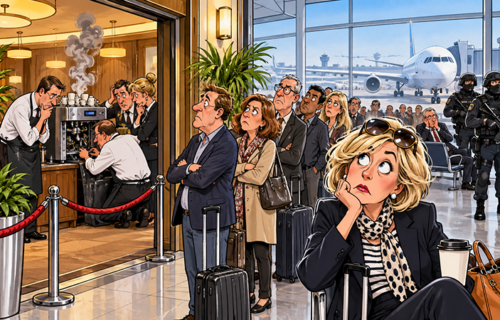
This was the situation before a recent red-eye flight, when the opening of the lounge was delayed because the coffee machine would not start. Now, I am enormously fond of coffee. I would even accept that there are mornings when I should not be allowed to communicate with another human being until coffee has been administered. But I had never previously understood that an espresso machine formed part of an airport’s critical infrastructure.
Apparently it does.
The doors remained closed. Somewhere behind them, I imagined a management team standing around the machine like surgeons around a particularly difficult patient.
“Have we switched it off and on again?”
“Twice.”
“Dear Powers to Be”
“Should we open the lounge?”
“Without cappuccino?”
Silence.
There are limits.
The peculiar thing about crisis management is that the crisis is rarely the problem itself. Things break. Aircraft develop technical faults. Weather happens. Computers fail. Coffee machines occasionally decide that producing coffee is beneath them. The test is what happens next.
If your published opening time says the lounge opens at a particular hour, then, within reason, you open it. You explain that the coffee machine is temporarily unavailable. You apologise. You provide whatever else is available. Perhaps you even deploy that most sophisticated piece of customer-service technology yet invented: a kettle.
Instead, passengers were left outside while management apparently wrestled with the existential question of whether civilisation could continue without a functioning latte.
Then there is airline communication. Airlines now possess an astonishing number of ways to tell you what is happening. There are apps, emails, text messages, push notifications, departure boards, gate screens, announcements and, occasionally, an actual human being.
The difficulty is getting any two of them to agree.
Your phone may confidently tell you one thing while the airport screen says another. The email has a third theory. Eventually you walk 15 minutes to the gate, where the electronic board offers the definitive operational instruction: “Take a seat.”
Thank you. That certainly clears things up.
I have experienced this particular communication philosophy before at Warsaw Airport. On that occasion, asking questions at the gate eventually produced one of the more theatrical escalations in my flying career. Armed security appeared. Not a customer-service supervisor. Not an airline manager. Security. With automatic weapons, tactical clothing and balaclavas, standing behind the gate staff.
It was an impressive response to what had begun as passengers wanting to know what was happening with their flight. You start with, “Excuse me, is there an update?” and somehow arrive at a scene suggesting somebody has attempted to overthrow the terminal.
British passengers are particularly poorly equipped for this sort of escalation because our traditional weapon in a disagreement is mild sarcasm. “Well, this is all going terribly well.” Against a man holding an automatic weapon, however, sarcasm suddenly feels underpowered.
The wider problem becomes much more serious when disruption hits a major hub. Heathrow’s experience following the fire and power failure at an electricity substation in Hayes demonstrated just how quickly problems outside an airport can cascade through aviation. Flights can resume, but that does not mean the disruption has disappeared. Aircraft are in the wrong places. Crews are displaced. Passengers miss connections. Some must rebook, while others suddenly discover the remarkable price of buying an airline ticket when they absolutely need one.
And then comes the aircraft change. Your original aircraft disappears from the plan and is replaced by a Dreamliner. Wonderful, you think. A Dreamliner. Very glamorous.
Except the seating allocation may remain largely as it was while the physical aircraft is completely different. A Boeing 787 is designed for long-haul flying, with a cabin configuration that may bear only a passing resemblance to whatever aircraft was originally scheduled.
You therefore enter the fascinating world of airline seat mathematics. Your seat number still exists. Your expectations still exist. The relationship between the two is considerably less certain.
None of this is really about coffee machines, gate screens or even Dreamliners. It is about something much simpler. When travel goes wrong, passengers can cope remarkably well with bad news. What they struggle with is no news. Or contradictory news. Or an app telling them to proceed to a gate where a screen tells them to sit down while an email confidently informs them of something else entirely.
Airports and airlines spend billions on aircraft, terminals, lounges, software, biometric systems and increasingly sophisticated passenger technology. Yet sometimes the most valuable thing they could provide is one person who knows what is happening and is prepared to say it.
And perhaps somebody who knows where the kettle is.
Because if your entire premium lounge operation collapses when the coffee machine refuses to cooperate, you do not have a coffee problem.
You have a management problem.
Author: Mitzilinka (Turning grim reality into comic relief—without losing the truth)