Monday, 21 September 2026
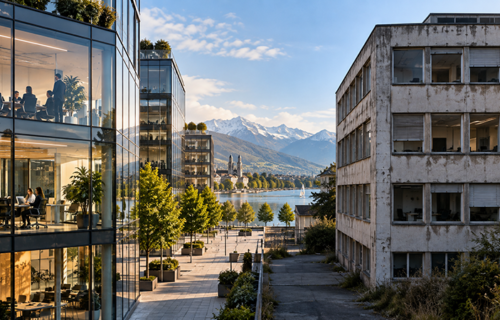
Switzerland has no overall shortage of office space, but the amount of property available tells only part of the story. Companies are increasingly concentrating their requirements on modern buildings in accessible locations, leaving some older and less conveniently situated offices facing weaker demand. This is creating a widening difference in performance between individual properties even within the same city.
Across Switzerland’s five largest office markets, approximately 1.03 million sq m was available at the end of 2025, around 4% more than a year earlier. The combined availability rate had increased from 4.1% at the end of 2019 to 5.2%. Those figures suggest tenants should have considerable choice, but much of that space does not necessarily provide the location, environmental performance, technical specification or workplace quality sought by larger occupiers.
Zurich illustrates the mismatch. Regional availability slipped from 5.2% in the first quarter to 5.1% in the second quarter of 2026 following several significant lettings. Demand has remained comparatively strong for central and well-connected offices, supporting high prime rents, while considerably more space is available in some outer districts and neighbouring business locations. With relatively limited new construction, companies seeking particular types of high-quality space can therefore face restricted options despite substantial vacancy elsewhere in the region.
Geneva is moving differently at the headline level. Its regional availability rate increased to around 6.1% in the second quarter, but stronger properties continue to find occupiers more readily than less competitive stock. Large Grade A offices in the central business district remain limited, while parts of the peripheral market carry more available space. Older central buildings are also being refurbished or, in some cases, considered for residential and hospitality uses, gradually changing the composition of the city’s office stock.
Basel provides another variation. Major transactions reduced availability to approximately 4.7% during the first half of 2026, the first time the rate had fallen below 5% since 2019. Development has slowed following the roughly 201,000 sq m completed between 2020 and 2023, with little evidence of another major construction wave in the immediate pipeline. Nevertheless, availability remains significant in parts of the market, meaning Basel should not be characterised simply as suffering from an office shortage.
The increasingly important dividing line is the quality of individual assets. Tenants are placing greater emphasis on public transport connections, efficient building systems, flexible layouts, amenities and environmental performance. Investors are making similar distinctions, favouring properties capable of producing reliable income without requiring extensive modernisation. For owners of ageing offices, remaining competitive can therefore require substantial expenditure at a time when refurbishment costs must be weighed against achievable rents and long-term asset values.
Switzerland’s office market is consequently becoming less useful to describe through a single national vacancy figure. Zurich, Geneva and Basel are following different supply cycles, but all show evidence that building quality and location increasingly influence leasing performance. The next challenge will concern the stock that fails to meet those expectations. Some properties will be modernised, others repositioned or converted, while buildings that cannot justify further investment risk becoming increasingly disconnected from the occupiers and capital targeting Switzerland’s strongest office assets.
Source: CIJ.World Research & Analysis Team