Saturday, 12 September 2026
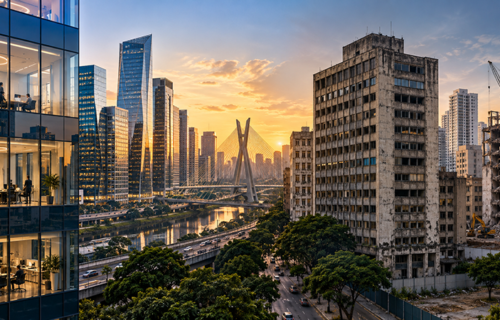
São Paulo’s office market is producing increasingly encouraging numbers, but the recovery is revealing a deeper problem within the city’s commercial property stock. Demand for high-quality space is strengthening, availability in several preferred business districts is becoming scarce and rents for the best buildings are rising. Yet these conditions do not mean that every office property is recovering. Instead, São Paulo appears to be developing an increasingly pronounced divide between buildings capable of meeting modern occupier requirements and properties designed for a very different generation of office users. For investors, this distinction could become more important than the city’s overall vacancy rate.
The headline indicators are positive. Availability within São Paulo’s higher-quality office market has fallen considerably from previous peaks, reaching levels not seen for many years. Some established districts have become particularly tight, while companies searching for very large blocks of contiguous premium space have fewer options than they did only a few years ago. Rental growth is reinforcing the recovery. Landlords controlling well-located, modern buildings are benefiting from competition among occupiers seeking quality space, particularly where new supply is limited. This strengthens income expectations and improves the investment case for the best assets.
But São Paulo is too large and too diverse to be understood through one vacancy figure. Conditions can vary significantly between districts, individual streets and buildings. A modern property in a highly accessible business location can face a completely different leasing environment from an ageing office only a few kilometres away. The distinction increasingly comes down to what tenants expect from their workplaces. Companies are looking beyond the amount of space available and considering efficiency, transport connections, environmental performance, air quality, building technology, amenities, security and the overall experience provided to employees.
Hybrid working has reinforced rather than eliminated many of these requirements. Companies may occupy less space than they once expected, but that does not necessarily mean they are willing to accept lower-quality buildings. In many cases, reducing total floorspace gives an occupier greater financial flexibility to lease better premises. This creates an important change in office economics. A company can reduce the number of square metres it occupies while paying more for each square metre. From the landlord’s perspective, this means the effect of hybrid working can be very different depending on the quality of the asset. Modern buildings in preferred locations can benefit from consolidation, while older offices can lose tenants even when total employment and business activity remain relatively stable.
The resulting migration towards quality can reinforce itself. As more companies move into leading buildings, vacancy falls and landlords gain greater pricing power. Higher rents support valuations and make further investment in the property easier to justify. Older buildings can enter the opposite cycle. Tenant departures reduce income, lower occupancy makes the building less attractive to prospective occupiers and landlords become increasingly dependent on discounts or incentives to compete. Capital expenditure can then become harder to justify precisely when the property needs it most.
Age alone does not determine whether a building will become obsolete. Some older offices occupy excellent locations and can remain competitive for decades if owners continually invest in them. Upgraded mechanical systems, improved façades, modernised common areas, better energy efficiency and redesigned interiors can substantially extend the useful life of an asset. The investment question is whether the cost of those improvements can be recovered through higher rents, stronger occupancy and increased property value.
For buildings in São Paulo’s most desirable districts, the answer can increasingly be yes. Rising rents at the top end of the market create room for owners to spend money repositioning assets, particularly where the location is difficult to replicate and redevelopment opportunities are limited. The calculation becomes much harder for properties requiring extensive intervention. Replacing lifts, mechanical equipment, electrical systems, façades and building-management technology can require substantial capital. Floorplates may need to be redesigned, entrances reconstructed and common areas completely modernised. Owners must then compare the cost of refurbishment with the additional income the upgraded property can realistically generate.
Brazil’s financing environment makes that decision particularly demanding. Capital committed to a major refurbishment has to generate a return capable of competing with other investment opportunities. If the difference between achievable rents before and after renovation is insufficient, retaining the building as an office may no longer be the most rational strategy. This is where São Paulo’s office recovery could begin creating redevelopment opportunities.
A building that performs poorly as an office does not necessarily represent a poor real-estate investment. The structure may be obsolete while the land remains extremely valuable. In established urban locations with transport, services and housing demand, investors can begin considering alternative uses. Residential conversion is an obvious possibility, particularly given the need for housing across São Paulo and the desire to increase residential populations in parts of the city historically dominated by commercial activity.
But converting an office tower into apartments is considerably more complicated than replacing desks with bedrooms. Many commercial buildings have deep floorplates that make it difficult to provide sufficient natural light for residential units. Plumbing and ventilation systems may require complete redesign, while lifts, fire safety, entrances and parking arrangements can create additional complications. Some office buildings will therefore be suitable for conversion while others will not. For the most difficult properties, demolition and redevelopment may eventually make greater economic sense. The investor is then effectively valuing the property according to its land and development potential rather than its existing rental income.
This possibility creates a new way of segmenting São Paulo’s office market. Modern, well-located buildings that already meet current occupier requirements are likely to capture the strongest demand, benefit most from rental growth and attract institutional investors seeking relatively secure income. Older buildings with good locations and physical characteristics that allow them to be upgraded economically could offer value-add opportunities for investors willing to undertake refurbishment and repositioning. The most problematic category consists of offices where the cost of modernisation is difficult to justify and where existing layouts, building systems or locations limit their ability to compete.
It is this final category that could become São Paulo’s next major property challenge. As the prime market strengthens, these buildings do not necessarily improve with it. In fact, rising standards among occupiers can make their disadvantages more obvious. A company presented with several high-quality alternatives may have little reason to occupy an inefficient building simply because its rent is lower. The result could be a structural vacancy problem concentrated in particular parts of the existing stock even while São Paulo’s overall office statistics continue improving.
For investors, this means vacancy needs to be analysed at building level rather than simply at city level. A declining metropolitan vacancy rate can conceal properties that remain persistently empty because the problem is not insufficient office demand but insufficient demand for that particular type of office. The same applies to rents. Strong increases in prime asking rents do not automatically translate into comparable growth across secondary buildings. As the quality divide widens, the rental difference between the best and weakest properties may become increasingly important to valuation.
This also creates opportunities for investors prepared to take development risk. An ageing office purchased at the right price could potentially be refurbished into competitive workspace, converted into another use or replaced entirely. But each strategy requires a different assessment of construction costs, planning, financing and future demand.
The most important question is therefore no longer simply whether São Paulo’s office market has recovered. The evidence increasingly suggests that the strongest part of it has. The harder question is what happens to the buildings that the recovery leaves behind.
São Paulo’s next office cycle may ultimately be defined by this process. Modern buildings in preferred districts can continue tightening, rents can rise and institutional investment can return without solving the structural problems affecting older stock. That would produce a market where successful offices become increasingly valuable at the same time as weaker buildings lose their economic justification as offices altogether.
For some owners, refurbishment will provide the answer. For others, conversion may create a new future for an ageing property. In the most difficult cases, the greatest value may eventually come from recognising that the building has reached the end of its competitive life. São Paulo’s office recovery is therefore not simply reducing vacancy. It is beginning to determine which buildings still belong in the city’s future office market and which sites may ultimately need an entirely different purpose.
Source: CIJ.World Research & Analysis Team