Saturday, 12 September 2026
Japan’s construction industry is beginning to rethink what happens to buildings and their materials over the full life of a property. After decades of improving the recovery of demolition waste, attention is increasingly shifting toward extending building lifespans, retaining existing structures and finding ways to use components again rather than simply processing them after demolition.
The development has potentially important consequences for commercial real estate. Rising construction costs, tighter environmental requirements and growing scrutiny of the carbon generated during development are strengthening the economic case for renovating existing assets and reducing dependence on newly manufactured materials.
Japan already has a well-established system for dealing with construction waste. Regulations introduced more than two decades ago strengthened requirements for separating and processing materials from qualifying construction and demolition projects. Concrete, asphalt and timber became particularly important parts of this system, helping the country achieve very high levels of recovery across major construction waste categories.
The next challenge is considerably more complicated. Processing material after a building has been demolished still consumes energy and can reduce the value of what is recovered. Concrete may become aggregate, for example, while steel frequently has to be melted before it can return to construction. A more efficient approach is to preserve as much of the original component as possible. If structural elements can be removed safely, inspected and incorporated into another building, significantly more of the resources and energy invested in their original manufacture can potentially be retained.
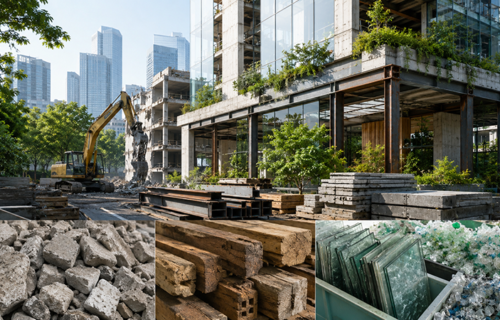
Japanese construction companies are beginning to test this principle in actual projects. One recent development reused steel and concrete structural components recovered from an existing building in the construction of its replacement. Rather than treating the original structure solely as demolition waste, parts of it effectively became construction materials for the next property.
Although direct structural reuse remains unusual, the project demonstrates how demolition could gradually become more selective. Buildings approaching the end of their original use may eventually be considered sources of valuable components rather than simply structures requiring disposal.
Other contractors are developing similar approaches across different materials. Glass removed from building façades is being collected for manufacturing into new products, while construction plastics are increasingly being separated and returned to building supply chains. Temporary structures are also being designed so that components can be dismantled and used elsewhere.
The implications extend to the initial design of buildings. If developers know that walls, structural elements, façades or internal systems may eventually need to be removed and reused, properties can be designed differently from the beginning. Connections can be made easier to dismantle, individual materials can be separated more effectively and information about building components can be retained throughout the property’s operating life. This could eventually make future refurbishment and redevelopment less wasteful and more predictable.
Extending the life of the building itself may be even more significant. Japan’s major cities contain substantial amounts of commercial property developed during earlier construction cycles. As these buildings age, owners face decisions about whether to refurbish, reposition or replace them.
Historically, redevelopment has often been attractive because a new property can provide larger floorplates, better energy performance, more efficient layouts and potentially greater development density. However, the economics surrounding that decision are changing. Construction expenses have increased sharply, while labour availability has become a growing challenge. At the same time, environmental targets are placing greater emphasis on emissions generated before a new building even begins operating.
Retaining an existing structural frame and upgrading the rest of the property can therefore become increasingly attractive. New façades, building services, interiors and energy systems can extend the commercial life of an asset without requiring the complete replacement of its structure. For investors, this creates another dimension to the traditional calculation between refurbishment and redevelopment.
The value of an ageing property may increasingly depend on how easily it can be upgraded. Buildings capable of accommodating new mechanical systems, flexible interiors and improved energy performance could remain competitive for longer, while assets that are difficult or expensive to modernise may face greater obsolescence risk.
Environmental certification alone may not eliminate that risk. As performance expectations increase, properties will increasingly need to demonstrate improvements in actual energy consumption and emissions rather than relying solely on labels obtained during construction or refurbishment.
Materials used in new development are changing as well. Concrete is particularly important because it is fundamental to Japanese construction while its production carries a substantial carbon footprint. Government-backed research and private companies are therefore developing alternatives intended to reduce the emissions associated with cement and concrete manufacturing.
Some Japanese projects are experimenting with concrete that incorporates carbon captured during industrial processes. Recent field applications have demonstrated that such materials can satisfy demanding engineering requirements while retaining carbon within the finished product. Other projects have introduced lower-emission precast components into actual buildings and infrastructure. These examples show that the technology is progressing beyond laboratory research, although widespread commercial adoption remains some distance away.
Cost, production capacity, technical standards and contractor familiarity will determine how quickly these products become mainstream. This distinction matters for developers and investors. New materials can attract considerable attention, but many of the most practical improvements available today are less dramatic.
Renovating an existing building, recovering façade glass, separating plastics, incorporating recycled materials and designing components so they can eventually be removed may deliver immediate benefits without depending on technologies that have yet to achieve mass-market economics.
One of the biggest future opportunities could be better information about the materials contained within individual properties. Today, when an older building is demolished, determining exactly what can be recovered can be difficult. Information about materials, specifications and previous alterations may be incomplete, while potential buyers of recovered components need confidence that they remain safe and suitable for reuse.
More comprehensive records could change that calculation. Future owners could potentially know what materials are contained within a building, when they were installed, their technical specifications and whether they could have another useful life. That would begin to change the way buildings are valued.
Commercial property is traditionally assessed according to location, income, occupancy, development potential and the physical condition of the asset. In the future, the ability to adapt a building and recover valuable components could become another consideration.
There are still substantial obstacles. Careful dismantling can cost more and take longer than conventional demolition. Structural elements need to be inspected and certified before they can be used again, while storage and transportation add further expense. Developers also require reliable supplies of standardised materials, something recovered components cannot always provide.
New construction will therefore continue to dominate many development situations, particularly where existing buildings cannot meet modern technical or commercial requirements. Nevertheless, Japan’s largest contractors are increasingly treating resource efficiency as part of their long-term construction strategies rather than as a waste-management exercise at the end of a project.
That change could become increasingly relevant as the country’s building stock ages. Japan already has extensive experience recovering construction waste. The next stage is about retaining more of the economic value already embedded within its buildings.
For the property market, this means asking a different question when an asset reaches the end of its current use. Instead of immediately considering what should replace the building, owners may increasingly examine what can be retained, upgraded or transferred into the next project.
As construction becomes more expensive and environmental requirements tighten, the ability to keep buildings and materials productive for longer could become an increasingly important source of value across Japan’s commercial real estate market.
Source: © CIJ.World Japan Research & Analysis Team